Next-Generation Ceramics: Unlocking Superior Properties for Industry

From One Meltdown to a Million Cycles
I watched a superalloy tube sag, then fail, after eighteen months. The repair bill was staggering. The production delay cost more. We tried everything-thicker walls, different alloys. The problem wasn’t our furnace. It was our material. That failure led me to a bench test with a dull grey cylinder: a reaction sintered silicon carbide radiant tube. It ran for seven years. Let’s talk about why yours should too.
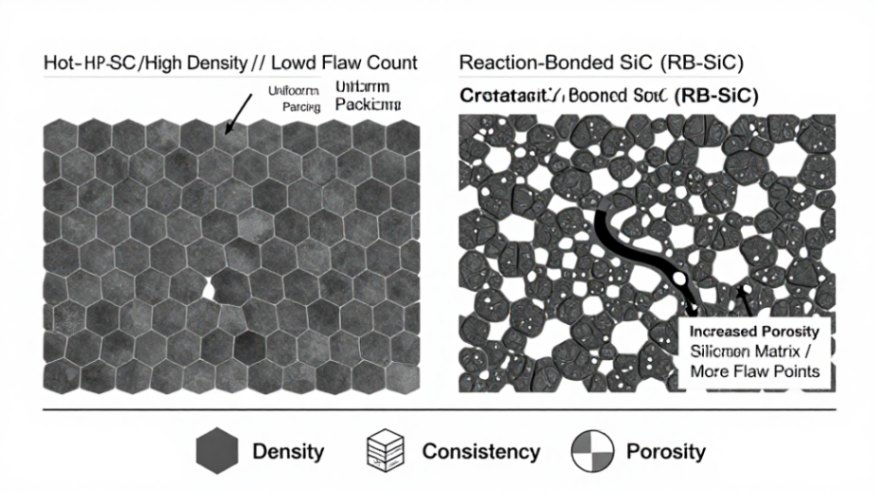
Why Silicon Carbide? The Physics of Unbreakable Heat
Forget marketing fluff. The advantage is pure physics. Metallic tubes work until heat, stress, and oxidation conspire against their crystalline structure. Reaction sintered silicon carbide (Reaction Sintered SiC) does not bend to these forces. Its covalent atomic bonds are orders of magnitude stronger. This fundamental difference manifests in three critical performance pillars for radiant tubes for furnaces.
1. Thermal Conductivity and Emissivity: The Heat Engine
Think of your tube as a lightbulb filament. Its job is to convert energy into radiant heat. Reaction Sintered SiC has a thermal conductivity rivaling aluminum and an emissivity coefficient over 0.9. Translation: it gets hot fast and radiates that energy intensely and evenly. You achieve target temperature faster. You reduce hot spots. You slash energy consumption by 20-30% compared to sluggish metal or porous ceramic tubes. The heat transfer is simply more efficient.
2. The Unshakeable Core: Resistance to Everything
This is where it gets interesting. Your furnace atmosphere is corrosive. Temperatures cycle. Mechanical loads exist. Reaction sintered silicon carbide radiant tubes laugh. Their oxidation resistance forms a passive silica layer that self-heals. Thermal shock resistance is legendary-you can quench them with air. Creep deformation? Negligible, even at 1600°C. The tube you install today maintains its shape and wall integrity for years. This isn’t incremental improvement. It’s a paradigm shift in reliability.
3. Total Cost of Ownership: The Math They Don’t Want You to Do
Yes, the initial price per tube is higher. Now, do the real math. Multiply your current tube replacement frequency by the cost of the tube, the labor to install it, and the production lost during downtime. A Reaction Sintered SiC tube lasts 3-10x longer. Your maintenance schedule evaporates. Your energy bills drop. The total cost plummets. This is an investment, not an expense. It’s the difference between buying a disposable lighter and a permanent torch.
How to Implement Them: A Step-by-Step Field Guide
This technology demands respect. You cannot install it like a metal tube. Follow these steps precisely.
Step 1: Selection and Specification
Do not buy a generic tube. Your specification is your first defense. You must define three things: your maximum continuous operating temperature, your furnace atmosphere (oxidizing, reducing, carburizing), and your exact mechanical footprint. Contact a specialist engineer with this data. They will specify the correct grade and wall thickness. This step is non-negotiable.
Step 2: Handling and Installation
Silicon carbide is a ceramic. It is hard. It is brittle. Handle it like fine glassware, not pipe. Use padded cradles. Never roll it. Support the tube according to the manufacturer’s diagram-typically at the cool ends, allowing for axial expansion. Use flexible ceramic fiber seals, not force. Overtightening a flange will crack the tube. This is the most common installation error. The mounting system must accommodate thermal expansion without inducing stress.
Step 3: Commissioning and Operation
First heat-up is critical. Follow a controlled ramp rate, usually provided by the manufacturer. This allows the entire tube mass to expand uniformly. Once operational, you can cycle aggressively. That’s the benefit. For atmosphere control, these tubes are exceptionally forgiving but consult your supplier for specific gas compatibility. Monitor system performance. You will see temperature uniformity improve and holding power decrease.
The Forge of the Future
The conversation around radiant tubes for furnaces is stuck in the past. We compare nickel alloys to iron-chromium alloys, debating marginal gains. Reaction sintered silicon carbide represents a different material class entirely. It enables processes you couldn’t reliably run before-higher temperatures, faster cycles, purer atmospheres. It’s not just a component. It’s a process intensification tool.
The Final, Logical Step
The evidence is clear. The logic is sound. If your operation involves heat treating, annealing, sintering, or carbon fiber processing and you are plagued by tube failure, energy waste, or inconsistent product quality, the solution exists. You have two choices: continue the costly cycle of replacement and compromise, or make a single decision that resets your operational baseline for the next decade. Stop patching the problem. Solve it. Request a formal performance and cost-benefit analysis for your specific furnace using reaction sintered silicon carbide radiant tubes today. The data will convince you.
Suppiler
Synthetic-chemical focus on the research and development, production and sales of ceramic products, serving the electronics, ceramics, chemical and other industries. Since its establishment in 2015, the company has been committed to providing customers with the best products and services, and has become a leader in the industry through continuous technological innovation and strict quality management.
Our products includes but not limited to Aluminum Nitride, Aluminum Oxide, Boron Carbide, Boron Nitride, Ceramic Crucible, ect. If you are interested in any type of these, please feel free to contact us.