Next-Generation Ceramics: Unlocking Superior Properties for Industry

PRODUCT PARAMETERS
Description
Overview of Quartz Ceramic Roller of Fused Silica for Glass Tempering Furnace
Quartz ceramics, also known as fused silica ceramics or re-bonded quartz products, are a high-performance advanced ceramic material. Unlike traditional clay-based ceramics, they are not made by sintering clay, but rather from high-purity fused silica (silicon dioxide, SiO₂) that is crushed, shaped, and then sintered at high temperatures.
Their core appeal lies in their unique combination of the excellent properties of fused silica glass (such as extremely low thermal expansion coefficient and excellent thermal shock stability) and the structural strength and versatility of ceramics (they can be made into crucibles, rollers, and irregularly shaped parts), overcoming the limitations of fused silica glass in terms of difficulty in manufacturing large sizes and complex shapes, and its high cost.
Quartz ceramics perform exceptionally well in harsh environments involving high temperatures, rapid temperature changes, and chemical corrosion, and are widely used in solar photovoltaics (crucibles for polycrystalline silicon ingot furnaces), semiconductors, aerospace, metallurgy and casting, the glass industry, and laboratories.
Main Characteristics of Quartz Ceramic Roller of Fused Silica for Glass Tempering Furnace
Excellent Thermal Shock Stability: They have an extremely low thermal expansion coefficient, generating almost no thermal stress during rapid temperature changes, and can withstand rapid cooling from extremely high temperatures to room temperature without cracking.
Extremely High Temperature Resistance and Thermal Stability: They can be used continuously at temperatures of 1100°C – 1350°C, and can even withstand higher temperatures for short periods. They do not soften or deform at high temperatures and maintain good dimensional stability.
Excellent Chemical Inertness and Corrosion Resistance: Except for hydrofluoric acid and hot concentrated phosphoric acid, they have strong resistance to most acids, salt solutions, and molten metals (such as aluminum, copper, gold, silver, and platinum), making them ideal melting and containment vessels.
Low Thermal Conductivity and Good Electrical Insulation: They have low thermal conductivity, making them excellent thermal insulation materials. They also maintain good electrical insulation properties at high temperatures.
High Purity and Low Contamination Risk: Made from high-purity quartz sand, they do not contaminate the high-purity molten metals or semiconductor materials they come into contact with, ensuring process cleanliness.
Moderate Mechanical Strength: Compared to most engineering ceramics, their mechanical strength at room temperature is relatively low; they are brittle materials. However, their strength is sufficient under their designed operating conditions (high-temperature insulation, thermal shock resistance). Its strength can be improved by optimizing the formula and manufacturing process.
Specifications of Quartz Ceramic Roller of Fused Silica for Glass Tempering Furnace
Quartz Porcelain Roller– Fused Silica for Glass Toughening Up Heating Systems
Product and Structure
These rollers are made from high-purity integrated silica. The material consists of over 99.9% SiO ₂. This guarantees superb thermal stability and resistance to deformation at heats. No binders or additives are utilized, which maintains the roller chemically inert and tidy throughout operation.
Running Temperature Array
The rollers execute accurately in between 600 ° C and 1150 ° C. They keep architectural integrity also under continuous high-heat direct exposure. Thermal shock resistance is strong, so sudden temperature level changes will certainly not trigger cracking or failing.
Dimensional Accuracy
Each roller is precision-ground to tight tolerances. Diameter resistance remains within ± 0.1 mm. Straightness variance is much less than 0.2 mm per meter of length. Surface surface is smooth, with a roughness standard (Ra) listed below 0.8 µm. This lessens glass surface area problems throughout transportation via the heating system.
Mechanical Toughness
In spite of being lightweight, the rollers provide great load-bearing capacity. Typical flexural toughness varieties from 45 to 55 MPa at area temperature. Stamina stays stable as much as 1000 ° C, sustaining constant efficiency in demanding manufacturing atmospheres.
Thermal Expansion and Conductivity
Fused silica has a very low coefficient of thermal development– regarding 0.55 × 10 ⁻⁶/ ° C. This prevents warping throughout home heating cycles. Thermal conductivity is reduced (around 1.4 W/m · K), which helps maintain uniform glass temperature level and lowers power loss.
Surface area and Tidiness
Roller surface areas are devoid of pores, cracks, or contaminants. They do not release bits or gases when warmed. This protects the optical quality of toughened up glass and stays clear of noting or scraping.
Customization Options
Standard lengths range from 1,500 mm to 4,500 mm. Diameters are offered from 50 mm to 120 mm. Custom-made dimensions and end setups can be generated to match particular heating system styles.
Applications of Quartz Ceramic Roller of Fused Silica for Glass Tempering Furnace
Applications of Quartz Ceramic Roller Made Of Fused Silica in Glass Tempering Furnaces
High-Performance Support for Demanding Processes
Quartz ceramic rollers made from integrated silica play an essential function in glass toughening up heating systems. These rollers bring level glass with high-temperature home heating areas. The glass must stay stable and undistorted throughout this procedure. Fused silica supplies the appropriate mix of stamina, heat resistance, and smooth surface finish to satisfy this demand.
Exceptional Thermal Stability
Merged silica deals with temperatures up to 1200 ° C without buckling or fracturing. This security keeps the glass surface area level as it moves with the heater. Even under duplicated thermal cycling, the roller keeps its shape and performance.
Reduced Thermal Growth
One significant benefit of merged silica is its extremely low coefficient of thermal growth. This implies the roller increases really little when heated. Consequently, there is minimal threat of call marks or optical distortion on the glass surface.
Smooth Surface Area Complete
The surface of these rollers is brightened to a great surface. This prevents scratches or acnes on the glass throughout transportation. Tidy, mark-free glass is crucial for top quality toughened up products utilized in design, auto, and electronics.
Long Service Life
Because integrated silica resists chemical deterioration and thermal shock, these rollers last much longer than numerous alternatives. They decrease downtime and maintenance expenses in continuous assembly line.
Glass manufacturers rely upon quartz ceramic rollers to make certain constant quality and efficiency. Their performance directly impacts the quality, strength, and safety and security of the final toughened up glass product. Making use of rollers made from pure integrated silica offers manufacturers a clear side in both outcome quality and operational integrity.

Company Profile
Synthetic-chemical focus on the research and development, production and sales of ceramic products, serving the electronics, ceramics, chemical and other industries. Since its establishment in 2015, the company has been committed to providing customers with the best products and services, and has become a leader in the industry through continuous technological innovation and strict quality management.
Our products includes but not limited to Aluminum Nitride, Aluminum Oxide, Boron Carbide, Boron Nitride, Ceramic Crucible, ect. If you are interested in any type of these, please feel free to contact us.

Payment Methods
T/T, Western Union, Paypal, Credit Card etc.
Shipment Methods
By air, by sea, by express, as customers request.
5 FAQs of Quartz Ceramic Roller of Fused Silica for Glass Tempering Furnace
Why choose quartz ceramic rollers made of fused silica for glass tempering?
Fused silica handles very high temperatures without deforming. It stays stable even when the furnace runs above 700°C. This material also resists thermal shock well, so it won’t crack during rapid heating or cooling cycles.
How long do these rollers last in a tempering furnace?
With proper use and maintenance, quartz ceramic rollers can work for several years. Their lifespan depends on operating conditions like temperature, load, and cleaning frequency. Regular inspection helps catch wear early and avoid unexpected downtime.
Do fused silica rollers affect glass surface quality?
No. These rollers have a smooth, non-reactive surface. They leave no marks or stains on the glass. Because fused silica doesn’t stick to molten glass, the finished product stays clean and clear.
Can these rollers handle heavy or thick glass?
Yes. Fused silica has high mechanical strength at elevated temperatures. It supports heavy loads without sagging or bending. This makes it suitable for tempering thick or large glass panels used in construction and automotive applications.
What maintenance do quartz ceramic rollers require?
Keep them clean. Remove glass dust and residues regularly with soft brushes or air blowers. Avoid using metal tools that could scratch the surface. Also, check alignment often to ensure even glass movement through the furnace. Proper care reduces wear and keeps performance consistent.
REQUEST A QUOTE
RELATED PRODUCTS
Factory Customized Gold Table Top Ceramic Tile Quartz Display Stand
High Efficiency Polishing Machine for Granite Marble Ceramic Quartz
Ceramic Liner Ball Mill for Quartz CE Certification
Silica Sand s High Purity White Quartz Sand for Ceramics
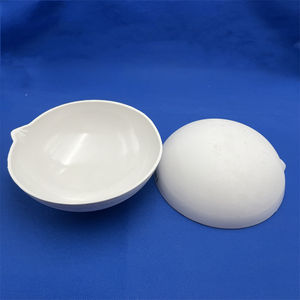
Casting Ceramic Quartz Melting Dishes Pot for Precious Metals