Next-Generation Ceramics: Unlocking Superior Properties for Industry

Defining the Standard: Aluminum Oxide Ceramic Fundamentals
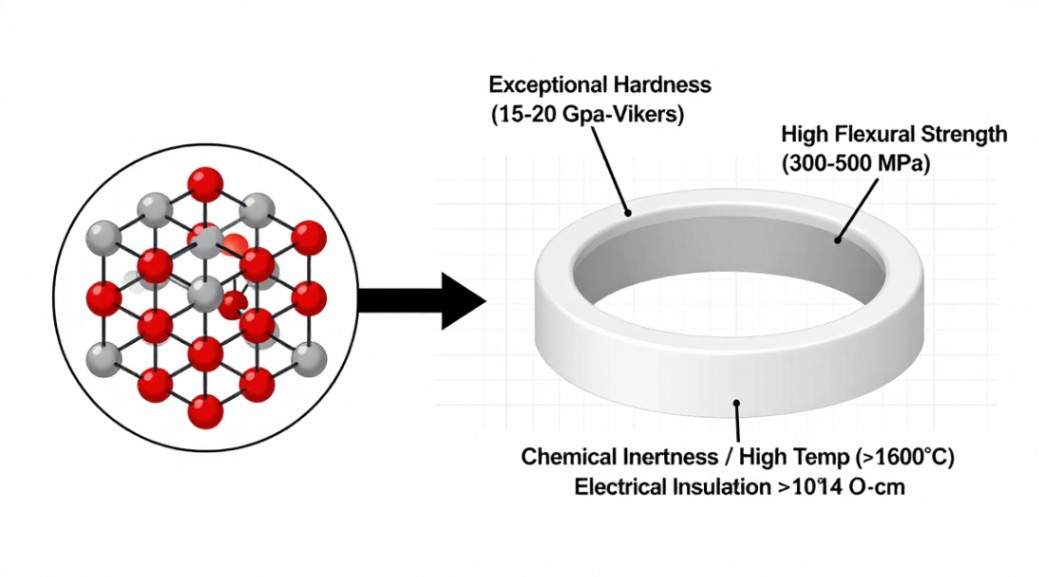
Aluminum oxide ceramic (Al2O3), or alumina, is the most widely used technical ceramic due to its optimal balance of properties, availability, and cost. It provides exceptional hardness, wear resistance, and chemical inertness at a scale unmatched by other advanced ceramics. Material properties stem from strong ionic bonding within its hexagonal crystal lattice, yielding a Vickers hardness of 15-20 GPa, a flexural strength of 300-500 MPa, and continuous service temperatures exceeding 1600°C. Its inherent electrical insulation (>10^14 Ω·cm) and dielectric strength form the bedrock of countless electronic applications.
Key Grades and Their Engineering Impact
Performance is directly tied to purity and microstructure. Industry-standard grades like 96% and 99.5% alumina demonstrate a critical trade-off. The 96% variant, containing silicate glass phases, offers superior machinability and cost-effectiveness for wear plates and industrial seals. In contrast, 99.5% and higher purity grades deliver maximum hardness, thermal conductivity (~30 W/mK), and corrosion resistance, making them mandatory for semiconductor wafer processing components and high-frequency substrates. A 2023 market analysis by Ceramic Industry Magazine indicated that 96% alumina still commands over 60% of the structural ceramic market by volume, a testament to its engineered practicality.
Manufacturing and Machining: Achieving Precision in a Brittle Material
Fabrication defines feasibility. Primary processes include dry pressing, isostatic pressing, and tape casting for thin substrates. Sintering temperatures range from 1600°C to 1800°C, densifying the powdered compact into a monolithic ceramic. Post-sinter machining of aluminum oxide ceramic is specialized but routine. Diamond grinding, lapping, and laser machining are standard. Design for manufacturability is non-negotiable: engineers must avoid sharp internal corners, specify generous radii, and maintain uniform wall thickness to prevent stress concentration and cracking during sintering or service.
The Competitive Landscape: Alumina vs. Advanced Ceramics
Aluminum oxide ceramic does not exist in a vacuum. Its position is defined by comparison to peer materials. For wear resistance under extreme abrasion, silicon carbide ceramic and boron carbide ceramic offer superior hardness but at higher cost and with poorer machinability. Where high fracture toughness is critical, such as in ballistics or medical implants, yttria-stabilized zirconia is the superior choice. For thermal management in high-power electronics, the high thermal conductivity of aluminum nitride ceramic makes it the preferred substrate. Alumina’s dominance is not based on being the best in any single category, but on being very good across all of them. It is the ultimate compromise material that rarely compromises the application.
Core Applications: Where Aluminum Oxide Ceramic Delivers Unmatched Value
Three sectors consume the majority of industrial alumina: electrical, wear-resistant, and biomedical.
- Electrical & Semiconductor: This is the high-value domain. Aluminium oxide ceramic substrates are the platform for thick- and thin-film circuits, power electronics, and LED packages. Its stability, smooth surface finish, and excellent dielectric properties are foundational. In semiconductor fabrication, high-purity alumina components are used in plasma etch chambers and wafer handling due to their ultra-clean, plasma-resistant nature.
- Industrial Wear Parts:
Evolution is continuous, not revolutionary. Current research focuses on enhancing alumina’s performance envelope without sacrificing its core economic advantage. Key trends include:
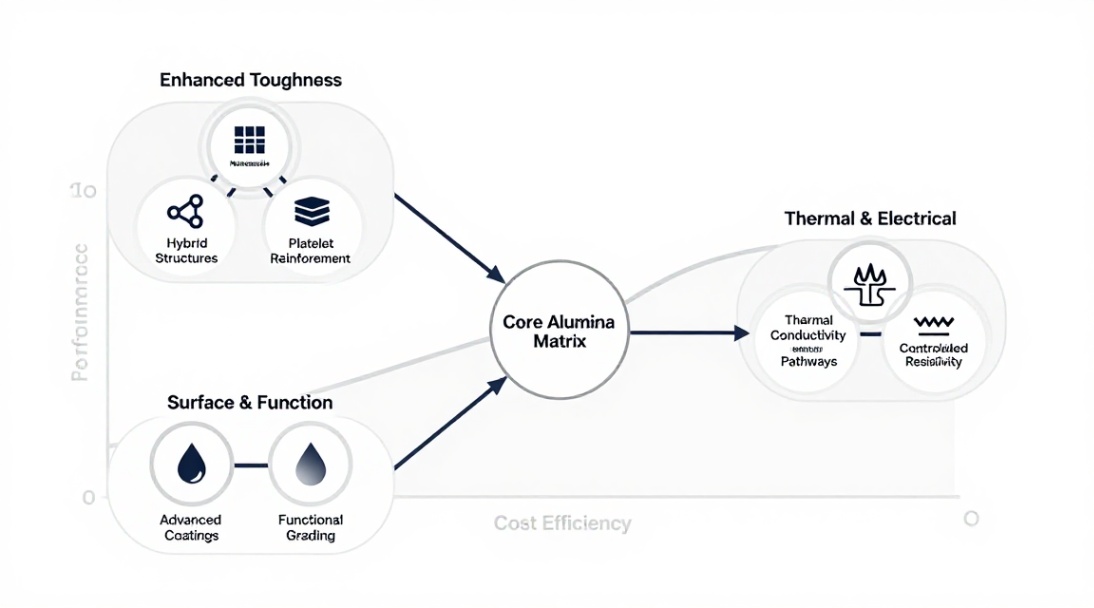
Research focuses on enhancing alumina’s toughness, thermal/electrical properties, and surface functionality. Composite and Microstructural Engineering
The ‘double continuous structure’ strategy from ultra-high-temperature ceramic matrix composite (UHTCMC) research offers a template. Infiltrating alumina matrices into fiber preforms can drastically improve fracture toughness. While this process targets materials like reaction-sintered silicon carbide ceramics, the principle translates: incorporating secondary phases or fibers into alumina can mitigate its inherent brittleness for more demanding structural roles.
The Pursuit of Higher Temperature Limits
While alumina’s melting point is ~2050°C, new frontiers exist. Research into high-entropy oxide systems, such as Hf0.85Ta0.15O with a melting point of 3006°C, points to a future where oxide ceramics could rival carbides and borides for extreme environments. For now, alumina composites with mullite ceramic or stabilized zirconia are being developed to improve thermal shock resistance for next-generation thermal barrier coatings.
Advanced Finishing and Functionalization
Surface engineering is critical. Techniques like the special coating for boron nitride ceramic crucibles-applied to prevent wetting-are being adapted for alumina. Advanced polishing achieves angstrom-level smoothness for optics and semiconductor wafers, while functional coatings can impart specific electrical or tribological properties. Precision laser machining is enabling more complex geometries previously thought impossible for a sintered ceramic.
Conclusion and Strategic Path Forward
Aluminum oxide ceramic will remain indispensable for the foreseeable future. Its development path is one of incremental, application-specific refinement. The strategic question for engineers is not if to use alumina, but which grade and fabrication route aligns with their performance-to-cost equation. For applications requiring extreme thermal conductivity or toughness, consider silicon nitride ceramics or aluminum nitride ceramic. For the vast middle ground of industrial need, alumina is the default, proven solution.
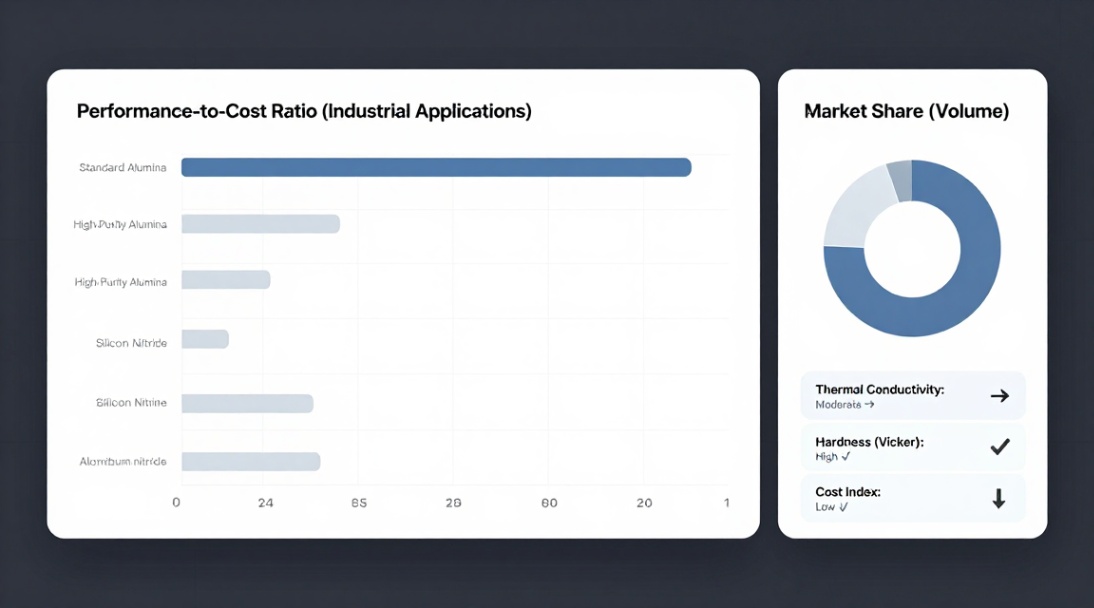
Comparative dashboard visualizing the performance-to-cost equation for alumina and alternative ceramics. Before finalizing a design, engage with a specialist fabricator. Prototyping a component in 96% alumina can validate design geometry and function at low risk. For production, the choice between pressureless sintered, isostatically pressed, or even reaction-bonded forms will determine final tolerances and cost. Rigorous material testing under simulated service conditions-especially for corrosion resistance and thermal cycling-is non-negotiable. The longevity of your component depends on this due diligence.
Suppiler
Synthetic-chemical focus on the research and development, production and sales of ceramic products, serving the electronics, ceramics, chemical and other industries. Since its establishment in 2015, the company has been committed to providing customers with the best products and services, and has become a leader in the industry through continuous technological innovation and strict quality management.
Our products includes but not limited to Aluminum Nitride, Aluminum Oxide, Boron Carbide, Boron Nitride, Ceramic Crucible, ect. If you are interested in any type of these, please feel free to contact us.