Next-Generation Ceramics: Unlocking Superior Properties for Industry

PRODUCT PARAMETERS
Description
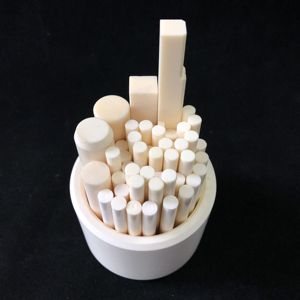
Overview of Hot Pressed Boron Nitride Ceramic Part
Boron Nitride (BN) exists in multiple polymorphs, with Hexagonal Boron Nitride (h-BN) being the most common ceramic form. Often called “white graphite” due to its similar layered, lubricious structure, it is distinguished by its exceptional thermal stability, electrical insulation, and chemical inertness, even at extreme temperatures.
Features of Hot Pressed Boron Nitride Ceramic Part
- High Thermal Conductivity & Excellent Electrical Insulation: Unique combination that allows it to conduct heat like a metal but insulate like a ceramic.
- Outstanding Thermal Shock Resistance: Can be heated and cooled rapidly without cracking.
- Natural Lubricity: Exhibits low friction and anti-stick properties, even at high temperatures.
- Chemically Inert: Resists wetting by and reaction with most molten metals, slags, and glasses.
- Machinable: Unlike most advanced ceramics, h-BN in its solid form can be machined to precision tolerances using conventional carbide tooling.
Specifications of Hot Pressed Boron Nitride Ceramic Part
Hot Pushed Boron Nitride Porcelain Component– Technical Specifications
Material Composition
Primary element: Hexagonal boron nitride (h-BN), purity ≥ 99%.
Additives: Marginal sintering aids, thoroughly controlled to keep thermal and electrical residential properties.
Physical Qualities
Density: 2.0– 2.1 g/cm SIX.
Shade: White to light gray.
Hardness: 2– 3 on the Mohs range– soft yet secure under pressure.
Machinability: Conveniently shaped with typical tools because of its split framework.
Thermal Performance
Max service temperature: Approximately 1000 ° C in air; over 2000 ° C in inert atmospheres.
Thermal conductivity: 30– 60 W/m · K (parallel to pushing direction); lower vertical to it.
Thermal growth: Extremely reduced– regarding 2– 3 × 10 ⁻⁶/ ° C from 25 ° C to 800 ° C. This guarantees dimensional stability during heating and cooling cycles.
Electric Characteristics
Electric resistivity: > 10 ¹⁴ Ω · cm at room temperature level.
Dielectric stamina: 15– 25 kV/mm.
These attributes make the component suitable for high-voltage insulation and non-conductive applications.
Mechanical Toughness
Flexural toughness: 80– 120 MPa.
Compressive strength: 200– 300 MPa.
Strength varies slightly based upon grain alignment from the hot pushing process.
Chemical Resistance
Security: Resists molten metals (like light weight aluminum and copper), slags, and lots of acids and antacids.
Oxidation: Secure in air up to 850 ° C; over this, progressive oxidation might occur.
Production Process
Components are formed making use of hot pushing— a technique that applies warm and uniaxial pressure simultaneously. This creates a dense, anisotropic structure with consistent efficiency in the pressing direction. Custom shapes and limited resistances are attainable without post-sintering machining for the most part.
Applications of Hot Pressed Boron Nitride Ceramic Part
Applications of Hot Pressed Boron Nitride Porcelain Components
High-Temperature Insulation
Hot pushed boron nitride (HPBN) ceramic parts job well in severe warm. They stay stable also over 2,000 ° C in inert ambiences. This makes them excellent for heater elements like insulation plates, crucibles, and assistance fixtures. Unlike lots of ceramics, HPBN does not respond with liquified steels or glass, so it keeps its form and function under stress and anxiety.
Semiconductor Production
In chip manufacturing, tidiness and accuracy matter. HPBN parts are utilized as insulators, spacers, and wafer handling tools. They do not contaminate sensitive procedures due to the fact that they launch virtually no bits or gases. Their smooth surface also protects against damage to delicate silicon wafers throughout transport and processing.
Metal Spreading and Processing
Factories rely on HPBN for molds, liners, and putting tubes. The material withstands moistening by aluminum, copper, and other responsive metals. This means liquified metal moves easily without sticking. Consequently, cast parts appeared smoother, and device life lasts longer.
Aerospace and Protection
HPBN’s light weight and thermal stability fit it for radar home windows, rocket nose cones, and heat shields. It allows electro-magnetic signals to pass through while shielding interior systems from intense warm during flight. Its mechanical stamina remains regular across large temperature level swings.
Electric and Digital Makes Use Of
Since HPBN is an exceptional electric insulator however conducts warmth well, it works in high-power electronics. You’ll discover it in substratums for power modules, warmth spreaders, and shielding layers in sensing units. It aids handle heat without creating short circuits.
These applications reveal why warm pressed boron nitride continues to be a top choice where efficiency under stress, heat, or electrical anxiety is non-negotiable.

Company Profile
Synthetic-chemical focus on the research and development, production and sales of ceramic products, serving the electronics, ceramics, chemical and other industries. Since its establishment in 2015, the company has been committed to providing customers with the best products and services, and has become a leader in the industry through continuous technological innovation and strict quality management.
Our products includes but not limited to Aluminum Nitride, Aluminum Oxide, Boron Carbide, Boron Nitride, Ceramic Crucible, ect. If you are interested in any type of these, please feel free to contact us.

Payment Methods
T/T, Western Union, Paypal, Credit Card etc.
Shipment Methods
By air, by sea, by express, as customers request.
5 FAQs of Hot Pressed Boron Nitride Ceramic Part
Frequently Asked Questions About Hot Pressed Boron Nitride Ceramic Parts
What is hot pressed boron nitride?
Hot pressed boron nitride is a high-performance ceramic made by heating and pressing boron nitride powder under controlled conditions. This process creates a dense, strong material with excellent thermal and electrical properties.
Why choose hot pressed boron nitride over other ceramics?
It stands out because it handles high temperatures without breaking down. It also resists thermal shock, does not conduct electricity, and stays stable in harsh environments. These traits make it better than many standard ceramics for demanding applications.
Where are these parts commonly used?
You’ll find them in aerospace components, semiconductor manufacturing tools, high-temperature fixtures, and lab equipment. They work well wherever heat resistance, electrical insulation, or chemical stability is needed.
Can hot pressed boron nitride be machined after production?
Yes. Even though it is hard, it can be shaped using diamond tooling. This allows for tight tolerances and custom geometries to meet specific design needs.
How does it perform in extreme conditions?
It performs very well. It keeps its strength up to 2,000°C in inert atmospheres. It also resists oxidation better than many non-oxide ceramics and won’t react with most molten metals or salts. This makes it reliable in aggressive industrial settings.
REQUEST A QUOTE
RELATED PRODUCTS
Boron Nitride Ceramic High Temperature Resistant Insulation
Custom Hot Pressed Solid Boron Nitride Ceramic Structural Parts Heavy
Boron Nitride Ceramic Evaporation Boat for Coating Long Life
Boron Nitride Ceramic Corrosion Proof for Semiconductor Thermal Management
Boron Nitride Composite Ceramic Round Shim Drilled