Next-Generation Ceramics: Unlocking Superior Properties for Industry

The Unseen Evolution of a Workhorse Material
Aluminium oxide ceramic, or alumina, is undergoing a quiet but profound strategic shift. For decades, engineers viewed it as the reliable, economical baseline-the default ceramic against which more exotic materials like silicon carbide ceramic or aluminium nitride ceramic were measured. That perception is now obsolete. The convergence of precision manufacturing, advanced sintering, and composite science is transforming alumina from a simple component into a high-value engineered substrate. The trajectory is clear: applications once dominated by metals or plastics are now in the realm of advanced ceramics, and alumina is often the first material engineers seriously consider. This shift isn’t about replacing one material with another; it’s about enabling entirely new design philosophies that prioritize longevity, thermal management, and chemical inertness over short-term cost savings.
Deconstructing the Logic of Material Choice
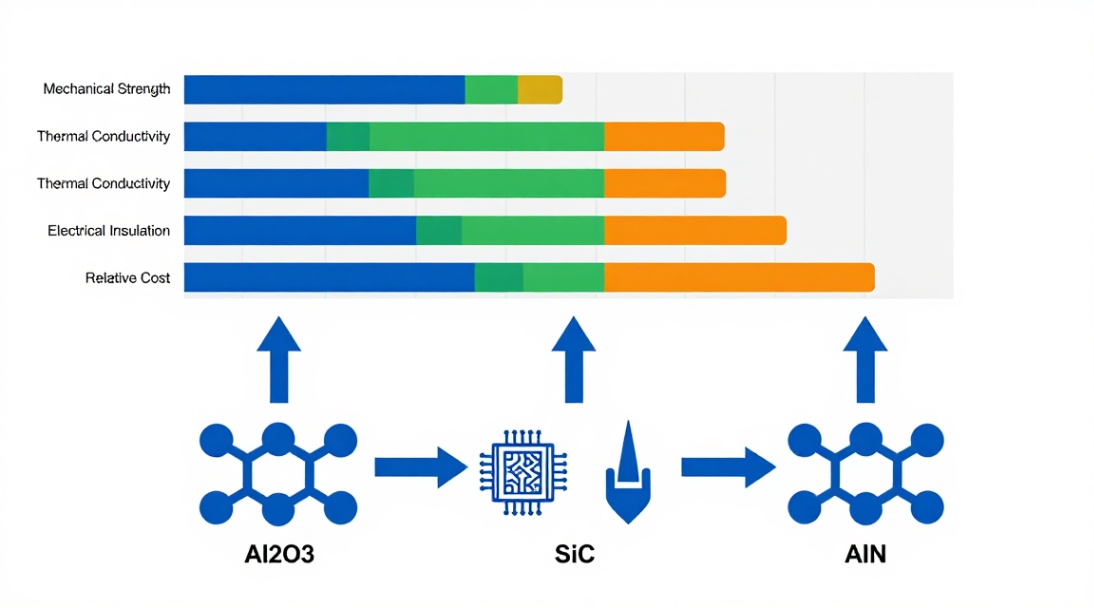
When you begin a design with aluminum oxide ceramic, you are making a foundational compromise rooted in first principles. You are trading the ultimate thermal conductivity of aluminum nitride ceramic or the extreme hardness of boron carbide ceramic for a uniquely balanced portfolio. Consider the logic. Alumina offers high hardness-often a Mohs 9-and excellent electrical insulation. Its compressive strength is formidable. But its true genius lies in its thermal profile. While its conductivity is lower than that of specialized rivals, its stability up to 1700°C is exceptional. This creates a clear decision matrix. If your primary failure mode is thermal shock, you might lean towards silicon nitride ceramic. If it is abrasive wear in a chemically harsh environment, silicon carbide ceramic may win. But for the vast majority of applications demanding a fusion of mechanical integrity, electrical isolation, and thermal resilience at a manageable cost, aluminum oxide ceramic presents an inarguably rational choice. The manufacturing processes, from cost-effective dry pressing for simple shapes to intricate injection molding for complex geometries, further cement this logic by providing scalable pathways from prototype to production.
The Purity Gradient: Where Performance is Forged
To speak of ‘alumina’ as a single entity is a critical error. The material’s behavior is dictated by a purity gradient, and this gradient is the primary lever for performance tuning. An 85% alumina formulation is a robust, economical workhorse, perfectly suited for wear plates or insulating sleeves where extreme properties are not critical. Move to 96% alumina, and you witness a significant leap in density, strength, and surface finish capability-this is the sweet spot for many precision seals and advanced industrial components. At 99.5% purity and beyond, the material transcends. Grain boundaries minimize, leading to superior corrosion resistance, higher thermal conductivity, and the potential for optical clarity in specialized forms. This high-purity material is what you specify for critical semiconductor processing components or demanding biomedical implants, where any ionic leaching or particulate generation is unacceptable. The choice of grade is not a minor detail; it is the core specification that dictates every subsequent design and machining decision.
The Inevitable Trade-offs and How to Navigate Them
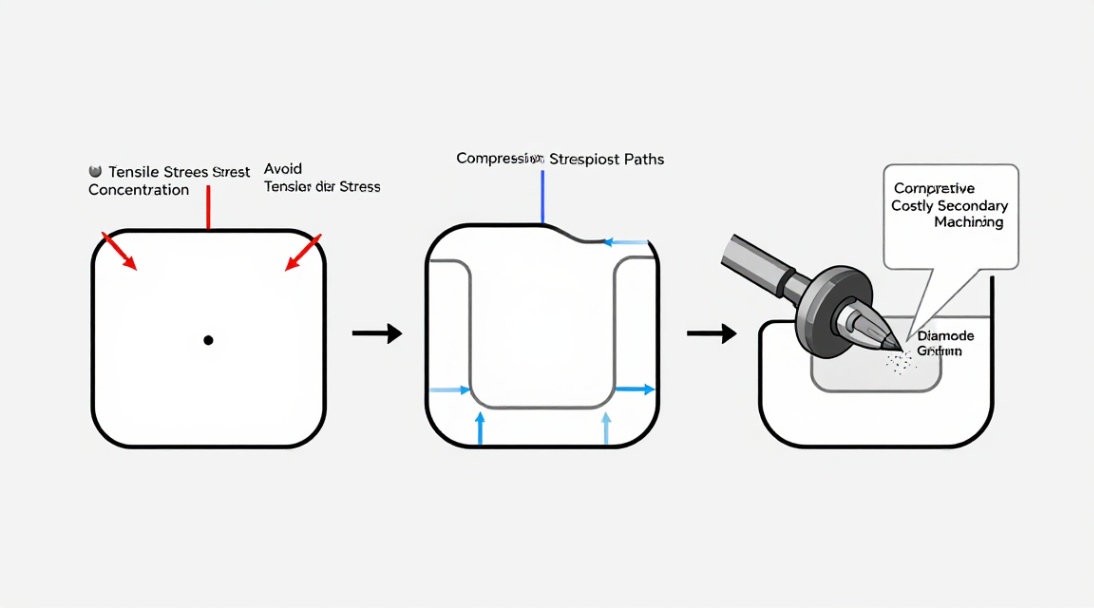
No material is perfect, and alumina’s limitations are as instructive as its strengths. Its brittleness is a fundamental characteristic, not a flaw. This means designs must avoid tensile stress concentrations and prioritize geometries that load the material in compression. Machining hardened alumina is difficult and expensive; it requires diamond grinding, lapping, or laser processing. This reality makes ‘design for manufacture’ paramount. Complex features are best formed during the initial shaping via isostatic pressing or injection molding, not added later through costly machining. Furthermore, while alumina outperforms most metals and all plastics in corrosion resistance and dimensional stability at high temperatures, it cannot match the thermal shock resistance of materials like quartz ceramic or mulite ceramic. Acknowledging these constraints is not a weakness; it is the mark of a sophisticated engineer who understands that material selection is about orchestrating a symphony of properties, not finding a mythical unicorn.
Beyond the Baseline: The Frontier of Advanced Forms
The future of aluminum oxide ceramic lies in its advanced and composite forms. The industry trend is moving away from monolithic, single-phase ceramics. We are now engineering materials where alumina is the matrix for nanostructured reinforcements, creating composites with dramatically improved fracture toughness. Transparent aluminas are enabling new applications in high-pressure lamp enclosures and optical sensors. Specialized coatings, akin to the special coating for boron nitride ceramic crucibles, are being developed for alumina substrates to impart non-wetting surfaces or enhanced electrical properties for specific semiconductor applications. The evolution of reaction-sintered silicon carbide ceramics and silicon carbide-bonded silicon nitride ceramics provides a roadmap: tomorrow’s high-performance alumina components will likely be tailored microstructures, engineered at the grain level for a specific function in aerospace, next-generation medical devices, or extreme industrial machinery.
Your Next Logical Step
The analysis leads to one clear action. If your project involves high wear, electrical insulation, or high-temperature operation, defaulting to a metal or plastic without evaluating aluminium oxide ceramic is a strategic oversight. The data on total cost of ownership, driven by longevity and reduced maintenance, overwhelmingly favors advanced ceramics in an increasing number of cases. Do not get lost in generic supplier catalogs. You need a partner who understands the nuance between a 96% and a 99.5% alumina, who can guide you on the feasibility of injection molding versus dry pressing for your specific geometry, and who has the technical depth to discuss finishing techniques like precision lapping or metallization for brazing. I urge you to move from consideration to specification. Request a formal consultation and material sample kit from a specialist manufacturer today. Test the actual performance against your application’s failure modes. The logical conclusion of this trend is that the engineers who master these material specifications first will build the more reliable, efficient, and innovative products of the next decade.
Suppiler
Synthetic-chemical focus on the research and development, production and sales of ceramic products, serving the electronics, ceramics, chemical and other industries. Since its establishment in 2015, the company has been committed to providing customers with the best products and services, and has become a leader in the industry through continuous technological innovation and strict quality management.
Our products includes but not limited to Aluminum Nitride, Aluminum Oxide, Boron Carbide, Boron Nitride, Ceramic Crucible, ect. If you are interested in any type of these, please feel free to contact us.