Next-Generation Ceramics: Unlocking Superior Properties for Industry

The Surprising Truth About Extreme Temperature Survival
We might think of ceramics as fragile. Yet, certain engineered materials laugh at extremes that would shatter most solids. The real benchmark for recrystallized silicon carbide thermal shock resistance isn’t a gradual change. It’s a violent, instant transition. Think of taking a white-hot component from a 1600°C furnace and plunging it directly into room-temperature water. The best materials survive, even thrive, after this torture. Understanding and quantifying that survival is the entire purpose of thermal shock resistance testing.
What is Recrystallized Silicon Carbide?
Let’s define our subject. Recrystallized Silicon Carbide (R-SiC) is not a sintered ceramic with additives. We make it by forming a green body from high-purity SiC powder and a carbon source. During firing at temperatures above 2200°C, the silicon carbide sublimates and re-deposits, forming a rigid, interlocking network of pure SiC crystals. The key outcome? The finished part is almost entirely silicon carbide, with no glassy secondary phase. This purity gives R-SiC its unique set of properties.
What Drives Its Thermal Shock Resistance?
Thermal shock failure happens when thermal stress from rapid temperature change exceeds the material’s fracture strength. For R-SiC, three intrinsic properties create a formidable defense. Its high thermal conductivity allows heat to dissipate quickly, minimizing internal temperature gradients. Its moderate thermal expansion coefficient means it simply doesn’t try to expand or contract as dramatically as other ceramics under the same ΔT. Finally, its high fracture toughness and strength provide a robust barrier against crack initiation. The microstructure-a network of large, interlocked grains-forces cracks to deflect and branch, absorbing energy.
What is Thermal Shock Resistance Testing?
This isn’t a single test. It’s a systematic methodology to quantify a material’s tolerance to rapid temperature change. The core principle is simple: we induce a known thermal stress and measure the damage. The most common standardized method is the water quench test, outlined in standards like ASTM C1525. We heat a standardized test bar to a specific temperature, then rapidly quench it in a water bath at room temperature. The severity is controlled by the temperature differential (ΔT). We repeat this process, often increasing ΔT incrementally, until we observe failure or reach a target cycle count.
How We Measure and Interpret the Results
We don’t just look for breakage. The most valuable data comes from measuring the retained strength after quenching. We subject the quenched bars to a 3-point or 4-point bend test. Plotting retained strength versus quench ΔT gives us a critical curve. The point where strength begins to drop sharply indicates the material’s practical thermal shock limit. We also calculate theoretical parameters like the thermal shock resistance parameters (R, R”, R”’) which combine conductivity, strength, expansion, and elasticity to allow comparison between different materials on paper.
Inside the Failure: Microstructural Analysis
Testing provides numbers. Microscopy tells the story. After a quench test, we examine the microstructure for crack origins. In R-SiC, cracks often initiate at large, isolated pores or at the junctions of grain boundaries. The high-purity, direct-bonded grain structure of R-SiC means cracks must travel through the strong SiC crystals themselves, not along weak grain boundary phases. This is a fundamental advantage. The inherent porosity of R-SiC, often seen as a weakness, can actually blunt crack tips and reduce stress intensity.
Applying Test Data to Real-World Design
Raw test data is useless without context. For a kiln furniture post supporting a heavy load, we focus on the retained strength after a representative number of cycles at the furnace’s operating ΔT. The design must ensure strength never drops below the required load-bearing threshold. For a heat exchanger component experiencing rapid gas quenches, we analyse the critical ΔT for strength degradation and design a safety factor below it. The test tells us the boundary; smart engineering stays well inside it.
Limitations and the Path Forward
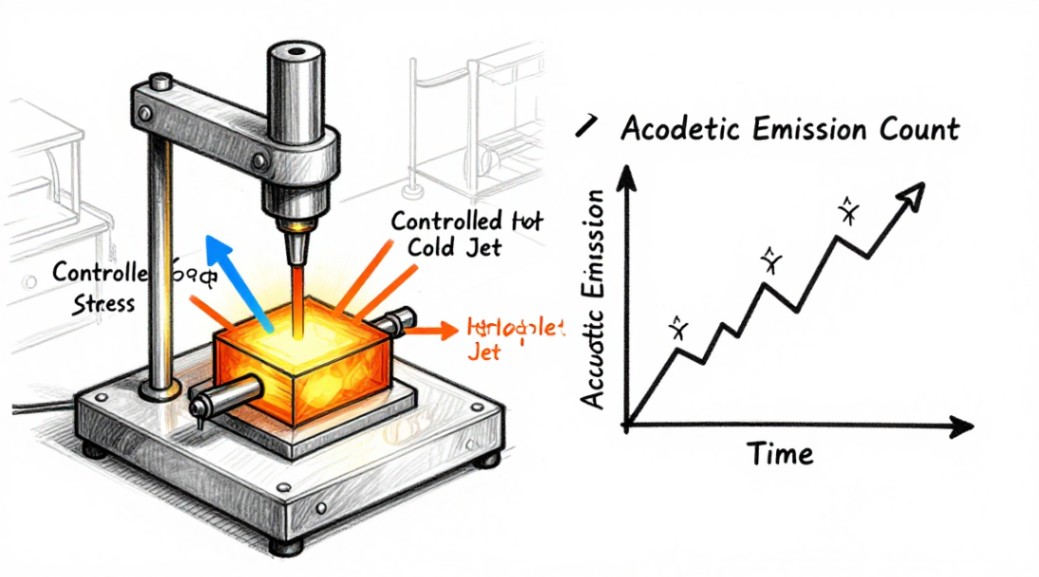
Standard quench tests are excellent for ranking materials but have limits. They create a uniform, severe shock. Real-world conditions often involve gradients, slower cycles, or combined mechanical load during the thermal cycle. The future of thermal shock resistance testing lies in more complex, application-specific rigs that can superimpose mechanical stress or use controlled gas jets for quenching. Furthermore, advanced non-destructive evaluation like in-situ acoustic emission during quenching gives us a real-time map of damage accumulation.
Your Next Step as an Engineer
Now you have the definition and the logic behind it. When you review a recrystallized silicon carbide thermal shock resistance test report, look beyond the single “R” parameter. Scrutinize the retained strength curve. Ask about the test’s quench medium and cycle profile. Compare it to the actual thermal and mechanical environment of your application. Use this deep, principled understanding to select materials not just from a datasheet, but from a position of informed confidence. That’s how we design components that don’t just work, but endure.
Suppiler
Synthetic-chemical focus on the research and development, production and sales of ceramic products, serving the electronics, ceramics, chemical and other industries. Since its establishment in 2015, the company has been committed to providing customers with the best products and services, and has become a leader in the industry through continuous technological innovation and strict quality management.
Our products includes but not limited to Aluminum Nitride, Aluminum Oxide, Boron Carbide, Boron Nitride, Ceramic Crucible, ect. If you are interested in any type of these, please feel free to contact us.