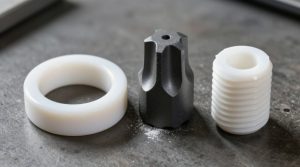
Next-Generation Ceramics: Unlocking Superior Properties for Industry

PRODUCT PARAMETERS
Description
Overview of Boron Nitride Ceramic Insulators for Ion Source
Boron Nitride (BN) exists in multiple polymorphs, with Hexagonal Boron Nitride (h-BN) being the most common ceramic form. Often called “white graphite” due to its similar layered, lubricious structure, it is distinguished by its exceptional thermal stability, electrical insulation, and chemical inertness, even at extreme temperatures.
Features of Boron Nitride Ceramic Insulators for Ion Source
- High Thermal Conductivity & Excellent Electrical Insulation: Unique combination that allows it to conduct heat like a metal but insulate like a ceramic.
- Outstanding Thermal Shock Resistance: Can be heated and cooled rapidly without cracking.
- Natural Lubricity: Exhibits low friction and anti-stick properties, even at high temperatures.
- Chemically Inert: Resists wetting by and reaction with most molten metals, slags, and glasses.
- Machinable: Unlike most advanced ceramics, h-BN in its solid form can be machined to precision tolerances using conventional carbide tooling.
Specifications of Boron Nitride Ceramic Insulators for Ion Source
Specs of Boron Nitride Porcelain Insulators for Ion Resource
Material Composition
These insulators are made from high-purity hexagonal boron nitride (h-BN). The product consists of over 99% BN. No binders or additives are utilized. This ensures excellent electric insulation and thermal security.
Electrical Qualities
Quantity resistivity exceeds 1014 Ω · cm at room temperature. Dielectric strength is above 30 kV/mm. These worths remain secure even under high vacuum and raised temperature levels. The insulators prevent current leakage in demanding ion resource atmospheres.
Thermal Performance
Boron nitride insulators manage constant procedure as much as 1000 ° C in inert environments. In vacuum cleaner, they do dependably approximately 850 ° C. They show very low thermal expansion. This lessens mechanical stress and anxiety throughout fast heating or cooling cycles. Thermal conductivity ranges from 30 to 60 W/m · K along journalism direction.
Mechanical Attributes
The product is machinable yet strong sufficient for accuracy elements. Typical flexural strength is 60– 90 MPa. Compressive stamina reaches 200 MPa. Parts preserve dimensional accuracy after machining. Surfaces can be completed to tight tolerances for safe fit in ion optics settings up.
Vacuum Compatibility
Outgassing rates are very low. Total mass loss is much less than 0.1% after 24 hr at 900 ° C under high vacuum. This makes the insulators ideal for ultra-high vacuum (UHV) systems. They do not launch contaminants that could affect light beam pureness or resource efficiency.
Geometric Options
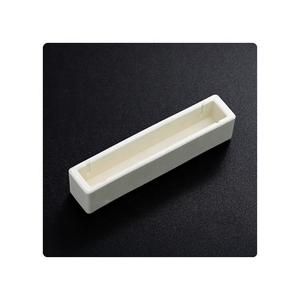
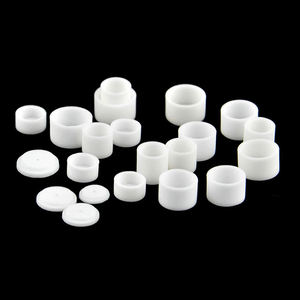
Criterion forms include rings, tubes, spacers, and custom-made flanges. Wall surface thicknesses begin at 0.5 mm. Diameters vary from 5 mm to 150 mm. All parts are manufactured to meet accurate customer drawings. Tight resistances of ± 0.05 mm are attainable on essential measurements.
Applications of Boron Nitride Ceramic Insulators for Ion Source
Applications of Boron Nitride Ceramic Insulators for Ion Source
Why Boron Nitride Functions Well in Ion Sources
Boron nitride ceramic insulators play a vital function in ion source systems. These insulators manage high voltages and extreme temperatures without breaking down. They maintain electrical components divided while allowing the ion resource job efficiently.
Ion resources produce beam of lights of billed bits. This process needs stable insulation that will not crack or leak current. Boron nitride provides superb electrical resistance even when hot. It stays strong under thermal tension, which prevails inside ion resources.
Performance in Harsh Issues
Several materials fall short when exposed to plasma or reactive gases. Boron nitride resists chemical assault from most substances utilized in ion generation. It does not absorb moisture and keeps its shape gradually. This stability helps preserve regular ion light beam high quality.
The material also has reduced outgassing. That suggests it releases very little vapor in vacuum cleaner settings. Tidy operation is vital in applications like semiconductor manufacturing or scientific research study. Any kind of contamination can wreck results.
Layout Adaptability and Integrity
Designers value boron nitride since it can be shaped right into complicated parts. Slim wall surfaces, specific holes, and custom-made geometries are all possible. This allows limited integration with various other ion source elements.
Its thermal conductivity is moderate, which helps manage warm without developing locations. At the exact same time, it remains a solid electrical insulator. This equilibrium supports long life span and lowers maintenance demands.
Boron nitride ceramic insulators are trusted in requiring areas. These include bit accelerators, mass spectrometers, and room propulsion systems. Wherever integrity and pureness issue, boron nitride supplies stable efficiency.

Company Profile
Synthetic-chemical focus on the research and development, production and sales of ceramic products, serving the electronics, ceramics, chemical and other industries. Since its establishment in 2015, the company has been committed to providing customers with the best products and services, and has become a leader in the industry through continuous technological innovation and strict quality management.
Our products includes but not limited to Aluminum Nitride, Aluminum Oxide, Boron Carbide, Boron Nitride, Ceramic Crucible, ect. If you are interested in any type of these, please feel free to contact us.

Payment Methods
T/T, Western Union, Paypal, Credit Card etc.
Shipment Methods
By air, by sea, by express, as customers request.
5 FAQs of Boron Nitride Ceramic Insulators for Ion Source
Frequently Asked Questions About Boron Nitride Ceramic Insulators for Ion Sources
What makes boron nitride a good material for ion source insulators?
Boron nitride has excellent electrical insulation even at high temperatures. It stays stable in vacuum environments and does not outgas much. This helps keep the ion source clean and working well. Its thermal conductivity is also high, so it handles heat without cracking.
Can these insulators handle high voltages?
Yes. Boron nitride ceramic insulators resist high voltages without breaking down. They are used in systems that run at tens of kilovolts. Their structure prevents arcing and maintains reliable performance under strong electric fields.
Are they compatible with different types of ion sources?
These insulators work with many common ion source designs, including electron cyclotron resonance (ECR) and Kaufman-type sources. Their chemical inertness means they do not react with plasma gases like argon or oxygen. This makes them suitable for a wide range of applications.
How long do boron nitride insulators last?
They have a long service life because they resist erosion from ion bombardment. Unlike some other ceramics, they do not degrade quickly in harsh plasma conditions. With proper handling and installation, they can operate for thousands of hours without failure.
Do they require special handling during installation?
Yes. Boron nitride is strong but brittle. You should avoid sudden impacts or uneven pressure when mounting it. Always follow the manufacturer’s torque specs and use clean tools to prevent contamination. Proper care during setup helps avoid cracks and ensures consistent performance.
REQUEST A QUOTE
RELATED PRODUCTS
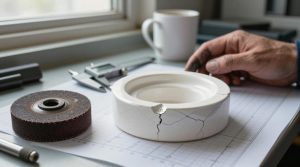
Boron Nitride Ceramic Insulation Block High Temperature Resistance Equipment
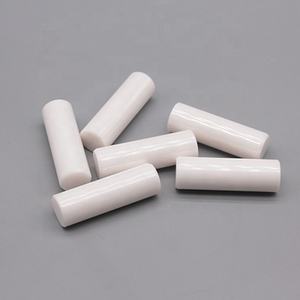
Boron Nitride Ceramics Insulating High Temperature Applications
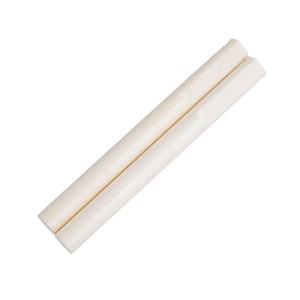
Boron Nitride Ceramic for Semiconductor Material
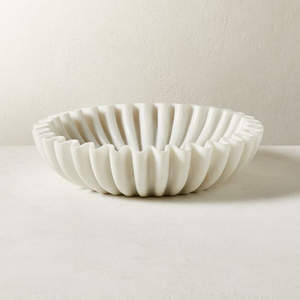
High Temperature Resistant Boron Nitride Ceramic Discs for Batteries
Boron Nitride Composite Ceramic Round Shim Drilled