Next-Generation Ceramics: Unlocking Superior Properties for Industry

The Myth of the Mundane
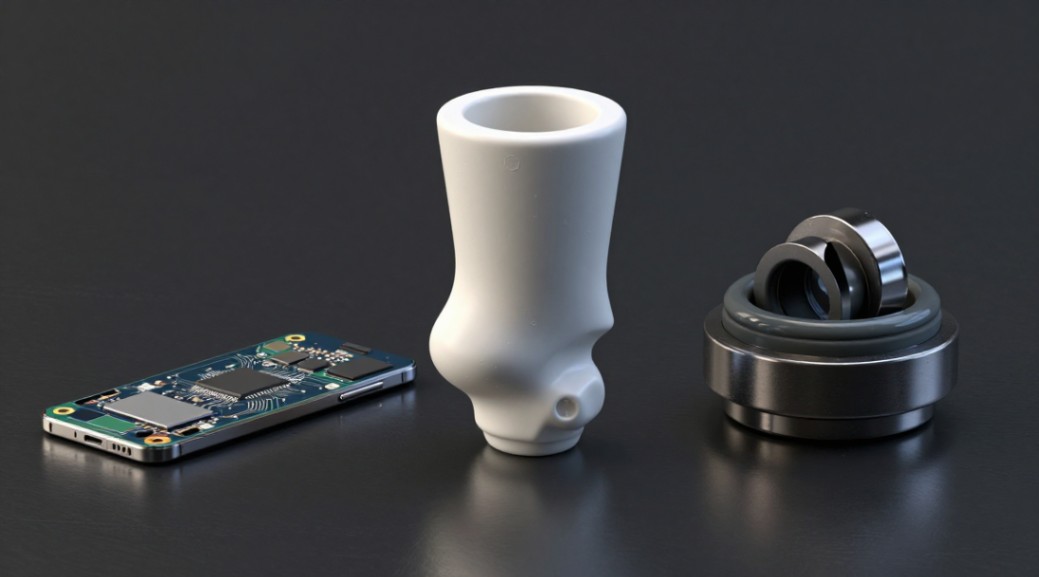
Think aluminium oxide ceramic is just for sandpaper? Think again. This material forms the hidden skeleton of modern technology. It is the insulating heart inside your smartphone’s circuit board. It is the wear-resistant seal in a rocket engine pump. It silently ensures your artificial hip joint lasts for decades. Most people never see it. Yet, modern life would grind to a halt without it. This is not a common material. It is a strategic enabler.
What Exactly Is Aluminium Oxide Ceramic?
Aluminum oxide ceramic, or alumina, is a synthetic inorganic compound of aluminum and oxygen (Al₂O₃). We call it technical ceramic or advanced ceramic to distinguish it from traditional clay-based pottery. Its power comes from a strong ionic-covalent atomic bond. This bond creates a material that refuses to compromise. This material does not melt until 2054°C. It does not conduct electricity. It resists attack from almost all chemicals. Its hardness approaches that of a diamond. In the world of materials, aluminum oxide ceramic is the ultimate stoic.
The Core Properties: A Profile of Extremes
Forget mild steel or common plastics. To understand aluminium oxide ceramic, you must think in extremes.
- Mechanical Hardness: Second only to diamond and boron carbide ceramic. It resists wear and abrasion indefinitely.
- Electrical Insulation: An exceptional dielectric material, even at high temperatures and voltages.
- Thermal Stability: It retains strength and shape from cryogenic temperatures up to 1650°C.
- Chemical Inertness: It laughs at acids, solvents, and molten metals. Only hydrofluoric acid and hot, concentrated phosphoric acid pose a threat.
Alumina vs. The World: A Brutally Honest Comparison
Engineers choose materials based on ruthless trade-offs. Here is how aluminum oxide ceramic stacks up against its peers.
Versus Zirconia (ZrO₂): Zirconia ceramic is tougher and stronger. It resists crack propagation better. However, aluminium oxide ceramic is harder, more wear-resistant, and dramatically cheaper. For pure abrasion resistance, alumina wins.
Versus Silicon Nitride (Si₃N₄): Silicon nitride ceramic has superior thermal shock resistance and fracture toughness. It is the champion for high-stress, high-temperature dynamic parts like bearings. Aluminum oxide ceramic offers better electrical insulation and corrosion resistance at a lower cost.
Versus Silicon Carbide (SiC): Silicon carbide ceramic has higher thermal conductivity and is even harder. It excels in heat exchangers and armor. But for electrical insulation and cost-effective chemical inertness, alumina remains king.
From Powder to Part: The Alchemy of Sintering
You cannot cast or machine aluminium oxide ceramic from a block. It starts as a fine, pure powder. We form this powder into a shape, called a green body. Then, we fire it in a furnace at temperatures approaching 1800°C. This process, sintering, fuses the powder particles together without melting them. The part shrinks and becomes dense. Final tolerances are achieved with diamond grinding.
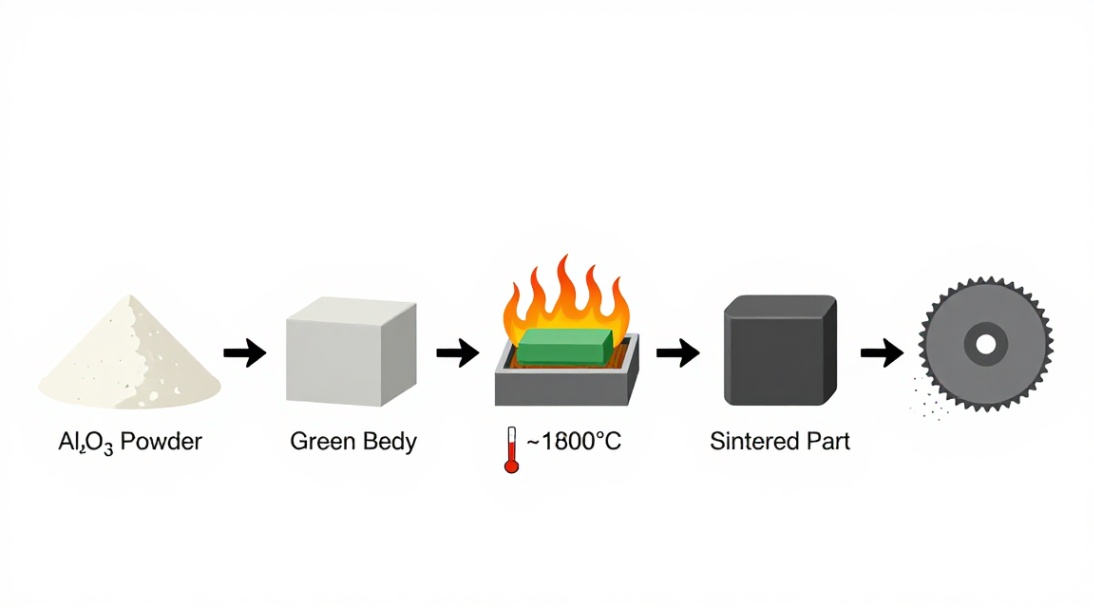
The purity defines the performance. Common grades are 96% and 99.5% alumina. That 3.5% difference is critical. 99.5% Al₂O₃ offers higher hardness, better wear resistance, and superior high-temperature performance. For semiconductor substrates or critical seals, only the purest grade will do.
Key Industrial Applications
This material thrives where others fail. Its applications are a catalogue of extreme engineering challenges.
- Electronics: The substrate for microchips and circuit boards. Its electrical insulation and thermal management are perfect.
- Mechanical Seals & Bearings: It operates in corrosive fluids and abrasive slurries without lubrication.
- Medical Implants: Its bio-inertness makes it ideal for hip replacements and dental implants.
- Industrial Wear Parts: Liner plates, nozzles, and guides that last orders of magnitude longer than steel.
- Cutting Tools: Inserts for machining superalloys, often coated with other materials.
The One Weakness (And How We Beat It)
Aluminum oxide ceramic is brittle. Its fracture toughness is low. A sharp impact or a severe thermal shock can cause catastrophic failure. This is its design constraint. We do not design with it like metal. We account for its brittleness by avoiding tensile stress concentrations and using it in compression.
Researchers are pushing past this limit. Advanced ceramic matrix composites (CMCs) embed fibers into the alumina matrix. This borrows from strategies used in ultra-high temperature ceramic composites (UHTCMCs). It creates a crack-deflecting structure, dramatically improving toughness. Future alumina components will be tougher, bridging the gap between monolithic ceramics and metals.
Your Next Move
Stop thinking of aluminium oxide ceramic as a commodity abrasive. It is a precision engineering solution for your most punishing application environments. Does your design face extreme wear, corrosion, or electrical isolation challenges? Standard materials are failing.
You need a specialist. You need our team. For over two decades, we have engineered alumina components that survive where others perish. We provide the material expertise and precision manufacturing to turn this extreme-performance ceramic into your competitive advantage.
The call is simple. Submit your application specs. Our engineers will analyze them and provide a material recommendation and feasibility assessment within 48 hours. Stop compromising with inadequate materials. Design with the foundation that never fails.
Suppiler
Synthetic-chemical focus on the research and development, production and sales of ceramic products, serving the electronics, ceramics, chemical and other industries. Since its establishment in 2015, the company has been committed to providing customers with the best products and services, and has become a leader in the industry through continuous technological innovation and strict quality management.
Our products includes but not limited to Aluminum Nitride, Aluminum Oxide, Boron Carbide, Boron Nitride, Ceramic Crucible, ect. If you are interested in any type of these, please feel free to contact us.