Next-Generation Ceramics: Unlocking Superior Properties for Industry

The Workhorse’s Edge
In the vast majority of engineering scenarios, aluminum oxide ceramic, or alumina, is the right first choice. Its dominance isn’t about being the best at any single thing. It’s about being exceptionally good at almost everything. When we need a component that demands a balanced combination of extreme hardness, high-temperature stability, excellent electrical insulation, and unwavering chemical inertness, the choice often defaults to alumina. We call it the workhorse of technical ceramics for a reason. It provides a remarkable, cost-effective platform of baseline properties that few other materials can match, making it the default starting point in countless design discussions. Its ubiquity in industries from automotive to medical isn’t an accident; it’s the result of decades of proven performance.
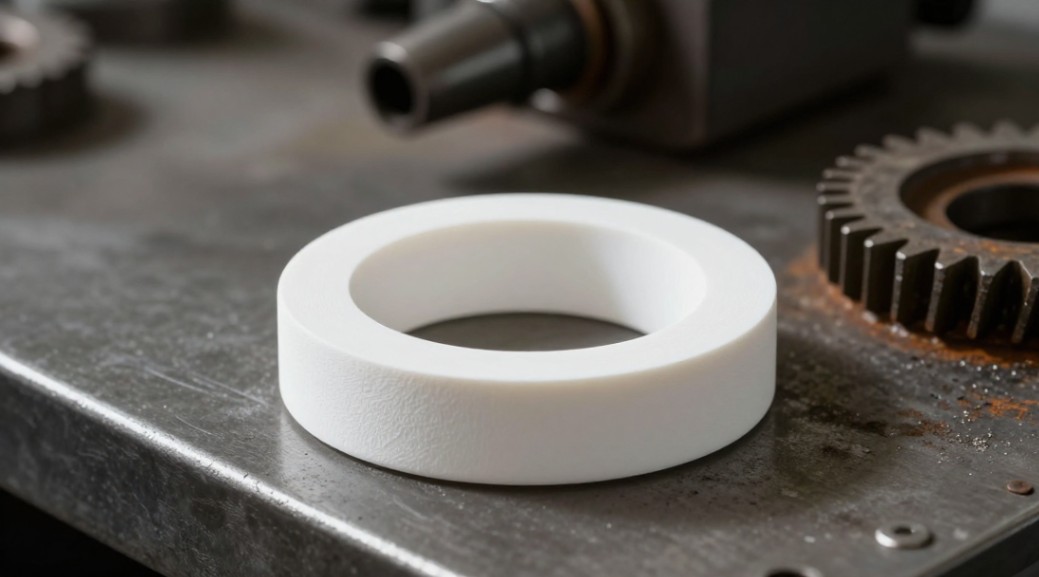
Understanding the Alumina Foundation
At its core, aluminum oxide ceramic is precisely what the name says: a ceramic form of Al₂O₃. We start with a powder, shape it into the desired form—using methods like dry pressing, isostatic pressing, or extrusion—and then fire it in a sintering furnace at temperatures that fuse the particles into a dense, polycrystalline solid. The magic lies in the purity and additives. We talk about grades like 96% or 99.5% alumina. That percentage refers to the Al₂O₃ content. Higher purity generally means better properties: superior wear resistance, higher dielectric strength, and greater chemical stability. But it also means higher cost and more challenging machining. So, 96% alumina, with its carefully balanced sintering aids, often hits the sweet spot for industrial wear parts and electrical insulators, offering fantastic performance without unnecessary expense.
The Property Suite: Where Alumina Excels
Let’s walk through what alumina brings to the table. Mechanically, its extreme hardness (second only to diamonds and a few ceramics like boron carbide) grants it legendary wear resistance. It shrugs off abrasion in pump seals, guide rollers, and cutting tool inserts. Its compressive strength is phenomenal, allowing it to bear immense loads without deforming. Thermally, alumina is a stalwart. It maintains its strength and form at temperatures that would melt most metals, making it ideal for furnace components and thermocouple tubes. However, its thermal conductivity is only moderate. This is a key differentiator. Electrically, alumina is a superb insulator with very high dielectric strength, forming the backbone of spark plug insulators, circuit substrates, and high-voltage bushings. Chemically, it is nearly inert, resisting attack from most acids and alkalis, which is why we use it for labware and chemical process components.
The Comparative Landscape: Alumina vs. The Field
This is where the real engineering decision happens. Alumina is rarely the only ceramic on the shortlist. The choice becomes a careful trade-off. Let’s compare.
For pure, unadulterated thermal management, aluminum nitride ceramic is the clear winner. Its thermal conductivity can be an order of magnitude higher than alumina’s. If your primary goal is to pull heat away from a high-power semiconductor, you choose AlN, accepting its higher cost and more complex processing. For ballistic armor or extreme abrasion applications where hardness is the only metric, boron carbide is harder. But it’s also far more brittle and expensive. We use it when the threat justifies the cost.
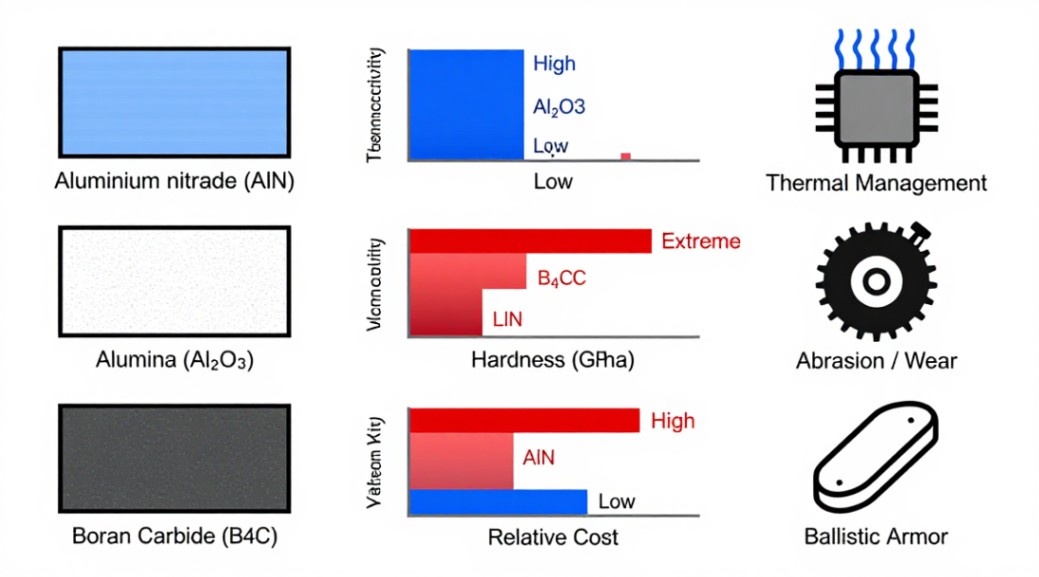
Silicon carbide ceramic, in its various forms like reaction-sintered or pressureless sintered, offers a compelling alternative. It surpasses alumina in thermal conductivity, creep resistance at high temperatures, and retains excellent hardness. For a high-temperature kiln roller or a demanding mechanical seal in a hot, corrosive environment, silicon carbide might be the upgrade. Silicon nitride ceramic brings exceptional fracture toughness and thermal shock resistance to the table. Where alumina might crack from rapid temperature swings, silicon nitride will often survive. This makes it a champion in metalforming tools and high-performance bearings. Mullite ceramic excels in ultra-high temperature stability with low thermal expansion, perfect for long-term furnace linings. Quartz ceramic offers unique optical and thermal properties for specialized windows and radomes.
The Decision Matrix
So how do we decide? We start with a brutally honest assessment of the primary failure mode. Is it wear? Heat buildup? Chemical corrosion? Thermal shock? If wear, corrosion, and electrical insulation are the top concerns, and the operating temperature is below 1500°C, alumina is likely your most economical champion. If the dominant issue is heat dissipation, we immediately look at aluminum nitride or silicon carbide. If the part must survive brutal thermal cycling, silicon nitride moves up the list. Cost is always the final arbitrator. Alumina’s mature manufacturing ecosystem gives it a significant price advantage for standard shapes and tolerances. When you need a custom-machined part from boron nitride ceramic with a special coating for a crucible, the cost equation changes completely. Alumina gives you a vast property portfolio at a bargain price. The other ceramics offer specialized, superior properties for a premium.
Looking Forward with a Trusted Material
The future for aluminum oxide ceramic isn’t about being displaced. It’s about consolidation and evolution. In biomedical fields, its biocompatibility is being leveraged for more complex implants. In electronics, high-purity grades continue to be the substrate of choice for thick-film and hybrid circuits. Advanced coatings and composites are enhancing its surface properties for even more demanding applications. For any engineer or designer, the path is clear. Begin your material selection with a deep understanding of alumina’s balanced capabilities. Use it as your baseline. Then, and only then, evaluate if the specific demands of your application justify the cost and complexity of moving to a more specialized ceramic like silicon carbide or silicon nitride. In most cases, you’ll find that the reliable, versatile workhorse—aluminum oxide ceramic—is not just the safe choice, but the smart one.
Suppiler
Synthetic-chemical focus on the research and development, production and sales of ceramic products, serving the electronics, ceramics, chemical and other industries. Since its establishment in 2015, the company has been committed to providing customers with the best products and services, and has become a leader in the industry through continuous technological innovation and strict quality management.
Our products includes but not limited to Aluminum Nitride, Aluminum Oxide, Boron Carbide, Boron Nitride, Ceramic Crucible, ect. If you are interested in any type of these, please feel free to contact us.