Next-Generation Ceramics: Unlocking Superior Properties for Industry

Introduction: The Core Cost Equation
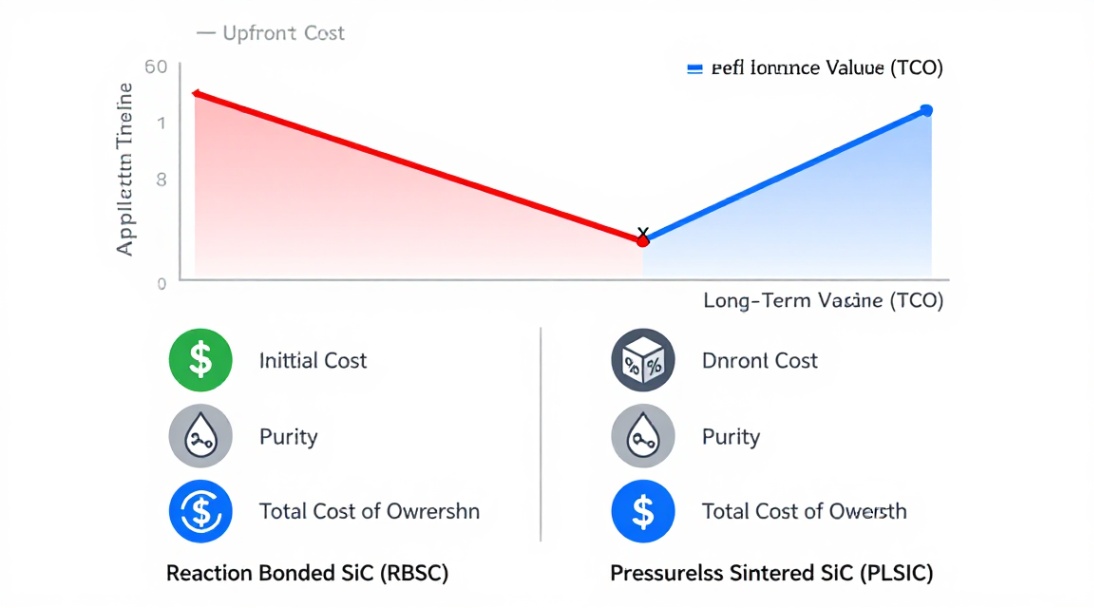
When comparing pressureless sintered silicon carbide (PLSIC) to reaction bonded silicon carbide (RBSC), the initial material cost is often only part of the story. In most industrial applications, RBSC offers a lower purchase price. However, the cost comparison pressureless sintered silicon carbide vs reaction bonded hinges on a detailed trade-off between upfront cost and total lifecycle performance. The superior density, purity, and mechanical properties of PLSIC can justify its higher price in critical applications, reducing total cost of ownership (TCO).
1. Manufacturing Fundamentals: Core Process Cost Drivers
The fundamental difference in production dictates the initial cost disparity. Understanding these processes is essential for the cost comparison pressureless sintered silicon carbide vs reaction bonded.
Pressureless Sintered Silicon Carbide (PLSIC)
Manufacturers form components from fine, sub-micron SiC powder mixed with sintering aids. They perform a high-temperature firing (typically 2000-2200°C) in an inert atmosphere. This process sinters the powder into a fully dense, single-phase ceramic body through solid-state diffusion. It is energy-intensive and requires precise kiln control. As noted in a 2022 International Ceramic Engineering report, “The energy consumption for PLSIC sintering can be 40-60% higher than for RBSC infiltration, a primary cost driver.”
Reaction Bonded Silicon Carbide (RBSC)
The process begins with a porous preform of carbon and SiC. Manufacturers infiltrate this preform with molten silicon at 1400-1600°C. The silicon reacts with the carbon to form new, in-situ SiC, bonding the structure. Unreacted silicon (typically 8-12%) remains in the final microstructure. This lower-temperature, liquid-phase process consumes less energy, making it inherently less expensive.
2. Property Differences: The Performance Basis for Cost
Cost must be evaluated against performance. The microstructure of each material directly influences its capabilities and, consequently, its value proposition.
- Density & Porosity: PLSIC achieves >99% theoretical density with virtually no open porosity. RBSC contains residual, unreacted silicon metal, creating a two-phase (SiC + Si) composite with minimal but present porosity.
- Mechanical Strength: PLSIC exhibits higher flexural strength (400-550 MPa) and hardness. RBSC offers excellent strength (350-450 MPa) and superior fracture toughness due to the metallic silicon phase, which provides crack blunting.
- Thermal & Chemical Performance: PLSIC has higher thermal conductivity and superior thermal shock resistance. Its pure SiC composition provides exceptional corrosion resistance. RBSC can suffer from silicon attack in strongly alkaline or certain molten metal environments.
- Purity: PLSIC is a high-purity ceramic, ideal for semiconductor wafer processing and extreme environments. RBSC contains free silicon, which can be a contaminant in ultra-high-purity applications.
3. Direct Cost Drivers and Price Ranges
The cost comparison pressureless sintered silicon carbide vs reaction bonded boils down to specific factors.
Primary Cost Drivers
- Raw Materials: Sub-micron SiC powder for PLSIC is more expensive than the carbon/SiC mix for RBSC.
- Energy: PLSIC’s extreme sintering temperatures incur significantly higher energy costs.
- Production Complexity & Yield: PLSIC sintering is more sensitive to process parameters, affecting yield. RBSC’s near-net-shape capability reduces machining waste.
Typical Price Comparison
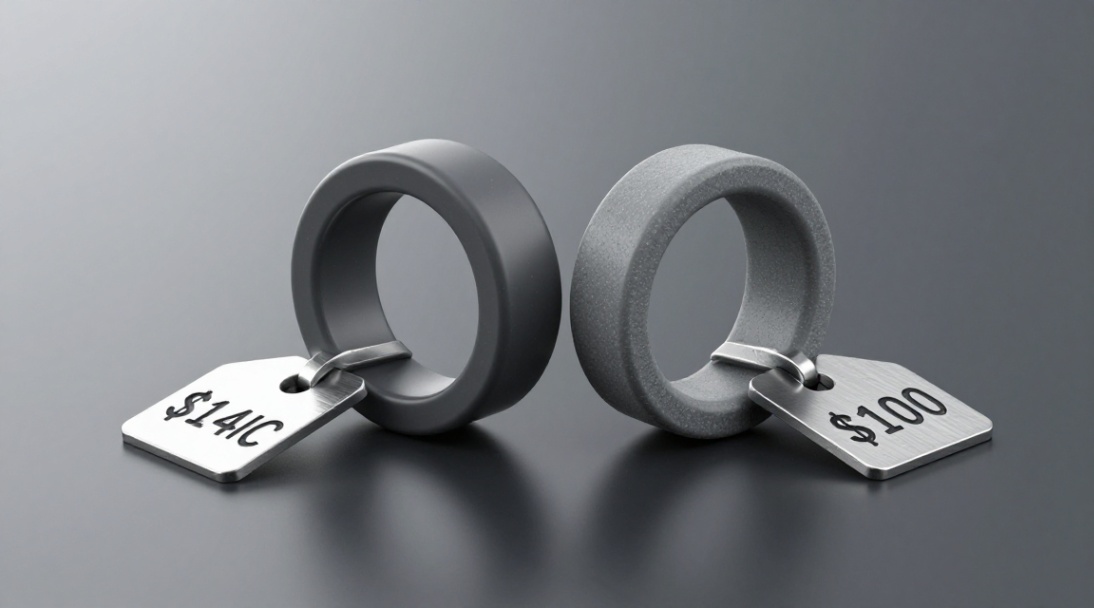
As a rule, standard-grade RBSC components cost 20-40% less than geometrically equivalent PLSIC parts. A simple seal ring might see RBSC at $100 versus PLSIC at $140. This gap narrows for complex geometries requiring extensive post-processing, where RBSC’s near-net-shape advantage becomes a significant cost saver.
4. Total Cost of Ownership: Beyond the Purchase Order
The smartest analysis looks beyond the invoice. Total Cost of Ownership (TCO) includes durability, maintenance, and performance losses.
Consider PLSIC for TCO when: Extreme wear, corrosion, or thermal cycling would cause RBSC to fail prematurely. The cost of unplanned downtime or process contamination far exceeds the material premium. High-purity requirements are non-negotiable.
Consider RBSC for TCO when: The operating environment is within its chemical and thermal limits. The higher fracture toughness reduces risk of handling damage. The component geometry is complex, leveraging near-net-shaping to avoid the high cost of machining dense PLSIC.
5. Application-Based Selection: Matching Material to Need
Use this decision framework. For severe abrasion in chemical slurries or high-temperature heat exchangers, specify PLSIC. Its monolithic structure resists corrosive wear far longer. For mechanical seal faces, wear plates, or burner nozzles in less aggressive media, RBSC provides an optimal balance of performance and economy. Its toughness is an asset. In semiconductor wafer handling or ultra-high vacuum, PLSIC is the only viable choice due to its purity and outgassing characteristics.
Conclusion and Recommendation
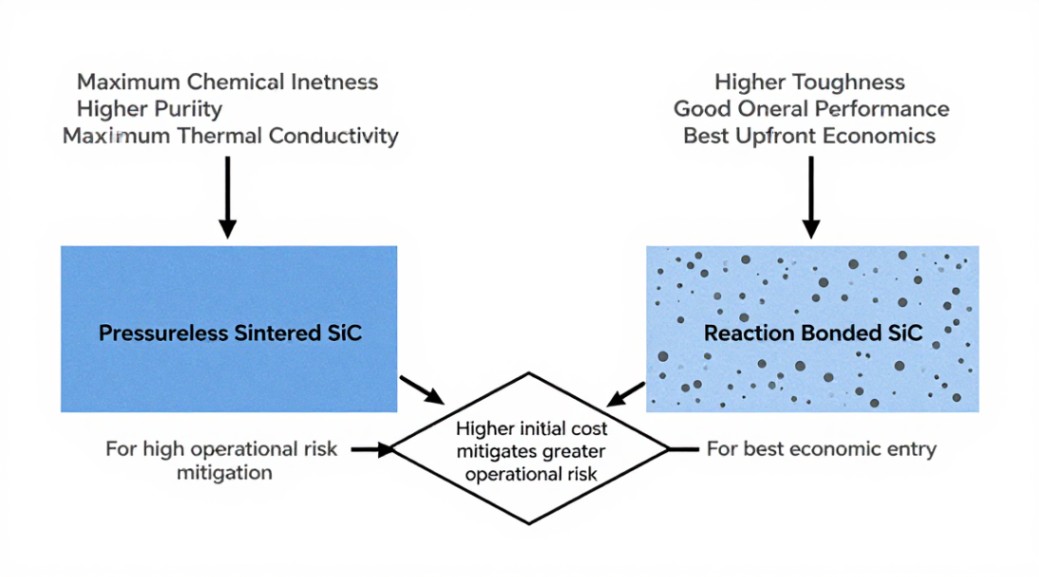
The choice is not abstract. It is a calculated engineering decision with direct financial impact. If your application demands maximum chemical inertness, thermal conductivity, or purity, invest in pressureless sintered silicon carbide. The higher initial cost mitigates greater operational risk. For applications requiring good overall performance, high toughness, and the best upfront economics, reaction bonded silicon carbide is the superior choice.
Do not guess. Consult with an application engineer who can analyze your specific operating conditions, component geometry, and failure modes. Contact our technical sales team today for a detailed cost-benefit analysis and a component quotation. We will provide the data you need to make the optimal technical and financial decision for your project.
Suppiler
Synthetic-chemical focus on the research and development, production and sales of ceramic products, serving the electronics, ceramics, chemical and other industries. Since its establishment in 2015, the company has been committed to providing customers with the best products and services, and has become a leader in the industry through continuous technological innovation and strict quality management.
Our products includes but not limited to Aluminum Nitride, Aluminum Oxide, Boron Carbide, Boron Nitride, Ceramic Crucible, ect. If you are interested in any type of these, please feel free to contact us.