Next-Generation Ceramics: Unlocking Superior Properties for Industry

When the Spec Sheet Falls Short
You’ve been handed the project. The application demands a material that survives abrasion, resists chemical attack, and handles thermal cycling without flinching. You specify silicon carbide. Then you receive a stack of data sheets from various manufacturers. The numbers look impressive, but also suspiciously similar. How do you cut through the marketing gloss to find the ceramic that won’t fail in your specific, punishing environment? If you’ve ever faced the anxiety of selecting a high-performance ceramic based on incomplete data, you know the stakes. A misinterpreted figure on a pressureless sintered silicon carbide mechanical properties data sheet can lead to catastrophic field failure, unplanned downtime, and a painful post-mortem.
The Pressureless Sintering Advantage: It’s in the Structure
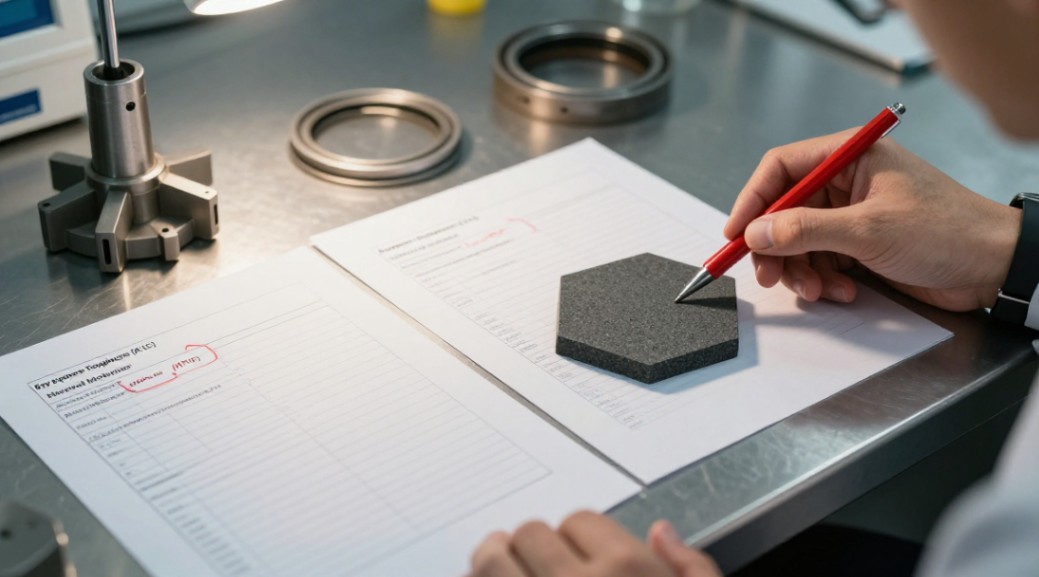
Understanding the material starts with its name. Pressureless sintered silicon carbide (PLSSC) forms its final, dense microstructure through high-temperature sintering without applied external pressure. This process relies on finely milled, high-purity alpha-SiC powder and sintering aids. The result is a fully dense, single-phase ceramic with a fine, uniform grain structure. This microstructure is the root cause of its superior and consistent mechanical properties. Unlike reaction-bonded SiC, PLSSC contains no free silicon, which boosts its high-temperature strength and corrosion resistance. Compared to some liquid-phase sintered variants, its grain boundaries are “cleaner,” often translating to better creep resistance and long-term stability. When you review a data sheet, you are fundamentally evaluating the quality of this microstructure.
Deconstructing the Core Mechanical Property Tables
A proper data sheet is your contract with the manufacturer. It quantifies performance. Your job is to interrogate each value.
Step 1: Scrutinize Density and Porosity
This is your first cheque for quality. Look for a bulk density typically exceeding 3.10 g/cm³, often reaching 3.15-3.18 g/cm³. The data sheet should explicitly state this is “theoretical density” or “bulk density.” Any value below 3.10 g/cm³ indicates residual porosity, which acts as a stress concentrator and will cripple flexural strength and wear life. Related, examine the listed porosity. For high-grade PLSSC, this should be <0.5%, often described as “near zero.” Open porosity is particularly detrimental for components in corrosive or sealing applications.
Step 2: Analyze Strength Through Flexural Data
Don’t just look at the average flexural strength, which is often a lofty 400-500 MPa. Demand more. A serious data sheet provides a Weibull modulus. This statistical parameter, often denoted as ‘m’, quantifies the reliability and flaw size distribution within the material. A higher Weibull modulus (e.g., m > 10) indicates greater consistency and predictable performance. A high average strength paired with a low Weibull modulus is a red flag; it means the strength has high scatter and failures can be unpredictable. Ask for the test standard (e.g., ASTM C1161) and sample size used to generate these figures.
Step 3: Evaluate Hardness and Fracture Toughness as a Pair
Hardness, often reported as Knoop (HK) or Vickers (HV), will be exceptionally high, typically HK0.5 > 2200. This defines its resistance to penetration and abrasive wear. However, hardness alone is insufficient. You must cross-reference it with fracture toughness (KIC), usually in the range of 3.5-4.5 MPa·m¹/². This value tells you how well the material resists crack propagation. A component in an impact-prone or thermally shocking environment needs an optimal balance: high hardness for wear, with sufficient toughness to avoid catastrophic brittle fracture. A data sheet lacking fracture toughness data is incomplete for mechanical design.
Beyond Room Temperature: The True Test of Performance
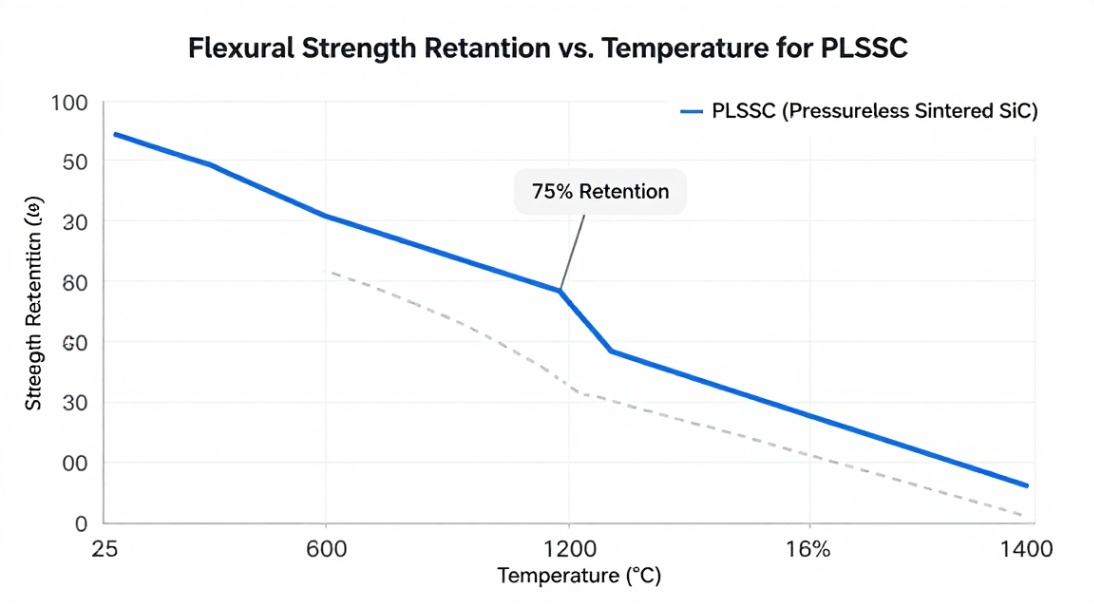
Many ceramics look good at 25°C. PLSSC excels where others weaken. A robust data sheet includes mechanical property retention at elevated temperatures. Look for graphs or tables showing flexural strength out to 1400°C. High-quality PLSSC will retain 70-80% of its room temperature strength at 1200°C, a testament to its strong covalent bonds and clean grain boundaries. This is where it decisively outperforms materials with metallic or glassy grain boundary phases that soften and creep.
The Silent Guardians: Thermal and Chemical Properties
Mechanical performance doesn’t exist in a vacuum. Two other data sheet sections are non-negotiable for system design. First, thermal conductivity and the coefficient of thermal expansion (CTE). PLSSC boasts high thermal conductivity (often >100 W/m·K) and a moderately low CTE (~4.5 x 10⁻⁶ /K). This combination is the secret to its legendary thermal shock resistance. The material can dissipate heat quickly and experiences minimal dimensional change, preventing stress buildup during rapid temperature changes.
Second, confirm its chemical inertness. The data sheet should state resistance to strong acids, alkalis, and molten salts up to specific temperature limits. This property, stemming from its thermodynamic stability, is why PLSSC seals and bearings succeed in chemical pump applications where metals rapidly degrade. Don’t assume; verify the exact chemical environments tested.
From Data Sheet to Real-World Component
On engineering forums, veterans share a common refrain: the data sheet is the starting point, not the finish line. Your final step is application mapping. Match the quantified properties to your operational demands.
- For Seal Faces and Bearings: Prioritize the combination of high hardness, low porosity, and excellent chemical resistance. The Weibull modulus is critical here for reliability.
- For Wear Liners and Nozzles: Flexural strength and fracture toughness become paramount to handle particle impact. Cross-reference abrasion test data if available.
- For Thermal Processing Components: Focus on the high-temperature strength retention graphs and the thermal shock resistance parameter (often derived from conductivity, strength, and CTE).
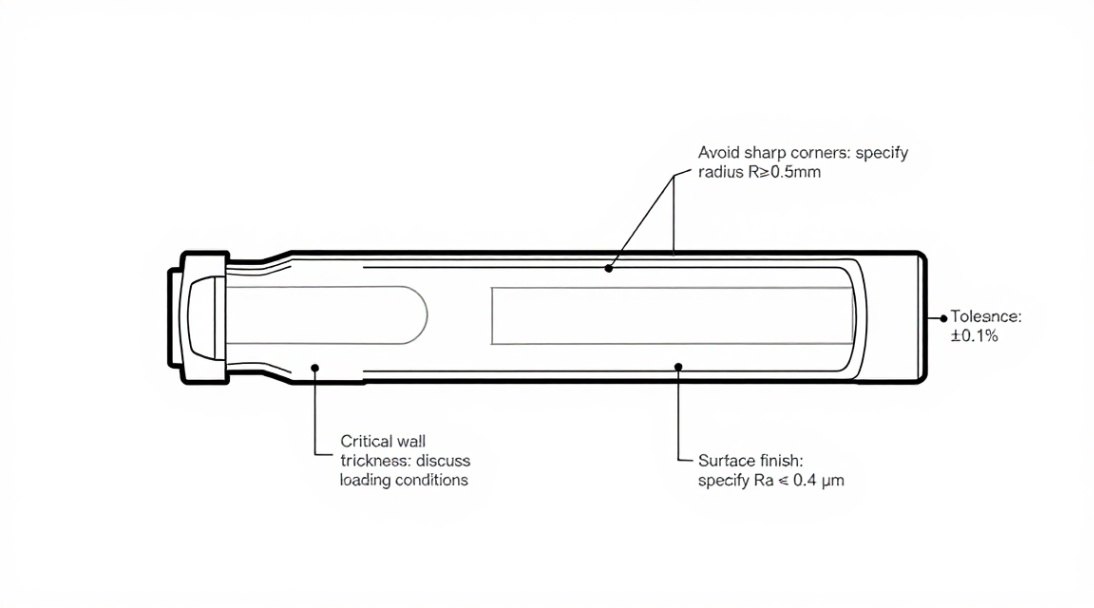
Always discuss critical dimensions and loading conditions directly with the manufacturer’s engineering team. They can advise on design for ceramic manufacturing, such as avoiding sharp corners and specifying appropriate surface finishes and tolerances to minimize machining costs and stress risers.
The Final Verification
A comprehensive pressureless sintered silicon carbide mechanical properties data sheet is a blueprint of capability. It should provide the dense, interconnected story of a material engineered for extremes: interconnected microstructure, statistically validated strength, retained performance at temperature, and inherent resistance to the environment. When these data points align, you are no longer just selecting a ceramic. You are specifying a deterministic engineering solution. Your next action is clear. Take your shortlisted data sheets and conduct a formal, line-item comparison against your specific service conditions. That is the process that separates a good component from a great one.
Suppiler
Synthetic-chemical focus on the research and development, production and sales of ceramic products, serving the electronics, ceramics, chemical and other industries. Since its establishment in 2015, the company has been committed to providing customers with the best products and services, and has become a leader in the industry through continuous technological innovation and strict quality management.
Our products includes but not limited to Aluminum Nitride, Aluminum Oxide, Boron Carbide, Boron Nitride, Ceramic Crucible, ect. If you are interested in any type of these, please feel free to contact us.