Next-Generation Ceramics: Unlocking Superior Properties for Industry

Are Your Ceramic Parts Failing Prematurely?
Have you ever designed a component, selected aluminum oxide ceramic for its renowned hardness, only to watch it shatter under a minor impact? Or perhaps you’ve seen a precision alumina wear plate or seal degrade rapidly in a corrosive environment, despite the material’s excellent reputation. These failures aren’t just expensive. They halt production lines and destroy project timelines. More often than not, the fault lies not with the aluminum oxide ceramic itself, but with a critical misunderstanding of its capabilities and limitations. After decades in this field, I’ve seen the same costly errors repeated. Let’s fix that.
Mistake #1: Assuming All Alumina is the Same
This is the single most dangerous assumption. Calling a material “aluminum oxide ceramic” or “alumina” is like saying “metal”-it tells you almost nothing. The purity and microstructure define everything. Low-purity (85-96%) alumina is a workhorse for general wear parts. But if you need superior electrical insulation, higher thermal conductivity, or extreme chemical resistance, you need high-purity (99.5%+) fine-grained technical ceramics. Using the former where the latter is required is a guarantee of failure.
The Critical Grades You Must Know
Think of purity as a ladder. Climbing it improves performance but also cost and manufacturing complexity.
- Low Purity (85-96% Al2O3): Excellent general wear resistance. Economical. Used in pump seals, liners, and grinding media.
- High Purity (99.5-99.9% Al2O3): This is where aluminum oxide ceramic truly shines. Superior strength, corrosion resistance, and thermal properties. Essential for semiconductor equipment, high-performance insulators, and advanced bearings.
- Specialty Grades: Includes formulations with controlled grain size or additives to enhance specific properties like fracture toughness or surface finish.
Choosing based on price alone almost always leads you to the wrong rung on this ladder.
Mistake #2: Ignoring the Brittleness Factor
Aluminum oxide ceramic is hard. Incredibly hard. But it is also inherently brittle. You cannot design with it like you design with steel or even tough engineering plastics. The cardinal sins here are sharp internal corners, inadequate support for cantilevered sections, and ignoring point loads.
Design Rules to Live By
Your design must work *with* the material‘s nature, not against it.
- Never specify sharp 90-degree internal corners. Always radius them. This simple step redistributes stress and prevents crack initiation.
- Never assume it will bend or deform. It won’t. It will fracture. Support it fully along its load-bearing faces.
- Never ignore thermal shock. While alumina has good thermal conductivity, rapid temperature changes can still cause cracking. Consider materials like silicon nitride ceramic or aluminum nitride ceramic for extreme cyclic thermal loads.
Remember: Strength in ceramics is a statistical property. A flawless part is strong; a part with a tiny flaw from poor design is weak.
Mistake #3: Using It as a Universal Solution
Aluminum oxide ceramic is phenomenal, but it’s not magic. It has specific domains where it dominates. Using it outside those domains invites trouble and leads engineers to wrongly dismiss all advanced ceramics.
When to Choose a Different Ceramic
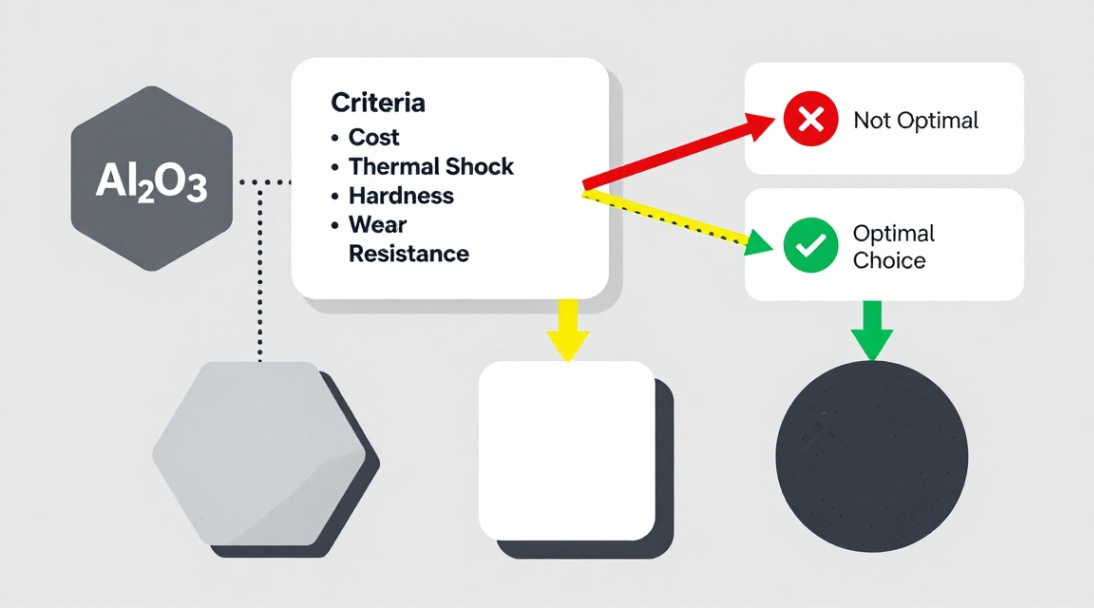
Here is a clear, logic-based guide. Don’t guess.
- For Extreme Wear & Abrasion: Alumina is great, but silicon carbide ceramic or boron carbide ceramic are often harder and more wear-resistant, albeit more expensive.
- For High Thermal Conductivity & Electrical Insulation: Here, aluminum nitride ceramic is the undisputed champion, especially in electronics. Don’t use alumina if you need to pull heat away quickly.
- For Maximum Fracture Toughness & Strength: If you fear brittle failure above all, look to zirconia or silicon nitride ceramic. They are the “tough guys” of the ceramic world.
- For Ultra-High Temperature (>1800°C) Non-Oxidizing Environments: This is the realm of materials like boron nitride ceramic (with a special coating for boron nitride ceramic crucibles) or advanced composites like silicon carbide-bonded silicon nitride ceramics.
Choosing the right ceramic is a strategic decision, not a default.
Mistake #4: Overlooking the Manufacturing Reality
The perfect design on your screen is worthless if it can’t be made. The primary processes-powder forming and sintering-cause parts to shrink significantly and unpredictably if not controlled. Tolerances much tighter than ±0.5% on a dimension often require expensive diamond grinding, which can cost more than the part itself.
Talk to Your Manufacturer Early
This is non-negotiable. Before you finalize a drawing, consult with a specialist in pressureless sintered silicon carbide ceramics or high-purity alumina. They will tell you:
- The achievable “as-sintered” tolerances for your geometry.
- Which features must be ground and the cost impact.
- If your wall thicknesses or aspect ratios are feasible.
This conversation will save you weeks of redesign and thousands of dollars.
Mistake #5: Neglecting the Surface and the Joint
An aluminium oxide ceramic component doesn’t exist in a vacuum. It interfaces with metal housings, other components, and fasteners. This is where projects fail at the final hurdle.
Installation is Everything
The ceramic part is only as good as its installation.
- Never directly clamp hard ceramic against soft metal without an engineered interface. You will create point loads and crack the ceramic.
- Always consider thermal expansion mismatch. Aluminum and alumina expand at different rates. Your mounting scheme must accommodate this, or thermal cycling will generate destructive forces.
- Always specify the correct surface finish. A mirror finish isn’t just for looks; it can drastically reduce friction in dynamic seals or improve corrosion resistance by leaving fewer flaws for attack.
Treat the interface with the same engineering rigor as the ceramic part itself.
The Future and Your Next Step
The field isn’t static. Innovations like ceramic matrix composites and additive manufacturing for aluminum oxide ceramic are addressing brittleness and complex geometry challenges. But these are tools for specific, advanced applications. For most engineers today, success comes from mastering the fundamentals we’ve just covered: grade selection, intelligent design, and smart application.
You now know the major pitfalls. But knowledge alone doesn’t protect your project. You need expert guidance tailored to your specific challenge-the loads, the environment, the budget.
Stop risking failure and costly delays. I strongly recommend you take the next critical step. Consult with a true specialist who can review your application. Share your operating parameters and design concepts. A one-hour review can prevent a six-month disaster. Don’t just buy a ceramic part; invest in a solution engineered for success. Reach out to a trusted expert today and move forward with confidence.
Suppiler
Synthetic-chemical focus on the research and development, production and sales of ceramic products, serving the electronics, ceramics, chemical and other industries. Since its establishment in 2015, the company has been committed to providing customers with the best products and services, and has become a leader in the industry through continuous technological innovation and strict quality management.
Our products includes but not limited to Aluminum Nitride, Aluminum Oxide, Boron Carbide, Boron Nitride, Ceramic Crucible, ect. If you are interested in any type of these, please feel free to contact us.