Next-Generation Ceramics: Unlocking Superior Properties for Industry

It’s In Your Phone, Your Car, and Your Body
Stop for a moment and look at your smartphone. The delicate circuitry that powers every app and call rests on a tiny, milky-white plate you’ve likely never seen. It’s not silicon. It’s not plastic. It’s aluminum oxide ceramic. Over 85% of all integrated circuit packages worldwide rely on this material. That thin, unassuming sliver withstands intense heat, channels electricity with perfect precision, and provides a rock-solid foundation for the digital age. It works silently, ceaselessly, in places where failure is not an option. This is the reality of advanced ceramics. They are not laboratory curiosities; they are the enabling materials for modern technology.
More Than Just a Pretty Crystal
At its core, aluminum oxide ceramic is purified and engineered alumina (Al2O3). We start with a fine powder. Then we apply pressure and tremendous heat-a process called sintering-which fuses the particles into a dense, polycrystalline structure. Think of forging a diamond, but with scientific intent. This transformation yields a suite of properties that leave metals and plastics far behind. It boasts a hardness second only to diamond and boron carbide in the ceramic world. It laughs at wear. It maintains its strength at temperatures that would melt steel. And it acts as a nearly perfect electrical insulator, even when things get hot. This isn’t just one material; it’s a platform. By adjusting purity from 85% to 99.9% and controlling the microstructure, we can tailor it for specific battles.
The Artisan’s Guide to Choosing and Using Alumina
So, your design calls for something harder than tool steel, more wear-resistant than tungsten carbide, and capable of insulating at 1500°C. Aluminium oxide ceramic likely tops your list. But success lies in the details. Here is the practitioner’s guide.
First, define the true enemy. Is it abrasive slurry wearing down a pump seal? A 99.5% alumina, finish-ground to a mirror surface, will outlast any metal. Is it the need for a biocompatible housing for a pacemaker that must not corrode inside the human body? Medical-grade 99.9% alumina, polished to sub-micron smoothness, is the proven solution. I’ve seen engineers specify the highest purity by default, thinking ‘more is better.’ Often, a robust 96% alumina is tougher, more cost-effective, and entirely fit-for-purpose. Match the grade to the actual stress, not the hypothetical one.
The Forming Crucible: Pressing, Casting, and Molding
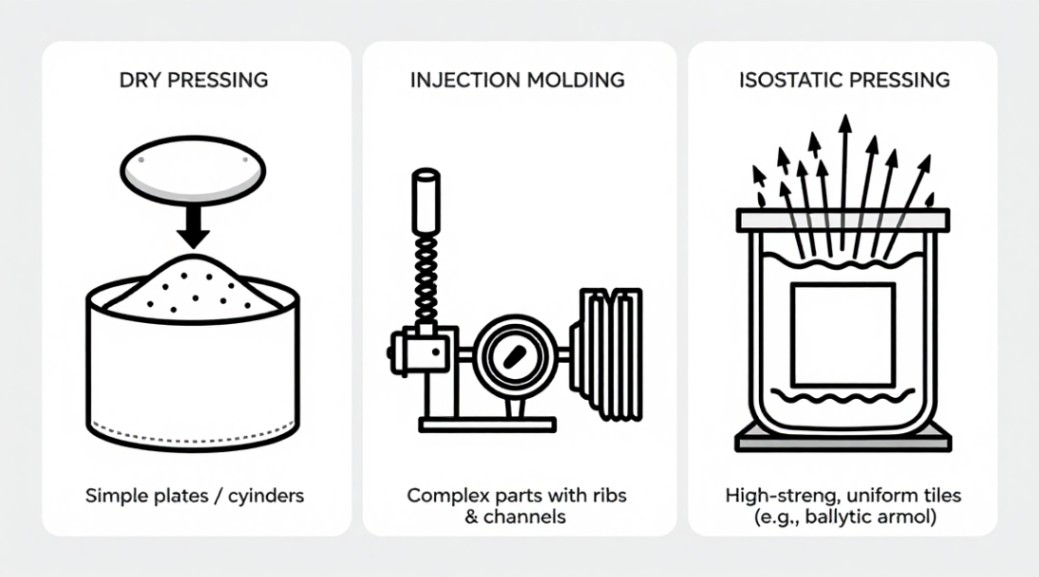
Second, understand how shape dictates process. For simple, flat plates or cylinders, dry pressing is fast and economical. Need a complex feedthrough with internal channels? Injection molding with a ceramic-filled polymer lets you achieve intricate geometries akin to plastic parts, which are then sintered. For components demanding absolute uniformity and high strength-like a ballistic armor tile-isostatic pressing applies equal pressure from all directions, eliminating weak points. I once worked on a project for a semiconductor wafer handling arm. The design was complex, with thin ribs and precise locating features. We prototyped via injection molding. The final production used isostatic pressing for critical dimensions. You must choose the right tool for the job.
Embracing the Brittle Truth
Third, and this is the most critical step: design for its brittleness. Aluminium oxide ceramic is not forgiving. It does not bend. It does not yield. Under excessive tensile or impact load, it will fracture. The key is to put it into compression, where it is phenomenally strong. Use supportive metal housings. Avoid sharp internal corners. Specify generous radii. One of the most common failure points I see in new designs is a metal bolt torqued directly against a ceramic surface, creating a point of concentrated stress. The fix? A compliant washer or a redesigned interface that distributes the load. On forums like Eng-Tips or Reddit, seasoned machinists often warn newcomers: ‘You don’t machine alumina, you grind it.’ It’s a different mindset. Use diamond tools. Go slow. Understand that final finishing often requires specialized lapping or polishing.
Where It Earns Its Keep
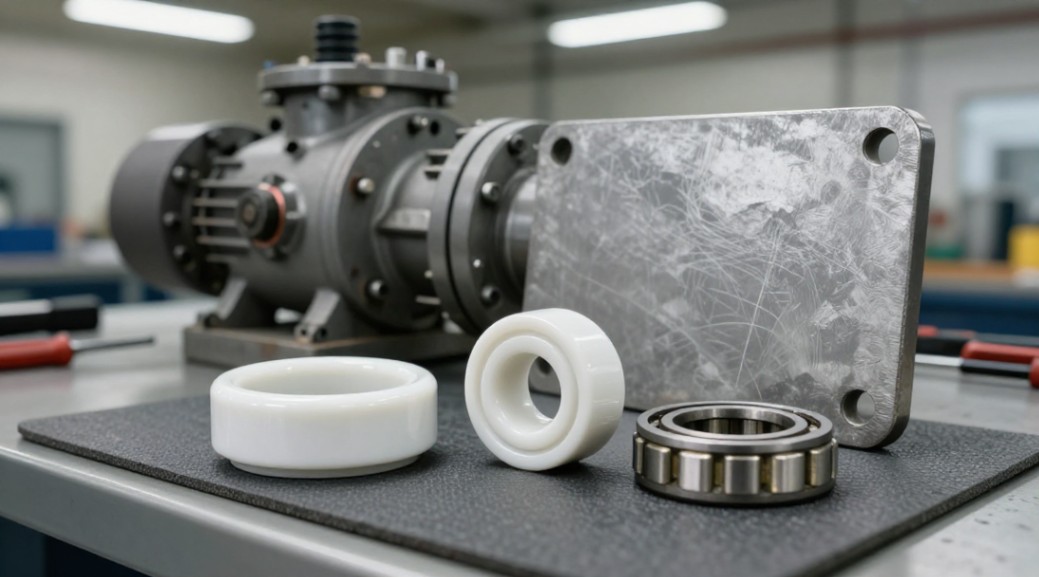
You’ll find it where others fail. In the seals and bearings of a chemical pump, shrugging off corrosive acids. As the wear plate in a mining conveyor, lasting ten times longer than hardened steel. In that spark plug insulator in your car’s engine, enduring thousands of volatile cycles. Its cousin materials-like silicon nitride for even higher toughness or boron carbide for extreme lightweight armor-have their own niches. But for the broadest combination of performance, reliability, and manufacturability, aluminum oxide ceramic remains the workhorse.
The journey from a raw powder to a life-critical component is profound. It requires respect for the material’s nature. Start with a clear definition of the problem. Choose your forming method wisely. And always, always design to keep it in compression. When you do, you unlock a level of performance that feels less like engineering and more like alchemy. You transform a common oxide into the backbone of innovation.
Suppiler
Synthetic-chemical focus on the research and development, production and sales of ceramic products, serving the electronics, ceramics, chemical and other industries. Since its establishment in 2015, the company has been committed to providing customers with the best products and services, and has become a leader in the industry through continuous technological innovation and strict quality management.
Our products includes but not limited to Aluminum Nitride, Aluminum Oxide, Boron Carbide, Boron Nitride, Ceramic Crucible, ect. If you are interested in any type of these, please feel free to contact us.