Next-Generation Ceramics: Unlocking Superior Properties for Industry

What is Aluminum Oxide Ceramic? The Engineer’s Workhorse
Aluminum oxide ceramic, most often called alumina, is a technical ceramic made from aluminum oxide (Al2O3). It’s the material of choice when we need a reliable combination of hardness, electrical insulation, and chemical stability. Think of it as the default starting point for solving tough engineering problems. From the substrate in your electronics to the seal in a high-pressure pump, alumina is there, working silently and reliably. Its balance of performance and manufacturability makes it indispensable.
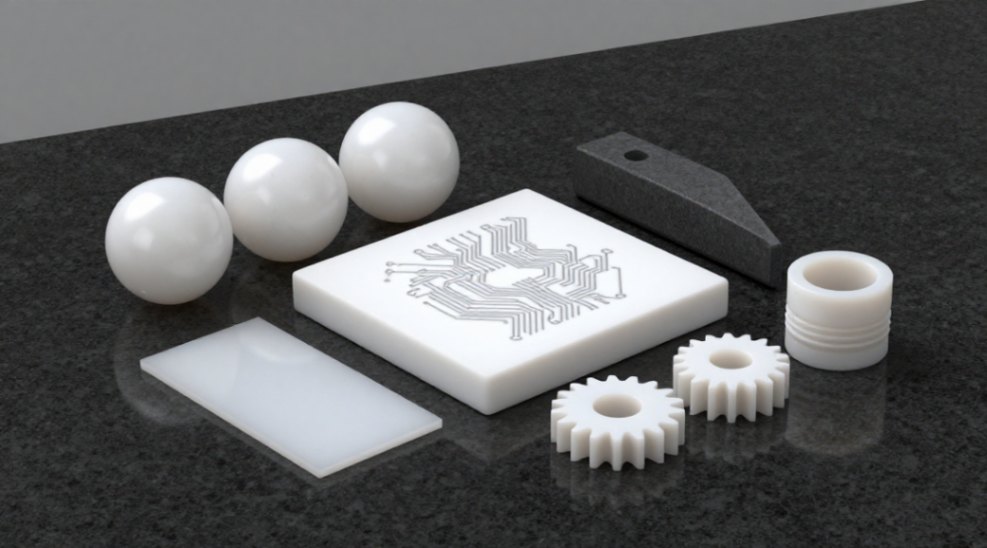
Core Properties & Composition
At its heart, alumina is simple: it’s primarily aluminum and oxygen. But how we process and purify it creates a material with exceptional traits. The purity level-from 85% to 99.9+% Al2O3-directly dictates its performance.
Mechanical & Physical Properties
- Extreme Hardness: Rivals sapphire (which is single-crystal alumina). This gives it outstanding wear and abrasion resistance.
- High Compressive Strength: It handles heavy loads without deforming, often exceeding 2,000 MPa.
- Stiffness: A high modulus of elasticity means it resists bending and deflection under load.
Electrical & Thermal Properties
- Excellent Electrical Insulator: Even at high temperatures, it maintains high resistivity. This is why it’s the foundation for circuit substrates.
- Moderate Thermal Conductor: It moves heat well (about 20-30 W/m·K), but not as well as aluminum nitride ceramic or silicon carbide ceramic. This makes it suitable for many thermal management tasks.
- High-Temperature Stability: It retains its properties up to ~1600°C, resisting creep and thermal shock.
How Does It Compare to Other Ceramics?
Choosing the right ceramic means understanding the trade-offs. Here’s how alumina stacks up.
- vs. Silicon Nitride (Si3N4): Silicon nitride has higher fracture toughness and better thermal shock resistance, ideal for bearings and cutting tools. Alumina wins on cost and electrical insulation.
- vs. Silicon Carbide (SiC): SiC has far superior thermal conductivity (4-5x higher) and is harder. We use it for extreme wear and heat sinks. Alumina is more electrically insulating and easier to machine to tight tolerances.
- vs. Aluminum Nitride (AlN): AlN is the thermal management champion (150-200 W/m·K). We specify it for high-power electronics. Alumina is the cost-effective, all-rounder insulator.
- vs. Boron Nitride (BN): BN is a machinable, lubricious ceramic with excellent thermal conductivity. It’s perfect for fixtures and thermal interfaces. Alumina is harder and more wear-resistant.
Primary Industrial Applications
Alumina‘s versatility shines across industries. We rely on it for precision and reliability.
- Electronics: The #1 use. It forms the substrate for thick and thin film circuits, chip carriers, and insulators.
- Mechanical Components: Wear plates, seal rings, bushings, and ball valve seats. It outlasts metals in abrasive slurry pumps.
- Medical: Biocompatible, it’s used in orthopedic implants, dental components, and surgical tools.
- Cutting Tools: Inserts for machining cast iron and superalloys, often with coatings.
- High-Temperature & Corrosive: Thermocouple tubes, furnace liners, and labware for harsh chemical processes.
Manufacturing Alumina Components: A Process Overview
Making a precision alumina part is a multi-step journey. Consistency at each stage is non-negotiable.
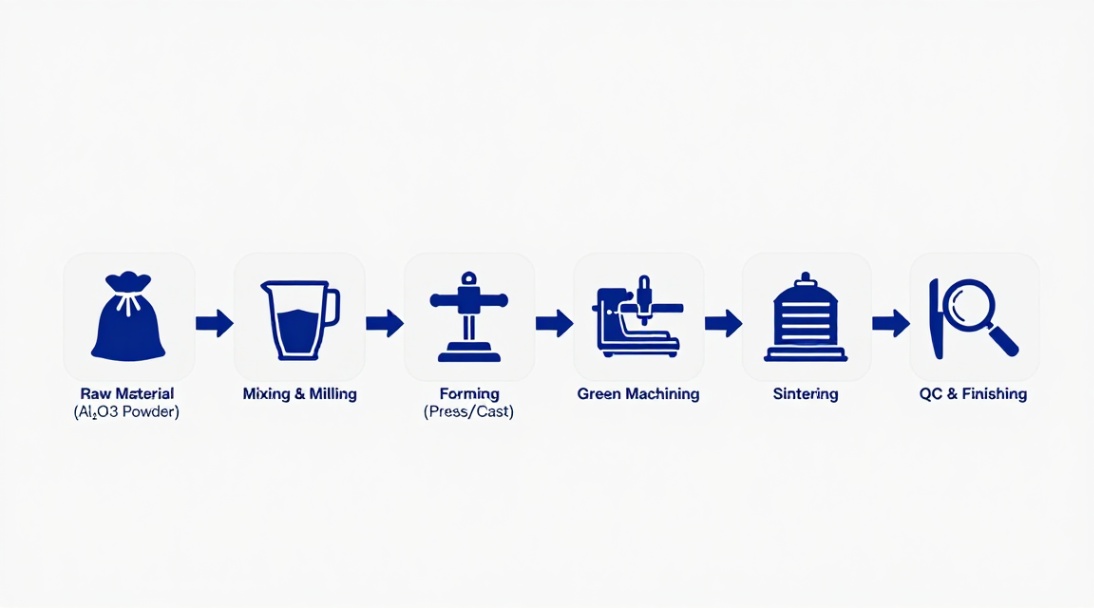
- Powder Preparation & Mixing: We start with fine, high-purity Al2O3 powder. We mill it with binders and sintering aids in a ball mill for 12-24 hours to achieve a homogeneous slurry.
- Forming: The slurry is shaped. For simple shapes, we use dry or isostatic pressing at 50-200 MPa. For complex, thin-walled parts, we inject the slurry into molds. Tape casting creates thin, flat substrates.
- Debinding: The “green” part is heated slowly to ~600°C to burn out the organic binders. This step requires precise ramp rates, typically 0.5-2°C per minute, to avoid cracking.
- Sintering: The core step. Parts are fired in a kiln at 1500-1800°C for several hours. This densifies the material, driving out porosity and creating the final mechanical properties. Atmosphere control (air or hydrogen) is critical.
- Finishing: Sintered parts are ground, lapped, or laser-cut to final dimensions. Diamond tooling is mandatory due to alumina’s hardness.
Grades, Purity, and Performance
Not all alumina is created equal. The purity level is your primary spec.
- 85-95% Alumina: The workhorse grade. Excellent wear resistance and mechanical strength at a lower cost. Used for seals, wear plates, and insulators.
- 96-99.5% Alumina: High-purity. Offers superior electrical insulation (lower loss tangent), better corrosion resistance, and higher strength. The standard for electronic substrates and high-performance components.
- 99.6-99.99% Alumina: Ultra-high purity. Used in critical semiconductor processing equipment, medical implants, and advanced laser tubes where ionic contamination or slight discoloration is unacceptable.
Designing & Machining with Alumina: Key Considerations
To use alumina successfully, we must design for its nature. It’s not a metal.
- Design for Brittleness: Avoid sharp corners and stress concentrators. Use generous radii. Compressive loads are best; tensile loads require careful design.
- Tolerancing is Critical: Sintering causes shrinkage (10-20%). We design oversized tooling to compensate. Final precision comes from diamond grinding, so specify only critical dimensions.
- Joining & Assembly: You can’t weld it. We use mechanical fastening, brazing with active metal alloys, or diffusion bonding.
- Machining Post-Sinter: Only diamond grinding works. It’s slow and costly. The rule is: machine as much as possible in the “green” state before sintering.
The Future of Aluminium Oxide Ceramic
Innovation continues. We’re pushing alumina into new frontiers.
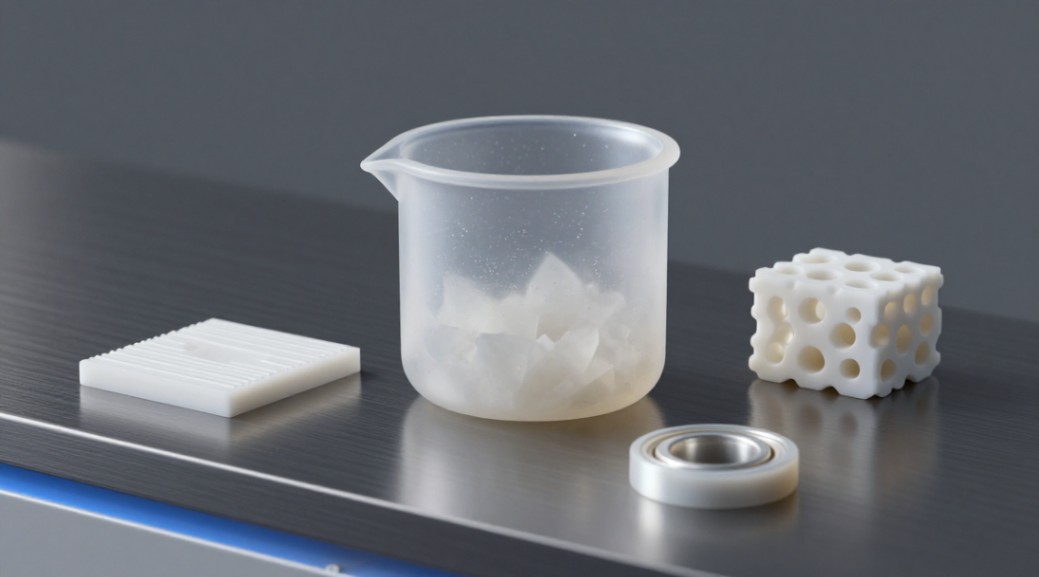
- Nanostructured Alumina: Using nano-scale powders to achieve even higher strength, hardness, and optical transparency.
- Alumina Matrix Composites: Reinforcing alumina with fibers (like the ‘double continuous structure’ strategy used for ultra-high-temperature ceramics) or platelets to drastically improve fracture toughness, moving from 3-5 MPa·m¹/² towards 10-20 MPa·m¹/².
- Advanced Coatings: Developing functional coatings to enhance surface properties, like the specialized coatings used on boron nitride crucibles, for even better wear or thermal performance.
- Additive Manufacturing: 3D printing of complex alumina geometries via stereolithography (SLA) or binder jetting is maturing rapidly, opening doors to previously impossible designs.
Your Next Step with Alumina
So, where do you start? If your application demands electrical insulation, wear resistance, and high-temperature stability, alumina is likely your best first candidate. The key is partnering with a fabricator who understands the nuances between grades and can guide you on design-for-manufacturability. Ask for material test reports. Request prototypes. Test them in your actual environment. For components where thermal management is the primary driver, you may also explore aluminium nitride or silicon carbide. But for a proven, reliable, and versatile ceramic solution, aluminum oxide ceramic remains an engineering cornerstone we’ve trusted for decades.
Suppiler
Synthetic-chemical focus on the research and development, production and sales of ceramic products, serving the electronics, ceramics, chemical and other industries. Since its establishment in 2015, the company has been committed to providing customers with the best products and services, and has become a leader in the industry through continuous technological innovation and strict quality management.
Our products includes but not limited to Aluminum Nitride, Aluminum Oxide, Boron Carbide, Boron Nitride, Ceramic Crucible, ect. If you are interested in any type of these, please feel free to contact us.