Next-Generation Ceramics: Unlocking Superior Properties for Industry

It’s Everywhere, But You Rarely See It
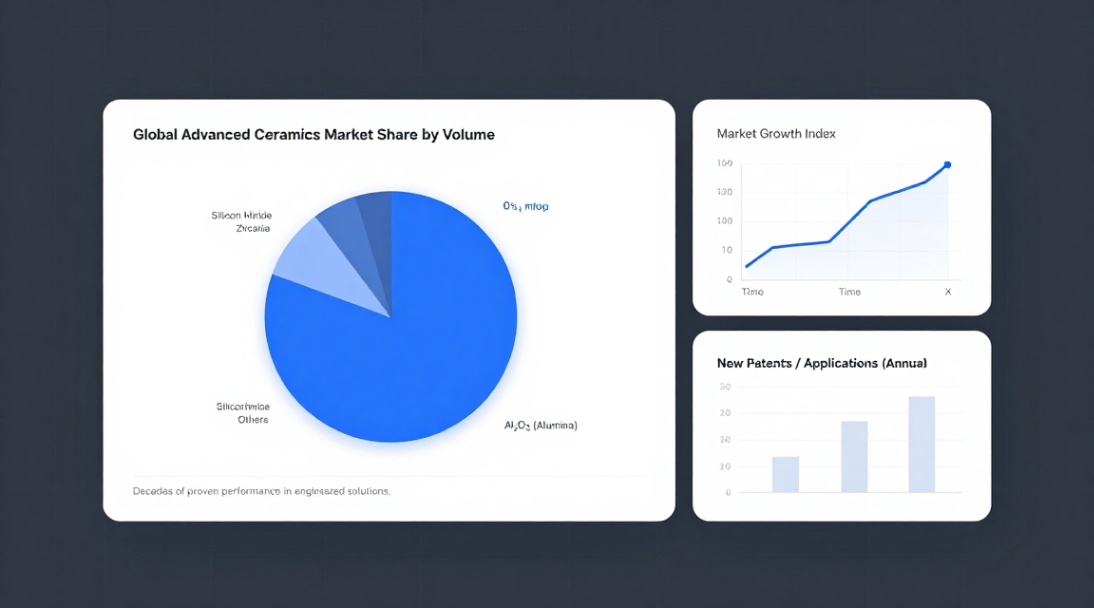
A recent market analysis from Ceramic Industry magazine highlighted something we’ve felt for years: aluminum oxide ceramic now comprises over 60% of the global advanced ceramics market by volume. Think about that. In a field bursting with exotic contenders like silicon nitride ceramic and zirconia, the workhorse alumina still holds a commanding majority. The reason isn’t complacency. It’s because engineers keep finding new ways to leverage its unique balance of properties where other materials fail. We’ve spent decades proving this in the trenches.
The Anatomy of a Workhorse: Composition and Core Properties
At its heart, aluminium oxide ceramic (or alumina) is deceptively simple: a crystalline structure of aluminium and oxygen. This simplicity is its strength. The ionic bonds in this lattice grant it a combination of properties that, frankly, metals and polymers envy. Its hardness is second only to diamond and boron carbide in the ceramic world. It laughs off abrasion. It maintains incredible strength at high temperatures where steel would sag. Most critically, it’s a superb electrical insulator, even when hot. This combination isn’t common. Silicon carbide ceramic conducts heat better but can be conductive. Aluminum nitride ceramic is a thermal superstar but more costly and sensitive. Alumina gives you a reliable, predictable, and cost-effective toolkit.
Where Alumina Earns Its Keep: Critical Applications
You don’t achieve 60% market share by being a niche player. Alumina’s applications span the entire spectrum of modern industry.
The Go-To for Wear and Tear
If something is sliding, grinding, or blasting, alumina is often the first material we consider. It’s the primary material for wear-resistant components. Think pump seals in abrasive slurries, cutting tool inserts, textile guides that see endless friction, and liners for mining equipment. In these roles, it routinely outlasts hardened steel by factors of 10 to 100. The lifetime cost analysis is overwhelmingly in alumina’s favour.
The Foundation of Electrical Integrity
Its excellent dielectric strength and volume resistivity make it indispensable in electronics. Substrates for semiconductor packages, insulating washers in high-voltage equipment, and spark plug insulators all rely on alumina’s ability to isolate electrical pathways reliably, even in demanding thermal and corrosive environments.
A Trusted Partner in the Human Body
This is where purity matters immensely. High-purity, medical-grade alumina (99.5% and above) is bio-inert. The human body tolerates it exceptionally well. For decades, it has been the gold standard for ball heads in hip replacements and components in other orthopedic and dental implants. Its biocompatibility, combined with that wear resistance, makes it ideal for articulating joint surfaces.
The Devil is in the Details: Grades, Processing, and Comparisons
Not all alumina is created equal. The percentage of Al2O3 defines its capability.
- 92-95% Alumina: The industrial workhorse. Excellent mechanical strength and wear resistance for seals, liners, and wear plates.
- 99.5%+ Alumina: High-purity. Superior corrosion resistance, higher operating temperatures, and the required biocompatibility for medical uses.
- 99.9%+ Alumina: Ultra-high purity. Used in demanding semiconductor applications where even trace elements can disrupt electrical performance or in specialized laboratory ware.
The journey from powder to part is precise. We start with finely milled, controlled-purity powder. Forming methods like dry pressing, isostatic pressing, or injection molding create a “green” body. Then, sintering at temperatures often exceeding 1600°C densifies the part, creating the final, strong ceramic microstructure. This processing control is what separates a commodity part from an engineered component.
How It Stacks Up Against the Competition
Choosing a ceramic is about trade-offs. Here’s our field-tested perspective.
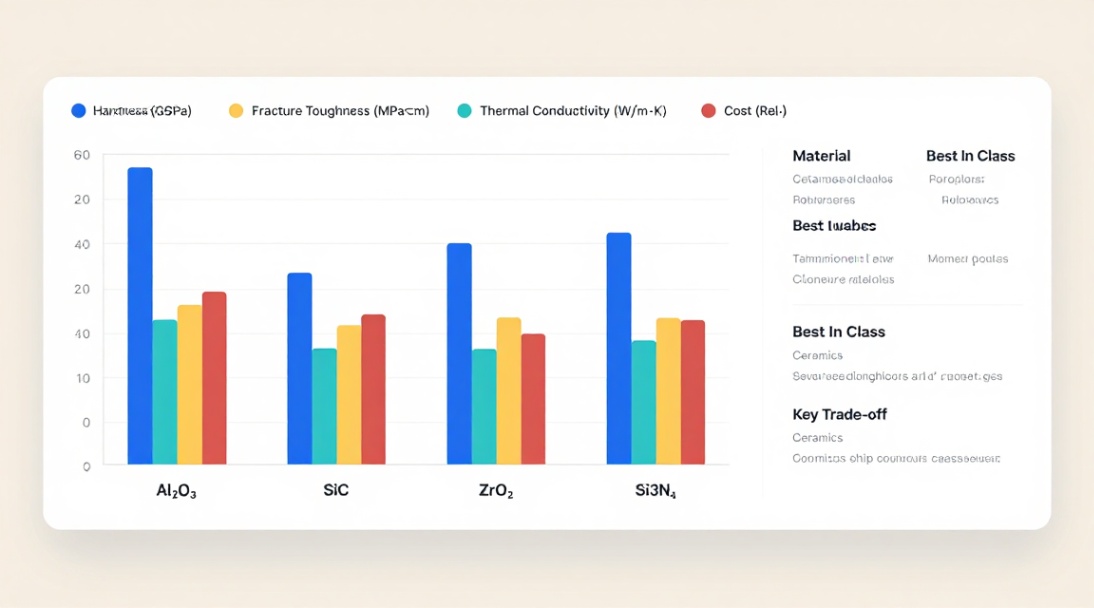
Vs. Zirconia: Zirconia is tougher (more fracture resistant) and has higher strength. Use it for applications demanding high mechanical shock resistance. But alumina is harder, more wear-resistant, more thermally stable, and significantly less expensive. For pure abrasion, we pick alumina.
Vs. Silicon Carbide: Silicon carbide ceramic has phenomenal thermal conductivity and is even harder. It’s the choice for extreme wear and heat sinks. However, it’s more brittle, harder to machine post-sinter, and generally more expensive. Alumina wins on cost and electrical insulation.
Vs. Aluminum Nitride: AlN is the king of thermal conductivity among electrical insulators. If you need to pull heat away from a high-power semiconductor, AlN is your answer. For general-purpose insulation and structural roles where extreme thermal conductivity isn’t the #1 driver, alumina’s cost-effectiveness and proven performance make it the default.
The Next Frontier: Where is Alumina Headed?
The story isn’t over. Innovation in alumina is about pushing limits and adding functionality.
Research is intensely focused on ultra-high temperature stability. While alumina’s melting point is around 2050°C, the quest for materials that maintain strength and form a dense, continuous, and low-oxygen-permeability oxide layer above 3000°C drives new composite and doped-alumina systems. Think next-generation hypersonic vehicle leading edges.
We’re also seeing smart integrations. Alumina components are being designed with built-in sensors or conductive traces. They’re being combined with polymers or metals in novel hybrid structures. And advanced surface treatments, akin to the special coating for boron nitride ceramic crucibles, are being developed to further enhance alumina’s corrosion resistance in molten metal environments.
Making the Right Material Choice
After twenty-plus years, our advice is straightforward. Start with alumina. Its vast data set, proven reliability, and cost profile make it the logical baseline. If your application needs more thermal conductivity, look at aluminum nitride or silicon carbide. If you need ultimate fracture toughness, consider zirconia. But for the vast majority of demanding applications involving wear, corrosion, high temperatures, or electrical insulation, aluminum oxide ceramic isn’t just an option. It’s the optimal, engineered solution that has quietly built the modern world.
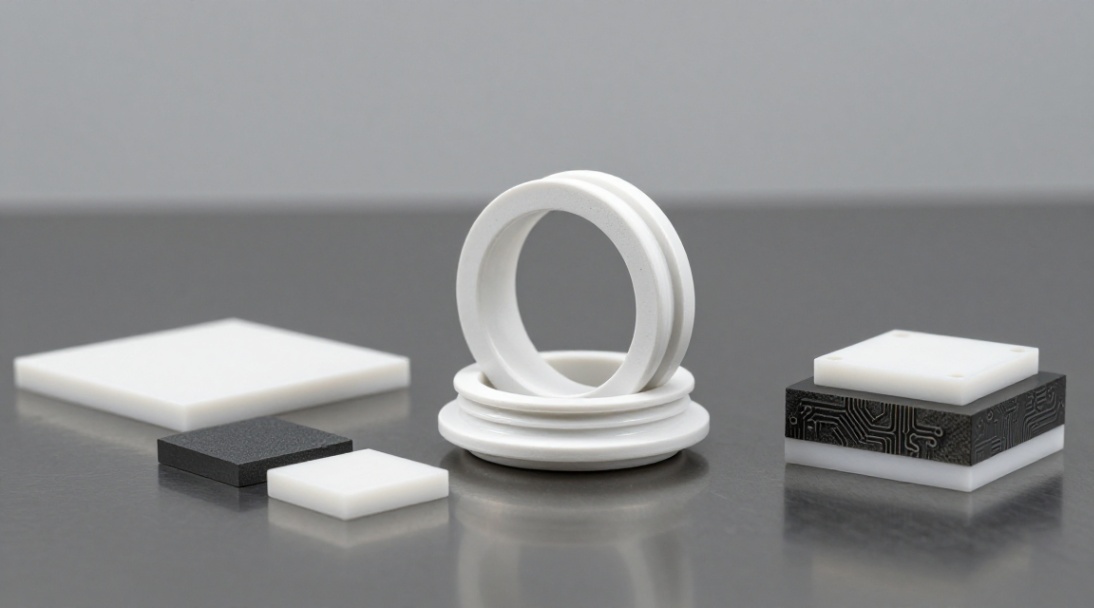
If you’re battling a specific wear, thermal, or insulation problem, test a sample. The data from a real-world trial will tell you more than any spec sheet. Let the performance of this foundational material speak for itself.
Suppiler
Synthetic-chemical focus on the research and development, production and sales of ceramic products, serving the electronics, ceramics, chemical and other industries. Since its establishment in 2015, the company has been committed to providing customers with the best products and services, and has become a leader in the industry through continuous technological innovation and strict quality management.
Our products includes but not limited to Aluminum Nitride, Aluminum Oxide, Boron Carbide, Boron Nitride, Ceramic Crucible, ect. If you are interested in any type of these, please feel free to contact us.