Next-Generation Ceramics: Unlocking Superior Properties for Industry

Aluminum Oxide Ceramic: The Unmatched Industrial Workhorse
Aluminum oxide ceramic, often called alumina, remains the most widely used advanced ceramic because it delivers an unmatched balance of properties, cost, and reliability. While newer materials like silicon carbide ceramic offer higher thermal conductivity or boron nitride ceramic provides better lubricity, alumina’s combination of hardness, electrical insulation, and chemical inertness makes it the default choice for thousands of critical applications. Its dominance is not a historical accident but a result of continuous refinement in processing and purity grades, from 85% to 99.9% Al2O3, each tailored for specific performance envelopes.
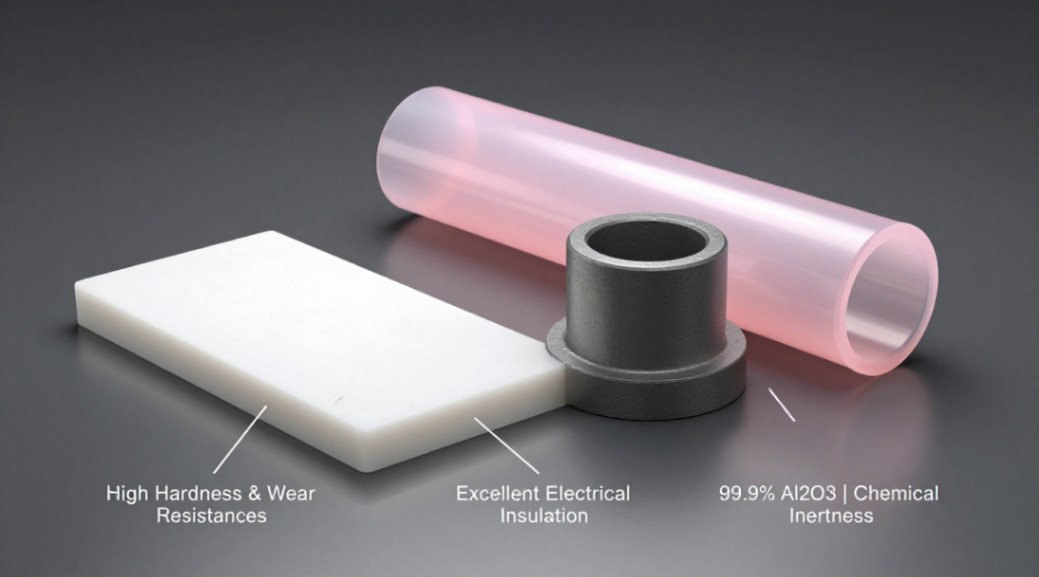
Core Properties and Comparative Advantages
The utility of aluminum oxide ceramic stems from its strong ionic bonding, which directly translates into exceptional performance. It is fundamentally an electrical insulator with high dielectric strength, making it ideal for substrates and insulating components. Its Vickers hardness exceeds 1500, providing superior wear resistance against abrasives. Crucially, it maintains these properties in environments that would degrade metals or polymers.
How Alumina Stacks Up Against Peer Ceramics
Material selection is a trade-off. The table below provides a data-driven comparison of aluminum oxide ceramic with other common engineering ceramics, illustrating why no single material dominates all applications.
| Material | Key Strength | Key Limitation | Primary Use Case vs. Alumina |
|---|---|---|---|
| Aluminum Oxide Ceramic (Al2O3) | Optimal balance of hardness, insulation, corrosion resistance, and cost. | Lower fracture toughness and thermal conductivity than some peers. | The default choice for wear plates, electrical insulators, labware, and biocompatible implants. |
| Silicon Carbide Ceramic (SiC) | Extreme thermal conductivity, hardness, and oxidation resistance at high temperatures. | Higher cost, more difficult to sinter to full density without additives. | Selected over alumina for high-heat-flux applications like heat exchangers or advanced kiln furniture. |
| Aluminium Nitride Ceramic (AlN) | Excellent thermal conductivity coupled with electrical insulation. | Susceptible to hydrolysis, significantly more expensive than alumina. | Used instead of alumina for high-power electronic substrates where heat dissipation is critical. |
| Zirconia (ZrO2) | Exceptional fracture toughness and strength (transformation toughening). | Lower hardness and wear resistance than alumina; can suffer from low-temperature degradation. | Chosen over alumina for mechanical components like cutting blades, pump seals, or biomedical implants requiring higher impact resistance. |
From Powder to Performance: Processing Defines Function
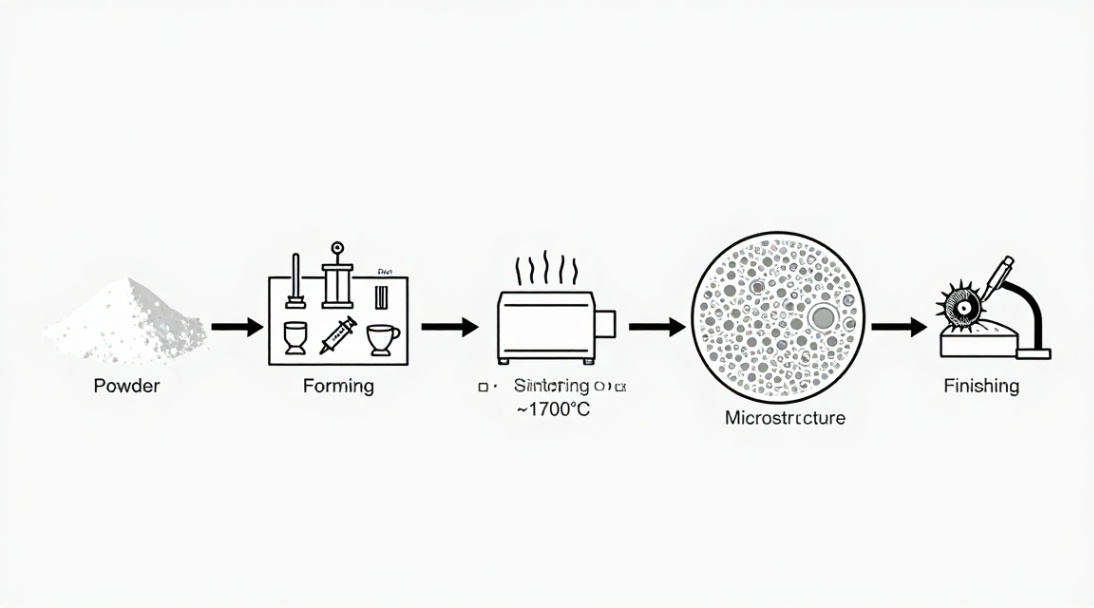
The properties of a finished alumina component are not inherent to the powder alone. They are engineered through precise processing. Methods like dry pressing, isostatic pressing, injection molding, and slip casting shape the ‘green’ part. Subsequent sintering at temperatures approaching 1700°C densifies the material, with final microstructure-grain size, porosity, phase composition-dictating mechanical and thermal performance. Advanced techniques create reaction-sintered or pressureless sintered variants with tailored densities. Finishing via diamond grinding or lapping achieves the tight tolerances and superior surface finishes required for sealing surfaces or semiconductor components.
Strategic Applications Across Sectors
Alumina’s value is proven in the field. In industrial settings, it forms wear-resistant liners, pump seals, and grinding media. The electronics industry relies on its high-purity (>96%) forms for circuit substrates, insulating housings, and vacuum chambers. In medical technology, its biocompatibility makes it the material of choice for hip joint bearings and dental implants. Its chemical inertness is leveraged in laboratory equipment and as a protective tube for thermocouples. Each application leverages a specific subset of alumina’s property profile, often defined by its purity grade.
Selecting the Correct Alumina Grade: A Data-Driven Framework
Choosing the wrong grade leads to premature failure or unnecessary cost. Use this framework.
- 85-90% Al2O3: Contains silicate glass phases. Use for general wear resistance, low-stress electrical insulation, and chemically inert surfaces. It is the most cost-effective.
- 96-99% Al2O3: The industrial workhorse. Offers superior mechanical strength, hardness, and improved corrosion resistance. Specified for high-performance seals, advanced substrates, and critical wear components.
- 99.5-99.9% Al2O3: Ultra-high purity with minimal grain boundary phases. Delivers the highest electrical resistivity, best corrosion resistance, and superior optical properties for specialized windows or demanding semiconductor applications.
The Future and Strategic Implementation
Innovation in aluminium oxide ceramic technology focuses on nanostructuring for enhanced toughness, advanced coatings for specific surface functionalities, and composite formulations with materials like silicon carbide ceramic or boron carbide ceramic to push property boundaries. For the engineer, the path forward is clear. Begin your specification with alumina as the baseline. Then, rigorously challenge that assumption against operational requirements for thermal shock, extreme wear, or thermal management. Only if alumina falls short should you move to more specialized and costly materials like silicon nitride ceramic or boron nitride ceramic. Its enduring relevance is a testament to its engineered versatility.
Suppiler
Synthetic-chemical focus on the research and development, production and sales of ceramic products, serving the electronics, ceramics, chemical and other industries. Since its establishment in 2015, the company has been committed to providing customers with the best products and services, and has become a leader in the industry through continuous technological innovation and strict quality management.
Our products includes but not limited to Aluminum Nitride, Aluminum Oxide, Boron Carbide, Boron Nitride, Ceramic Crucible, ect. If you are interested in any type of these, please feel free to contact us.