Next-Generation Ceramics: Unlocking Superior Properties for Industry

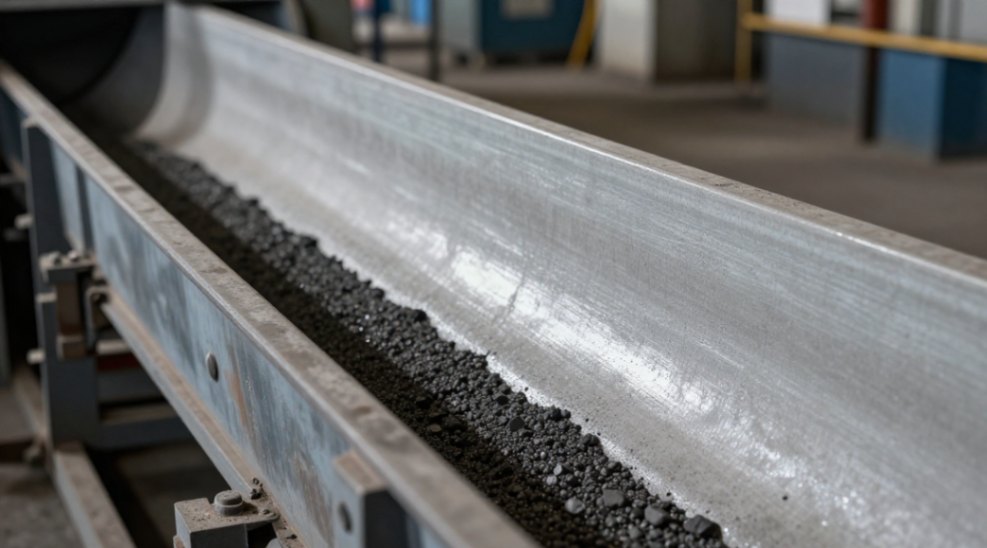
I remember the call like it was yesterday. A frantic engineer from a steel mill described a critical conveyor component failing every three weeks. The constant abrasion from iron ore was costing them thousands in downtime. We suggested a simple swap to an aluminum oxide ceramic liner. A year later, he called back-just to thank us. The liner was still going strong. That’s the quiet power of alumina. It doesn’t make headlines like graphene or exotic composites. It just works.
For over two decades, I’ve watched trends come and go. Yet, aluminum oxide ceramic remains the bedrock. Its success isn’t accidental. It’s a calculated result of specific properties that perfectly align with industrial reality. Let’s break down the data and trends behind this engineering staple.
1. The Core Identity of Aluminum Oxide Ceramic
Aluminium oxide ceramic, or alumina (Al₂O₃), isn’t your average pottery clay. It’s a technical, or advanced, ceramic. We synthesize it from refined bauxite or alumina powder through high-temperature sintering. The result? A material defined by its atomic bonds, not its shape.
Why the Composition Matters
The purity level dictates its destiny. Common grades range from 85% to 99.9% Al₂O₃. That last 0.1% of additives? They control grain growth during sintering, which directly impacts:
- Hardness: Only boron carbide and silicon carbide ceramic are harder.
- Wear Resistance: It laughs off abrasion that destroys metals.
- Thermal Stability: It maintains strength up to 1600°C, outperforming most metals and polymers.
2. The Unbeatable Property Profile: Data Over Hype
Trends favor multifunctional materials. Alumina delivers a rare combination that’s tough to replicate.
- Mechanical Muscle: Vickers hardness around 1500-1650 HV. For context, hardened steel is ~800 HV. This is why it dominates as a cutting tool insert and wear plate.
- Thermal Fortitude: A melting point of 2072°C and low thermal expansion. It’s a natural choice for refractory materials, furnace tubes, and kiln furniture.
- Electrical Insulation: Its dielectric strength is exceptional, making it the default substrate for microelectronic circuits and spark plug insulators. This is a key differentiator from conductive options like silicon carbide ceramic.
- Biocompatibility: High-purity alumina is bio-inert. The human body tolerates it well, leading to its use in hip joint bearings and dental implants.
3. Where It Reigns: Applications Defined by Demanding Environments
You’ll find alumina where failure is not an option. Its applications tell a story of extreme service.
- Abrasion & Wear: Pump seals, slurry nozzles, liners for mining equipment.
- Precision Engineering: Guide rollers for wire drawing, laser tubes, precision ball valves.
- Electronics Backbone: The white substrate in nearly every thick-film hybrid circuit. Thin-film substrates for high-power LED packages.
- Medical Reliability: Used in joint prosthetics and bone spacers for its wear resistance and biocompatibility. It’s the gold standard for ball-and-socket hip joints.
4. The Honest Comparison: Alumina vs. The Field
No material is perfect. Smart selection means knowing where alumina shines and where to look elsewhere. Here’s my blunt take:
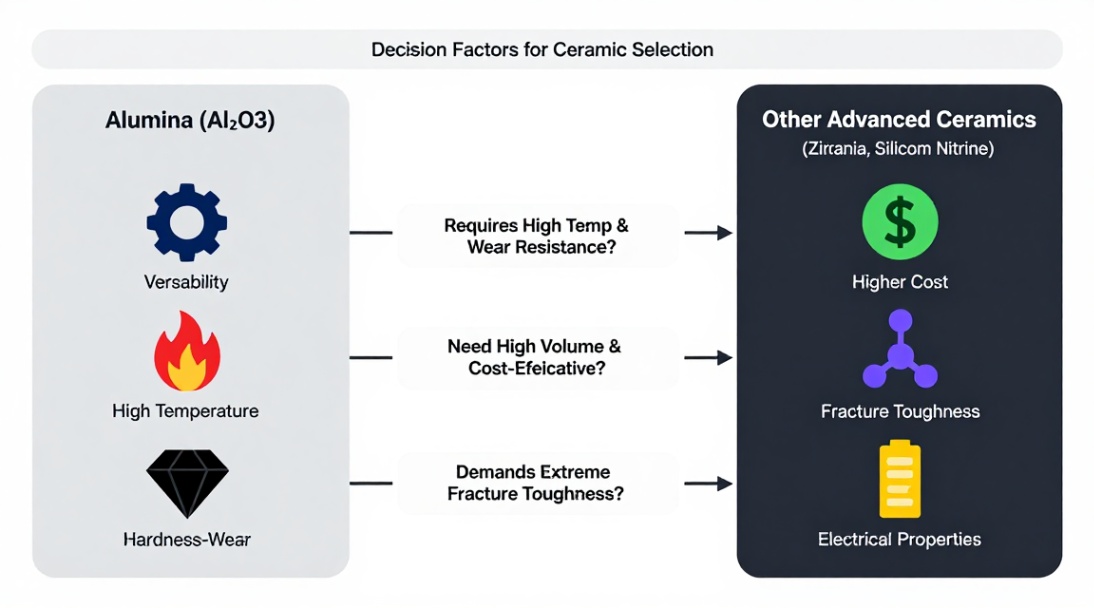
- vs. Zirconia (ZrO₂): Zirconia is tougher (higher fracture toughness) and stronger in bending. Choose it for components under high tensile stress. But for pure wear, hardness, and cost-effectiveness, alumina often wins.
- vs. Silicon Carbide (SiC) / Silicon Nitride (Si₃N₄): Both offer higher thermal conductivity and better thermal shock resistance. They’re superior for heat exchanger parts or engine components. However, they’re more expensive and conductive. Need electrical insulation? That’s alumina’s domain.
- vs. Boron Nitride (BN): BN is a softer, machinable ceramic with excellent thermal conductivity. Think of it for high-temperature insulators or release surfaces. They serve different masters.
The bottom line? Alumina is the high-value, high-performance workhorse. For specialized needs in extreme thermal management or supreme toughness, we look to silicon nitride ceramic or composites.
5. Future Trends: The Evolution of a Classic
Research isn’t about replacing alumina. It’s about enhancing it. The future lies in composites and ultra-refined microstructures.
- Alumina Matrix Composites (AMCs): We’re adding reinforcements like zirconia particles or silicon carbide whiskers. This pushes fracture toughness from ~3-4 MPa·m¹/² closer to 10 MPa·m¹/². It directly tackles alumina’s main weakness: brittleness.
- Processing Breakthroughs: Techniques like slurry infiltration for creating complex preforms are moving from aerospace labs to industrial shops. These methods allow us to build tougher, net-shape components at lower sintering temperatures.
- The Ultra-High Temperature Frontier: Pure alumina melts at ~2000°C. New high-entropy oxide ceramics are pushing limits past 3000°C for aerospace. This research validates the oxide ceramic approach for the most extreme environments, driving innovation across the board.
- Surface Engineering: Applying a special coating for boron nitride ceramic crucibles is one example. For alumina, advanced surface finishes and coatings are reducing friction and opening new applications in seals and bearings.
Making the Right Material Choice
So, when do you specify aluminum oxide ceramic? When you need a cost-effective, incredibly hard, electrically insulating, and chemically inert material for wear, high temperatures, or electrical isolation. Its manufacturing is mature, and supply chains are robust.
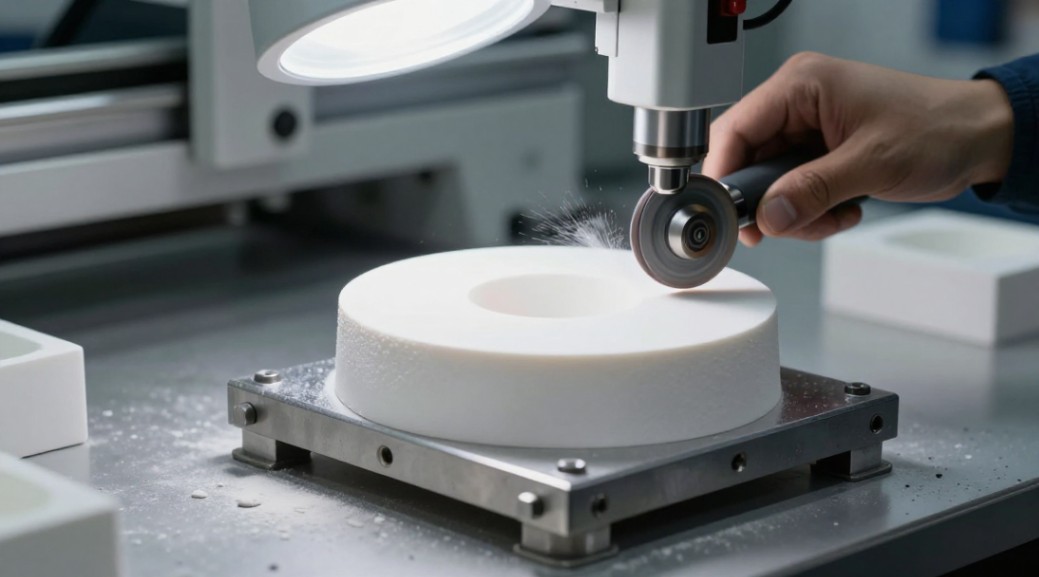
Its main challenge is machining. It’s brittle. We use diamond grinding, laser cutting, or design for net-shape sintering to overcome this. The upfront design effort pays off in legendary service life.
If your project involves relentless abrasion, a hot corrosive environment, or a critical insulating component, start your evaluation with alumina. Test a sample piece in your application. Feel its weight, test its hardness. For many engineers, it becomes the default solution-not because it’s new, but because it’s proven. That’s a trend that never goes out of style.
Suppiler
Synthetic-chemical focus on the research and development, production and sales of ceramic products, serving the electronics, ceramics, chemical and other industries. Since its establishment in 2015, the company has been committed to providing customers with the best products and services, and has become a leader in the industry through continuous technological innovation and strict quality management.
Our products includes but not limited to Aluminum Nitride, Aluminum Oxide, Boron Carbide, Boron Nitride, Ceramic Crucible, ect. If you are interested in any type of these, please feel free to contact us.