Next-Generation Ceramics: Unlocking Superior Properties for Industry

A Warning We Need to Heed
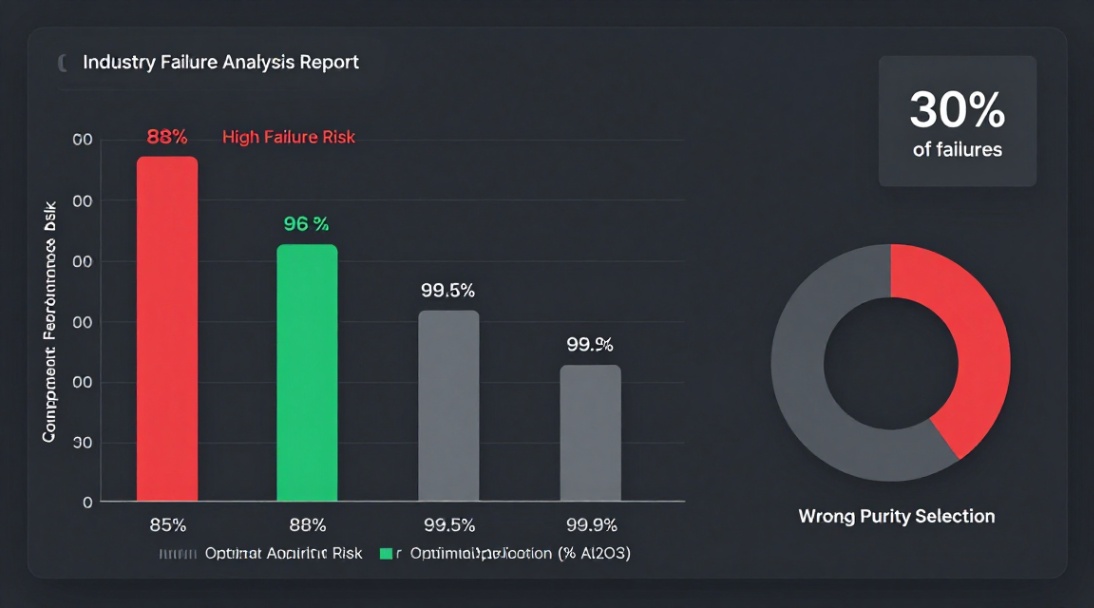
Here’s a sobering statistic from a recent industry failure analysis report: over 30% of premature alumina component failures can be traced back to selecting the wrong purity grade for the application. We see it all the time. A brilliant design is compromised because someone assumed “alumina is alumina.” That assumption is a recipe for wasted budget, delayed timelines, and, in worst-case scenarios, catastrophic equipment failure. Let’s walk through the most common traps we’ve seen engineers fall into with aluminium oxide ceramic and, more importantly, how to steer clear of them.
1. Mistake: Treating Alumina as a Single Material
This is the root of nearly every other problem. Aluminum oxide ceramic (Al2O3) isn’t one material. It’s a family, and the family members behave very differently. The key variable is purity, typically ranging from 85% to 99.9%+ Al2O3. The “other” 15% to 0.1%-often silica, magnesia, or calcia-are sintering aids that drastically change the game.
The High-Purity vs. Lower-Purity Reality Check
We often hear: “I need the best, so give me 99.8% alumina.” For a biomedical implant or a laser tube, that’s correct. Its ultra-high density, superior corrosion resistance, and excellent electrical insulation properties are critical. But for a massive wear plate in a mining chute? You’re throwing money away. A 92% or 96% alumina will provide phenomenal hardness and wear resistance at a fraction of the cost. The lower-purity grades sinter at lower temperatures, resulting in larger grain size and slightly lower mechanical strength, but for pure abrasion, they are more than sufficient.
Action: Match the purity to the primary stressor. Use this as your starting guide:
| Primary Application Driver | Recommended Al2O3 Purity | Why It Works |
|---|---|---|
| Electrical Insulation / RF Windows | > 99.5% | Minimizes dielectric loss, maximizes volume resistivity. |
| Severe Chemical Exposure | > 99.0% | Reduces glassy grain boundary phases that can leach. |
| High-Temperature Stability (>1500°C) | > 99.5% | Resists creep and maintains strength. |
| General Wear & Abrasion | 92% – 96% | Cost-effective, excellent hardness, good impact resistance. |
| Very High Mechanical Load | > 99.0% (Fine Grain) | Superior flexural strength and fracture toughness. |
2. Mistake: Overlooking the Thermal Shock Weakness
We rely on alumina for its high temperature stability. It handles sustained heat beautifully. But rapid temperature change? That’s its kryptonite. Compared to silicon carbide ceramic or even silicon nitride ceramic, alumina has a relatively high coefficient of thermal expansion and moderate thermal conductivity. This combination makes it prone to cracking under rapid thermal cycles.
I once consulted on a furnace baffle that kept cracking. The design called for alumina due to its purity and cost. The problem wasn’t the 1600°C operating temperature; it was the aggressive burner cycles that caused thermal gradients the material couldn’t handle. We switched to a recrystallized silicon carbide ceramic for that specific part. The project stayed on track.
Action: If your part will experience rapid heating or cooling rates exceeding 100°C per minute, stop. Re-evaluate. Consider silicon nitride or silicon carbide first. If you must use alumina, design to minimize thermal gradients: avoid sharp corners, use thinner sections, and consider a lower purity grade with a tailored microstructure for better thermal shock resistance.
3. Mistake: Designing for Metal, Not Ceramic
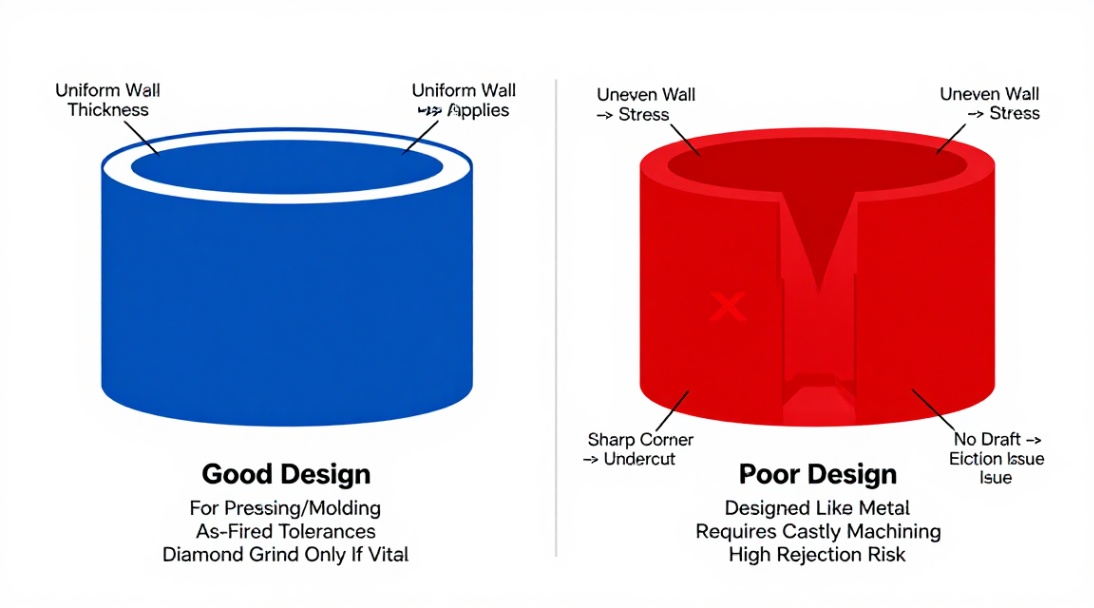
This is a design-for-manufacturability nightmare. You cannot machine alumina like stainless steel. Its extreme hardness and wear resistance mean it wears down cutting tools, not the other way around. Complex internal threads, deep blind holes with tight tolerances, or thin fins are often impossible or prohibitively expensive to produce via standard manufacturing processes for alumina components.
The rule is simple: design the part for the ceramic forming process-whether it’s dry pressing, isostatic pressing, or injection molding-from the very first sketch. Incorporate draft angles. Maintain uniform wall thickness. Avoid undercuts. Tolerances should be “as-fired” where possible; diamond grinding adds significant cost. One of our senior machinists puts it bluntly: “If you wouldn’t try to make it out of glass, don’t try to make it out of alumina.”
4. Mistake: Ignoring the “Brittle” in “Hard and Brittle”
We champion alumina’s hardness. But we must respect its fracture mechanics. It has virtually no plastic deformation. A tiny surface flaw from handling or machining becomes a stress concentrator that can lead to catastrophic crack propagation. This is where the comparison to zirconia is critical. Zirconia’s transformational toughening gives it far superior fracture toughness, making it a better choice for applications involving point impacts or tensile stresses.
Action: Never let alumina parts bear tensile or bending loads if you can avoid it. Design to put the material in compression. Use supportive metal housings. Specify a fine-grained, high-purity alumina if strength is paramount. And for goodness sake, handle finished parts with gloved hands-fingerprint acids can etch the surface and create flaws.
5. Mistake: Assuming It’s the Only Option
Alumina is a fantastic, versatile workhorse. But it’s not a magic wand. The modern world of engineering ceramics is rich with specialists. We’ve touched on a few, but let’s be direct:
- Need extreme thermal conductivity for a heat sink? Aluminium nitride ceramic is your choice, not alumina.
- Facing brutal abrasion with slurry? Look at boron carbide ceramic.
- Require a dry lubricant or a non-wetting surface for molten metal? That’s the domain of boron nitride ceramic, often with a special coating for boron nitride ceramic crucibles.
- Building a component for >1800°C in an oxidizing atmosphere? Research is pushing into new high-entropy oxide systems, but for now, you’re looking at silicon carbide-bonded silicon nitride ceramics or advanced composites.
Choosing a ceramic is an exercise in compromise. You trade toughness for hardness, thermal shock resistance for chemical inertness. The mistake is not doing the trade-off analysis.
The Path Forward: Stop Guessing, Start Testing
The biggest mistake of all is proceeding without data. We’ve spent decades in this field, and we still prototype and test. Material datasheets give you baseline properties, not application-specific performance. Will your specific chemical mixture attack the grain boundaries of a 96% alumina? How will your cyclic loading affect the fatigue life? You need to know.
This is where a partnership with a true specialist is non-negotiable. You need a partner who doesn’t just sell alumina blanks, but who understands the sintering curves, the grain growth inhibitors, the metallization processes, and the failure modes across the entire family of technical ceramics.
Our recommendation is clear and direct: Before you finalize a design, get a consult. Let’s look at your application’s primary stressors-thermal, mechanical, chemical, electrical-together. We can guide you to the right material, be it a specific grade of alumina, a toughened composite, or a completely different ceramic system like mullite or quartz ceramic. This single conversation can save you months of rework and tens of thousands in wasted capital. Don’t become part of that 30% failure statistic. Reach out for a technical review of your application today.
Suppiler
Synthetic-chemical focus on the research and development, production and sales of ceramic products, serving the electronics, ceramics, chemical and other industries. Since its establishment in 2015, the company has been committed to providing customers with the best products and services, and has become a leader in the industry through continuous technological innovation and strict quality management.
Our products includes but not limited to Aluminum Nitride, Aluminum Oxide, Boron Carbide, Boron Nitride, Ceramic Crucible, ect. If you are interested in any type of these, please feel free to contact us.