Next-Generation Ceramics: Unlocking Superior Properties for Industry

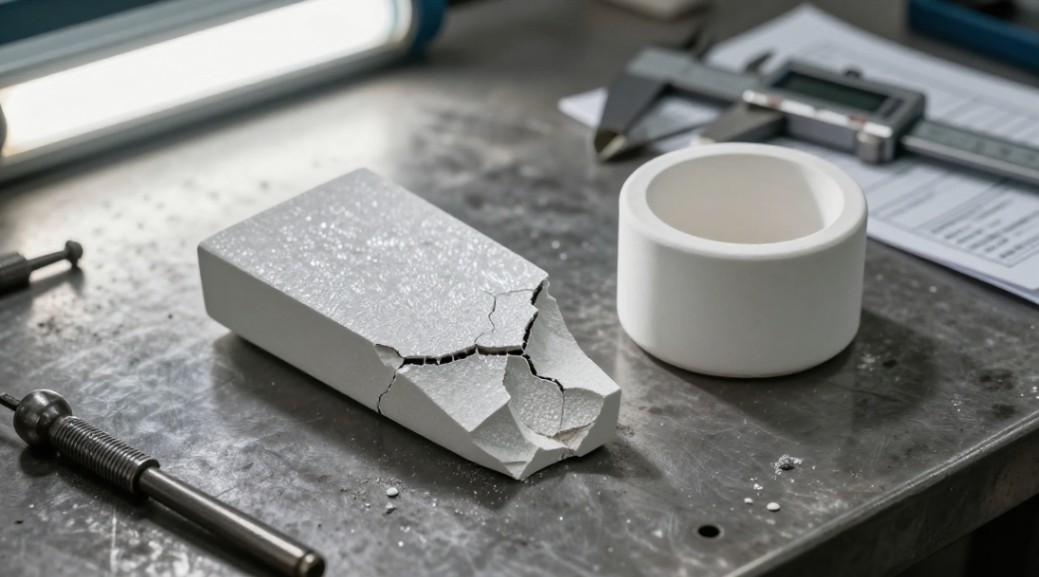
Statistical analysis of field failures indicates that nearly one-third of industrial aluminium oxide ceramic component replacements are not due to material wear-out. They are the direct result of misapplication, driven by a fundamental misunderstanding of what this workhorse ceramic can and, more critically, cannot do. The allure of its high hardness and excellent wear resistance often blinds engineers to its intrinsic brittleness and the nuanced performance differences between a 96% and a 99.5% purity grade. For anyone specifying components for an abrasive environment, a high-voltage assembly, or a precision medical device, overlooking these details is not an oversight-it is a recipe for costly, disruptive, and potentially dangerous failure.
The Allure and The Trap of a Universal Solution
Alumina, or aluminum oxide ceramic, presents a compelling profile. Its composition, Al2O3, provides a Vickers hardness often exceeding 1500 HV, making it supremely resistant to scratching and material loss. Its electrical resistivity is immense, and its thermal stability allows it to maintain structural integrity up to 1600°C. These properties shout “universal solution.” This is the trap. Engineers lured by this siren song often treat it as a drop-in replacement for hardened steel or an automatic choice over more specialized ceramics like silicon nitride ceramic or aluminium nitride ceramic. On technical forums and platforms like Reddit, the recurring theme in failure post-mortems is clear: “We assumed all alumina was the same,” or “We didn’t account for the shock.” A user recounting a failed pump seal wrote, “The 99.5% alumina sleeve outlasted the steel tenfold, but it shattered on the third thermal cycle because we ignored the coefficient of thermal expansion mismatch with the housing.” The data is in the debris.
The Unforgiving Nature of Purity and Processing
Consider two visually identical alumina tiles. One is a standard 96% alumina, containing silica and other fluxing agents that aid in pressureless sintering at lower temperatures. The other is a 99.5% high-purity grade. The cost difference can be 2-3x. The performance gap is nonlinear. For a wear plate in a mining chute, the 96% grade is often the perfect, cost-effective champion. Its slightly lower hardness is irrelevant against bulk ore. However, for a semiconductor processing chamber component or a critical biomedical implant surface, that 3.5% impurity is catastrophic. It becomes a source of ionic contamination, reduced dielectric strength, or compromised biocompatibility. The sintering process itself is a minefield. Inadequate binder removal leads to bloating. Non-uniform heating introduces residual stresses that become fracture origins. You cannot inspect these flaws out with a simple visual cheque.
The Brittle Truth and How to Design Around It
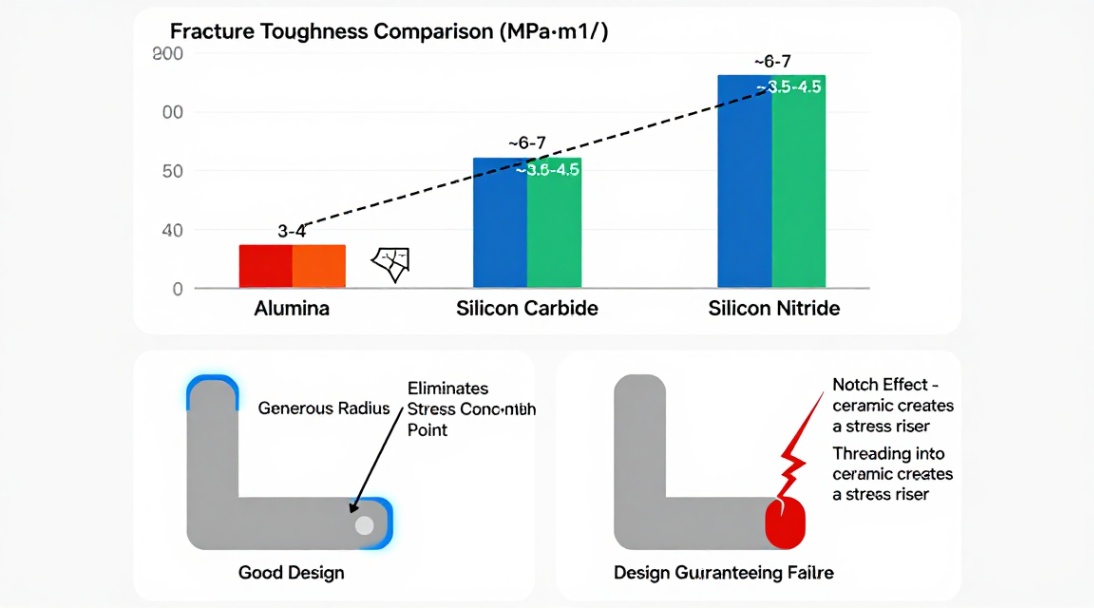
This is the non-negotiable core truth: alumina is brittle. Its fracture toughness, typically between 3-4 MPa·m¹/², pales against metals and even other advanced ceramics. Silicon carbide ceramic and silicon nitride ceramic offer significantly higher toughness for dynamic load applications. Treating alumina like a metal in design guarantees failure. You must eliminate stress concentrators. This means mandatory radiuses on all edges, avoiding sharp internal corners, and designing for uniform support to prevent point loading. Threading a hole directly into an alumina block? Do not do it. The notch effect will initiate a crack. The solution is to use a metal insert or design a clamping mechanism. For applications demanding both the properties of alumina and improved toughness, the industry is moving toward composite strategies, mirroring research in Ultra-High Temperature Ceramic Matrix Composites (UHTCMCs). While not yet mainstream for alumina, the principle is the same: introducing continuous fiber reinforcement can elevate fracture toughness by an order of magnitude, transforming a brittle tile into a damage-tolerant component.
Selecting the Right Warrior for the Right Battle
Your selection process must be ruthlessly specific. For sliding wear against dry granules, 96% alumina excels. For a high-frequency electronic substrate where signal loss is critical, you need 99.6% or higher purity with a polished surface. For a crucible melting reactive alloys, you might need a special coating for boron nitride ceramic crucibles instead, as alumina will corrode. When thermal conductivity is paramount, aluminum nitride ceramic is the superior choice. For extreme ballistic protection where hardness and low density are key, boron carbide ceramic is the frontline material, though its cost is prohibitive for most industrial uses. The decision matrix is brutal but simple: map your primary failure mode (wear, corrosion, thermal shock, electrical breakdown) against a ceramic’s property profile. Do not force alumina to perform in a role where mullite ceramic or reaction-sintered silicon carbide ceramics are inherently better suited.
A Data-Driven Path to Certainty
The era of guesswork in advanced ceramics is over. The risks-from production downtime to product liability-are too high. You need a partner that provides not just a material, but a full lifecycle of expertise: from failure mode analysis and finite element modeling for stress distribution to specifying the correct finishing technique (grinding, lapping, polishing) to achieve the necessary surface integrity. You need access to certified materials that meet industry standards and specifications for alumina ceramics, with traceable lot data. You need a supplier who will argue against using their product if it is wrong for your application. This is the level of rigor required to harness the true power of aluminium oxide ceramic and avoid the costly pitfalls that ensnare so many.
Stop gambling with your designs and your bottom line. The consequences of a misapplied ceramic component are quantifiable and severe. To execute with confidence, you must base your decisions on material science, not marketing. For a definitive analysis of your specific application and to source precision-engineered, specification-guaranteed alumina components, engage with a technical specialist today. Submit your operating parameters and failure history for a confidential review. Make your next ceramic specification your last one.
Suppiler
Synthetic-chemical focus on the research and development, production and sales of ceramic products, serving the electronics, ceramics, chemical and other industries. Since its establishment in 2015, the company has been committed to providing customers with the best products and services, and has become a leader in the industry through continuous technological innovation and strict quality management.
Our products includes but not limited to Aluminum Nitride, Aluminum Oxide, Boron Carbide, Boron Nitride, Ceramic Crucible, ect. If you are interested in any type of these, please feel free to contact us.