Next-Generation Ceramics: Unlocking Superior Properties for Industry

Introduction: A Common Material with Uncommon Performance
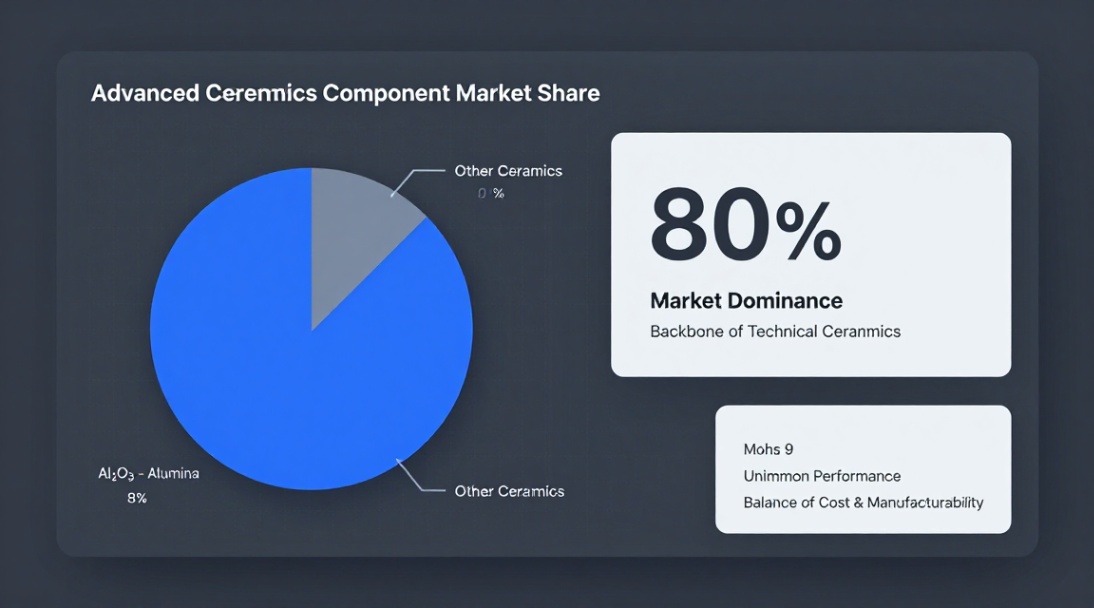
Despite ranking just ninth on the Mohs mineral hardness scale, aluminum oxide ceramic is the backbone of the modern technical ceramics industry, accounting for over 80% of all advanced ceramic components produced. This statistic underscores its unmatched balance of performance, manufacturability, and cost.
What is Aluminum Oxide Ceramic?
Aluminium oxide ceramic, commonly called alumina, is a synthetic inorganic material composed primarily of alpha-phase aluminium oxide (Al2O3) crystals. Engineers do not mine it; they manufacture it through controlled processes that transform purified alumina powder into a dense, polycrystalline solid. Its structure is fundamentally different from metals or polymers, relying on strong ionic and covalent atomic bonds for its remarkable properties.
Core Properties and Characteristics
Why is aluminium oxide ceramic so hard and wear-resistant?
The high hardness stems directly from its atomic bonding. The strong ionic-covalent bonds create a rigid, densely packed crystal lattice that resists penetration and deformation. This makes it vastly superior to metals in abrasive environments. For pure wear resistance without the need for electrical insulation, materials like silicon carbide ceramic or boron carbide ceramic may offer higher hardness, but often at greater cost and machining difficulty.
Is aluminum oxide a good electrical insulator?
Yes, it is an outstanding insulator. This is its most critical property for electronics. High-purity grades (e.g., 99.5% Al2O3) exhibit exceptionally high volume resistivity and dielectric strength, even at elevated temperatures. This allows it to function as a robust substrate for circuits, spark plugs, and insulators where metals or polymers would fail. For applications requiring even higher thermal conductivity alongside insulation, aluminum nitride ceramic is the logical alternative.
How does its thermal performance compare to other ceramics?
Aluminium oxide ceramic possesses a high melting point (~2050°C) and good thermal stability, but moderate thermal conductivity. It excels in applications requiring thermal shock resistance and high-temperature capability, such as furnace tubes or thermocouple sheaths. For extreme temperature applications above 1600°C where oxidation resistance is paramount, materials like zirconia or silicon nitride ceramic are often evaluated. Research into new oxide systems aims to push these limits even higher.
What chemicals can attack aluminum oxide ceramic?
Very few. Its chemical inertness is exceptional. It resists attack by most acids, alkalis, and molten metals. This corrosion resistance makes it ideal for pump seals in chemical processing, labware, and medical implants. In highly corrosive molten metal environments, specialized options like a special coating for boron nitride ceramic crucibles might be considered for specific metals.
Manufacturing and Form Factors
How is aluminum oxide ceramic made?
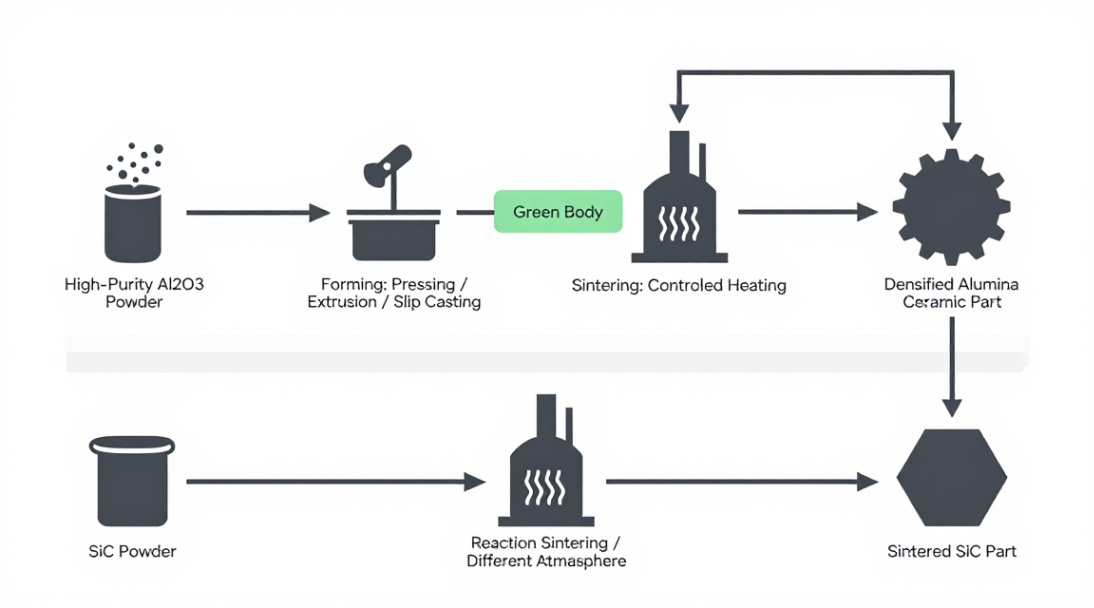
Manufacturing follows a consistent sequence: powder preparation, forming, and sintering. High-purity Al2O3 powder is mixed with binders and formed into a “green” body via pressing, extrusion, or slip casting. The critical step is sintering, where controlled heating densifies the part. For other ceramics like reaction-sintered silicon carbide ceramics or pressureless sintered silicon carbide ceramics, the sintering mechanisms and atmospheres differ significantly.
What shapes and forms are available?
It is highly versatile. Standard forms include thin substrates for electronics, tubes, rods, and plates. Manufacturers also produce complex custom components through advanced molding and machining. The ability to net-shape or near-net-shape form parts before sintering reduces costly final machining.
Can you machine aluminium oxide ceramic?
You can, but it requires specialized methods. Its hardness dictates the use of diamond-grit grinding tools. Post-sinter machining is expensive and risks micro-cracks. The design principle is to minimize machining through optimal forming. Complex geometries may require diamond grinding or laser machining, which is where partnering with an experienced fabricator becomes essential to control cost and ensure integrity.
Applications and Selection
Where is aluminum oxide ceramic most commonly used?
Its applications span critical industries. Key uses include: Electronic substrates and insulators; Wear pads, guides, and nozzles; Mechanical seals and bearings; Medical components like hip joints and dental implants; and Corrosion-resistant lab equipment and liners.
When should I choose it over silicon carbide or zirconia?
Follow this logic. Choose aluminum oxide ceramic when you need a proven, cost-effective material with excellent wear, good corrosion resistance, and superior electrical insulation. Select silicon carbide ceramic for higher thermal conductivity, greater hardness, or superior creep resistance at very high temperatures. Opt for zirconia when you need the highest fracture toughness and bending strength in a ceramic, often for mechanical components under high stress.
What are the future trends for this material?
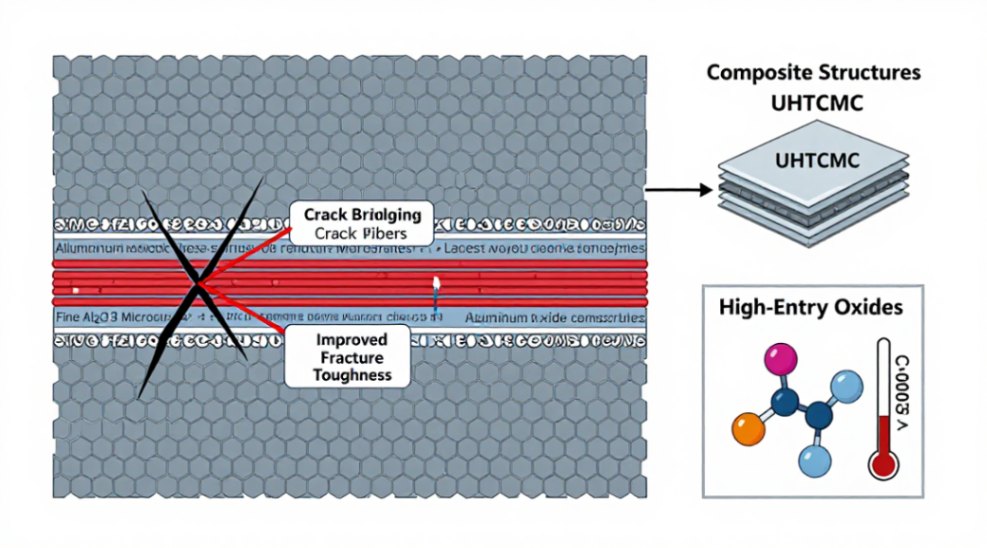
Innovation focuses on enhancing its inherent limitations. Research explores composite structures, such as incorporating fibers to improve fracture toughness, mimicking strategies used in Ultra-High Temperature Ceramic Matrix Composites (UHTCMCs). Other trends include developing finer, more uniform microstructures for higher strength and reliability, and creating new high-entropy oxide compositions to push the thermal limit of oxide ceramics beyond 3000°C.
Conclusion and Practical Next Steps
Aluminum oxide ceramic remains the default engineering ceramic for a reason. Its property matrix offers the best all-around solution for most severe-service applications. Selecting the correct grade-from 85% to 99.9% purity-is critical. The next step is to prototype. Engage with a technical ceramics supplier to fabricate a test component. Validate its performance in your specific environment for wear, temperature, and chemical exposure. This empirical test, guided by the fundamental properties outlined here, is the definitive method for successful material implementation.
Suppiler
Synthetic-chemical focus on the research and development, production and sales of ceramic products, serving the electronics, ceramics, chemical and other industries. Since its establishment in 2015, the company has been committed to providing customers with the best products and services, and has become a leader in the industry through continuous technological innovation and strict quality management.
Our products includes but not limited to Aluminum Nitride, Aluminum Oxide, Boron Carbide, Boron Nitride, Ceramic Crucible, ect. If you are interested in any type of these, please feel free to contact us.