Next-Generation Ceramics: Unlocking Superior Properties for Industry

A Surprising Contradiction in Ceramic Performance
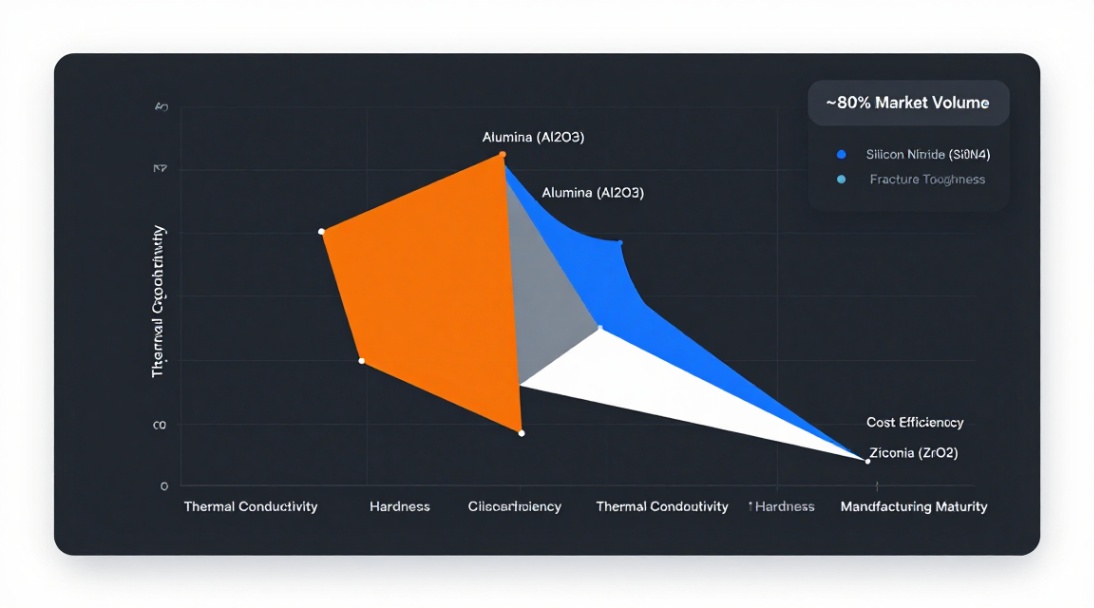
Alumina, or aluminium oxide ceramic, is the workhorse of technical ceramics, accounting for over 80% of the advanced ceramic market by volume. Despite its dominance, a 2023 Ceramic Industry Alliance report revealed a counterintuitive statistic: in applications demanding the absolute highest thermal conductivity or fracture toughness, it is often the second or third choice. Engineers select it not for peak performance in one metric, but for its unparalleled balance of properties, cost-effectiveness, and manufacturing maturity. This analysis clarifies that role through direct, objective comparison.
Defining the Baseline: What is Aluminium Oxide Ceramic?
Aluminium oxide ceramic (Al₂O₃) is a polycrystalline material produced by consolidating and sintering high-purity alumina powders. Its composition defines its core identity. Grades range from 85% to over 99.99% purity. Higher purity correlates directly with improved properties-99.5% Al₂O₃ offers superior hardness, corrosion resistance, and operating temperature (~1700°C) compared to 96% Al₂O₃. Manufacturing typically involves powder pressing, followed by sintering at temperatures exceeding 1600°C, and precise finishing like grinding or lapping.
The Technical Ceramic Comparison Matrix
Choosing the right ceramic requires comparing apples to apples. The table below presents a data-driven analysis of aluminium oxide ceramic against key competitors, based on median values from published manufacturer data sheets and peer-reviewed studies.
| Property / Application | Aluminum Oxide (96-99.5%) | Silicon Carbide (Sintered) | Silicon Nitride (Pressureless Sintered) | Zirconia (Y-TZP) | Aluminium Nitride |
|---|---|---|---|---|---|
| Density (g/cm³) | 3.7 – 3.9 | 3.1 – 3.2 | 3.2 – 3.3 | 6.0 – 6.1 | 3.3 |
| Hardness (HV1) | 1500 – 1700 | ~2600 | ~1500 | ~1200 | ~1200 |
| Fracture Toughness (MPa·m¹/²) | 3.5 – 4.5 | 3.5 – 4.0 | 6 – 8 | 8 – 12 | 2.5 – 3.5 |
| Flexural Strength (MPa) | 300 – 450 | 400 – 500 | 650 – 850 | 900 – 1200 | 300 – 350 |
| Thermal Conductivity (W/m·K) | 25 – 35 | 120 – 150 | 25 – 35 | 2 – 3 | 140 – 180 |
| Max Use Temp (°C, Oxidizing) | ~1700 | ~1650 | ~1400 | ~800 | ~1800* |
| Electrical Insulation | Excellent | Semiconductive | Good | Excellent | Excellent |
| Wear/Corrosion Resistance | Excellent | Superior | Excellent | Good | Good |
| Relative Cost Index | 1.0 (Baseline) | 2.0 – 3.0 | 3.0 – 5.0 | 1.5 – 2.5 | 4.0 – 6.0 |
| Primary Application Sweet Spots | Wear plates, seals, electronic substrates, labware, medical implants, cutting tools | Seals, bearings, abrasives, armor, high-temp kiln furniture (reaction-sintered silicon carbide) | Bearings, cutting tools, engine components, metal forming | Dental/medical implants, precision knives, wear parts requiring high toughness | Electronic substrates & packages, laser diode mounts, crucibles |
*Aluminium nitride requires a protective atmosphere above 1350°C to avoid oxidation.
Interpreting the Data: When to Choose Alumina
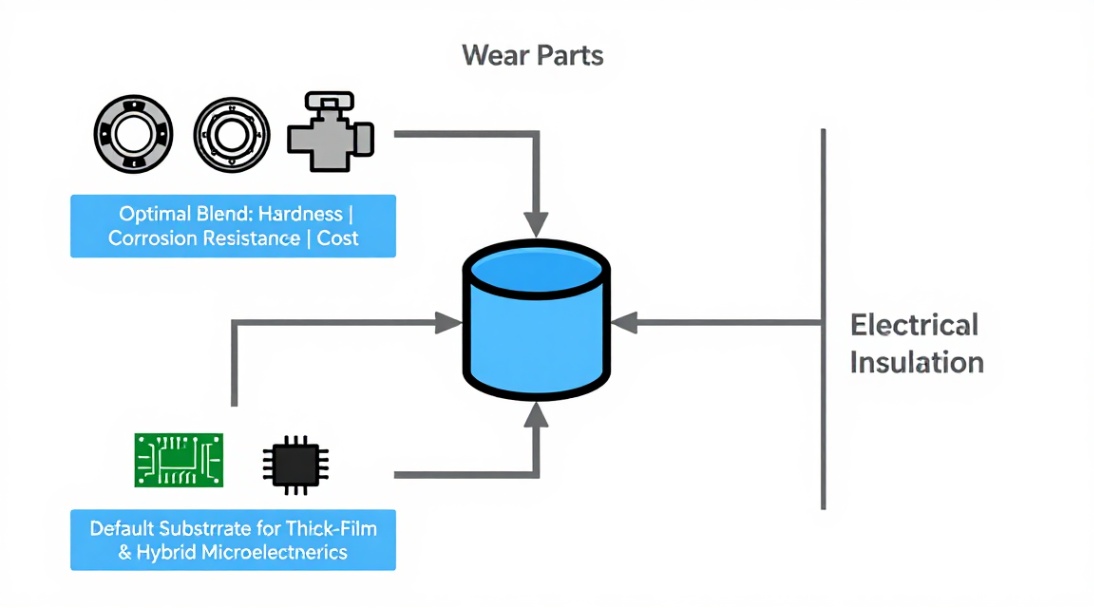
The table reveals clear decision paths. For wear parts like pump seals and bearings, aluminum oxide ceramic offers an optimal blend of hardness, corrosion resistance, and cost. Its electrical insulation makes it the default substrate for thick-film and hybrid microelectronics.
Alumina is the Best Choice When:
- Your design requires excellent electrical insulation at high temperatures.
- You need a very hard, chemically inert material for sliding wear against metals.
- Biocompatibility for medical implants is critical, and extreme fracture toughness is not.
- Total project cost is a major constraint, but metal or plastic performance is insufficient.
- You require complex geometries that leverage its mature, versatile manufacturing processes.
Look Beyond Alumina When:
- Thermal management is paramount; choose aluminium nitride ceramic for substrates or silicon carbide ceramic for fixtures.
- Impact or thermal shock resistance is the primary failure mode; silicon nitride ceramic or zirconia are superior.
- The operating environment involves non-oxidizing atmospheres at extreme temperatures (>1800°C); newer ultra-high temperature ceramics (UHTCs) or boron nitride ceramic with a special coating for boron nitride ceramic crucibles may be necessary.
- You require the ultimate in abrasion resistance; boron carbide ceramic or high-grade silicon carbide ceramic are harder.
The Future: Advanced Applications and Trends
Research continues to push boundaries. Emerging applications include fine-grained, transparent alumina for armor and lenses, and nanostructured grades for enhanced mechanical properties. Aluminum oxide ceramic remains a foundation, but its role is evolving. It serves as a matrix for composites and a base for advanced coatings. The drive for higher-temperature materials in aerospace, noted in research on oxide systems melting above 3000°C, indirectly spurs development in graded and composite alumina-based systems.
Make the Correct Material Decision
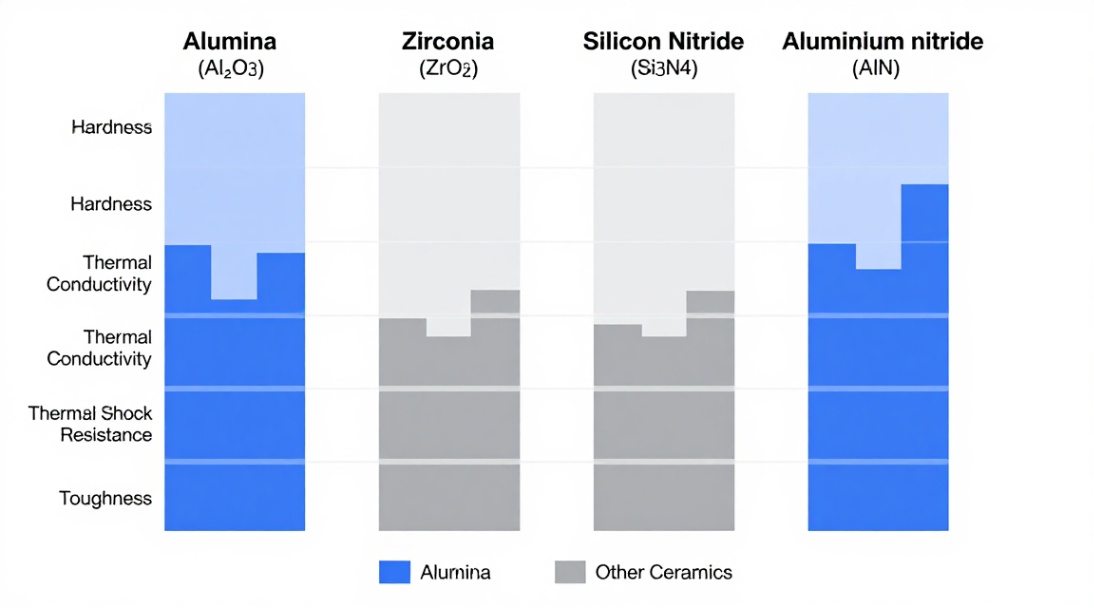
The data presents a compelling case. Aluminium oxide ceramic is not a universal solution, but it is the most widely applicable one. Its balanced portfolio of hardness, insulation, and chemical stability, paired with competitive pricing, secures its dominance. For pure thermal conductivity, specify aluminium nitride. For severe thermal shock, select silicon nitride. For extreme toughness, use zirconia. But for the vast majority of industrial wear, electronic, and biomedical applications demanding reliable performance without prohibitive cost, alumina is the unequivocal choice.
Do not compromise your design with an approximation. Consult with an application engineer who can analyze your specific stress states, environmental conditions, and cost targets. Request material samples and property data sheets for the exact grade under consideration. For prototypes or production runs requiring the consistent quality of high-grade aluminum oxide ceramic, partner with a certified manufacturer specializing in advanced technical ceramics. Submit your application parameters today for a formal material recommendation and quote.
Suppiler
Synthetic-chemical focus on the research and development, production and sales of ceramic products, serving the electronics, ceramics, chemical and other industries. Since its establishment in 2015, the company has been committed to providing customers with the best products and services, and has become a leader in the industry through continuous technological innovation and strict quality management.
Our products includes but not limited to Aluminum Nitride, Aluminum Oxide, Boron Carbide, Boron Nitride, Ceramic Crucible, ect. If you are interested in any type of these, please feel free to contact us.