Next-Generation Ceramics: Unlocking Superior Properties for Industry

Why Does Your High-Temperature Component Keep Failing? The Aluminum Oxide Ceramic Reality Cheque
Have you ever had a bearing seize after a heat cycle? Watched a seal wear out in months instead of years? Or struggled with an electrical insulator that broke down under load? We’ve been there. The frustration is real. The constant search for a material that can withstand severe environments often leads us to a familiar, yet frequently misunderstood, solution: aluminum oxide ceramic. While other options like silicon carbide or aluminum nitride get buzz, alumina remains the silent workhorse for a reason. Let’s cut through the noise.
Your Aluminium Oxide Ceramic Questions, Answered with Data
What makes aluminum oxide ceramic so special compared to metals or plastics?
It comes down to one word: extremes. Metals can be tough but often corrode or soften with heat. Plastics fail at high temperatures and wear easily. Aluminum oxide ceramic thrives where others falter. Think of it as a triad of strengths: extreme hardness, excellent electrical insulation, and solid high-temperature stability. You rarely get this combination in one package. A report from the American Ceramic Society notes that alumina accounts for over 80% of the technical ceramics market. That’s not by accident. We use it because it reliably solves the most punishing problems.
Is all aluminium oxide ceramic the same? 99.5% vs. lower purity grades.
Absolutely not. The purity grade is your first and most critical decision. A 99.5% alumina ceramic offers near-theoretical density. This means maximum hardness, best wear resistance, and highest dielectric strength. It’s your go-to for semiconductor wafer handling, high-performance pump seals, and critical medical implants. Lower purity grades (like 85% or 92% alumina) include other oxides (like silica) that act as sintering aids. They are cheaper to produce and offer good mechanical strength for less demanding applications, like textile guides or some insulator bodies. Choose wrong, and you pay for it in performance or cost.
How does the thermal performance of alumina stack up against other advanced ceramics?
This is a key trend. For pure thermal conductivity, aluminum nitride (AlN) and silicon carbide (SiC) are superior. But engineering is about trade-offs. Alumina’s thermal conductivity is moderate, but it combines that with excellent electrical insulation and lower cost. It’s the Goldilocks material. While reaction-sintered silicon carbide ceramics excel in thermal shock resistance for kiln furniture, and boron nitride is a fantastic high-temperature lubricant, alumina often provides the best balance for electrical insulators that also need to manage some heat, like spark plug bodies or furnace feedthroughs.
Why is aluminum oxide ceramic the default choice for electronics and electrical applications?
Dielectric strength and stability. A high-purity aluminum oxide ceramic substrate provides an incredibly stable, inert, and insulating platform for circuits. It doesn’t leak current. Its properties don’t drift significantly with temperature or frequency. In an era of miniaturization and higher power densities, this reliability is non-negotiable. While we see growth in specialized substrates, alumina remains the backbone for thick-film and hybrid circuits, power resistor cores, and laser tube envelopes because it just works. We trust it with our most sensitive electronics.
What are the biggest mistakes people make when designing with alumina?
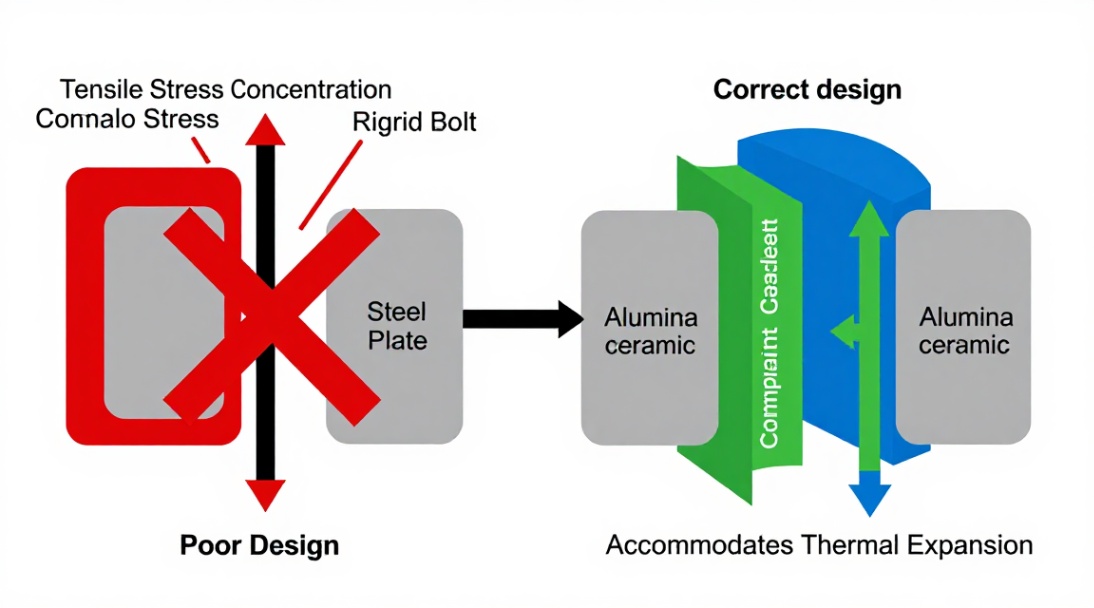
Two major ones. First, treating it like a metal. Alumina is brittle. You must avoid sharp corners and tensile stress concentrations. Design for compressive loading. Second, ignoring its thermal expansion. You can’t simply bolt it to steel and expect it to survive thermal cycling. You need compliant interfaces or careful joint design. As one senior design engineer put it, “Success with ceramics isn’t about forcing them to be something else; it’s about designing to their inherent strengths.”
What’s the future for aluminum oxide ceramic? Is it being replaced?
Replaced? No. Enhanced and specialized? Absolutely. The trend is toward advanced, tailored microstructures. Think ultra-fine grained alumina for even better wear resistance, or alumina matrix composites. We’re also seeing smarter coatings. For instance, applying a special coating for boron nitride ceramic crucibles can extend life, and similar surface engineering is being applied to alumina components in extreme chemical environments. The material is evolving, not retiring.
The Bottom Line: When to Choose Aluminum Oxide Ceramic
The data and decades of field experience point to clear winners. Choose high-purity aluminum oxide ceramic when your top priorities are: wear and abrasion resistance, electrical insulation at high temperatures, biocompatibility for implants, or chemical inertness. For pure heat dissipation, look at aluminum nitride. For the ultimate in thermal shock and strength, evaluate silicon nitride or silicon carbide ceramics like pressureless sintered silicon carbide ceramics. But for that critical balance of properties, cost, and proven reliability, alumina is often the undisputed champion.
Stop Compromising. Engineer with the Right Ceramic from the Start.
Guessing on material specifications costs you time, money, and product integrity. You don’t have to navigate the complexities of aluminum oxide ceramic, silicon carbide ceramic, or boron nitride ceramic alone. Our team of ceramic specialists has over two decades of hands-on experience specifying, sourcing, and testing these materials for real-world applications. We’ll help you select the optimal grade and design for manufacturability.
Take the next step. Request a confidential engineering consultation and a comparative materials analysis for your specific component. Let’s build something that lasts.
Suppiler
Synthetic-chemical focus on the research and development, production and sales of ceramic products, serving the electronics, ceramics, chemical and other industries. Since its establishment in 2015, the company has been committed to providing customers with the best products and services, and has become a leader in the industry through continuous technological innovation and strict quality management.
Our products includes but not limited to Aluminum Nitride, Aluminum Oxide, Boron Carbide, Boron Nitride, Ceramic Crucible, ect. If you are interested in any type of these, please feel free to contact us.