Next-Generation Ceramics: Unlocking Superior Properties for Industry

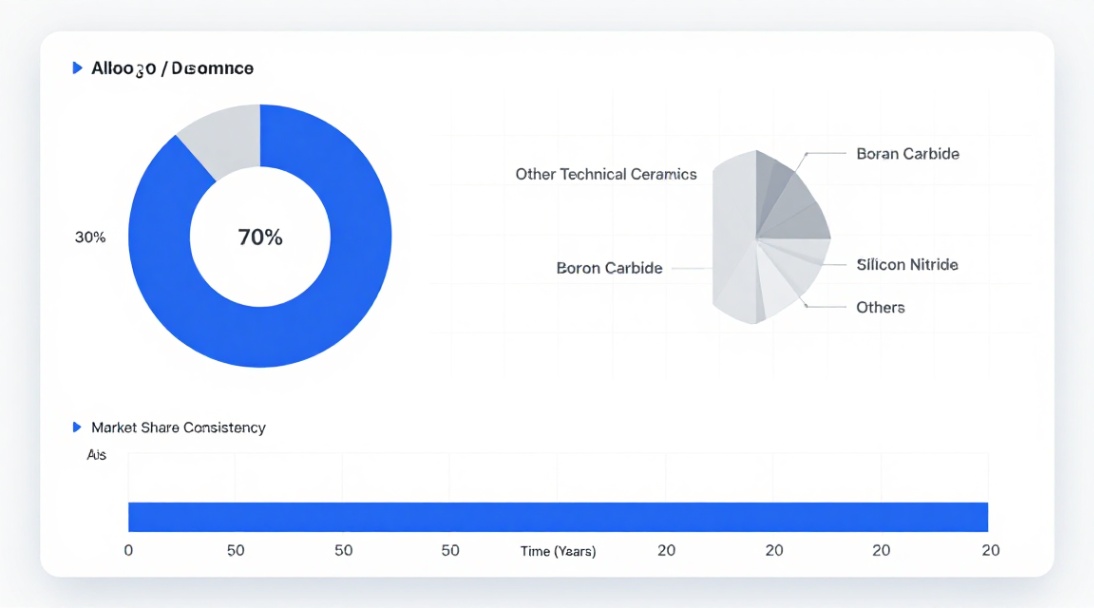
While headlines celebrate exotic materials like boron carbide ceramic and silicon nitride ceramic, a sobering fact persists: aluminum oxide ceramic commands over 70% of the global market for technical ceramics by volume. This share has remained stubbornly consistent for two decades, a testament not to marketing, but to an equation of performance, processability, and cost that remains largely unmatched. The story of alumina is not one of radical disruption, but of a foundational material whose logical dominance is etched in data and refined through decades of incremental engineering.
The Enduring Architecture of Alumina
Commonly called alumina, this material is not a new discovery. Its prevalence stems from a crystalline structure built on a simple chemical composition: Al2O3. This fundamental architecture delivers a triad of properties that define its utility. It exhibits a high hardness that places it between hardened steel and silicon carbide ceramic, coupled with a wear resistance that makes it a first-choice lining for pumps handling abrasive slurries. Perhaps its most critical characteristic is its role as a superb electrical insulation. This combination of mechanical robustness and dielectric strength is not easily replicated at scale. For substrate applications in electronics, from simple spark plugs to complex semiconductor packages, the economic argument for alumina is often insurmountable. As one senior process engineer at a leading semiconductor equipment manufacturer noted, ‘We evaluate newer materials annually, but for 95% of our electrical insulator components, alumina provides the optimal balance. Its thermal conductivity, while lower than aluminum nitride ceramic, is perfectly adequate, and its cost structure is predictable.’
Forming the Foundation: From Powder to Precision
The journey from raw oxide powder to a finished component is a masterclass in controlled consolidation. Powder is mixed with binders and formed. Isostatic pressing delivers high-density, near-net-shape blocks. Tape casting produces the thin, flat substrates critical for electronics. Slip casting creates complex hollow forms. Regardless of the green-state method, the final step is sintering-a high-temperature furnace cycle that densifies the material into its final ceramic state. This processability is a silent advantage. Unlike reaction-sintered silicon carbide ceramics or silicon carbide-bonded silicon nitride ceramics, alumina sinters in standard atmospheres with a high degree of reliability. This manufacturability translates directly into component availability and cost control.
The Competitive Landscape: A Clear Trade-Off Matrix
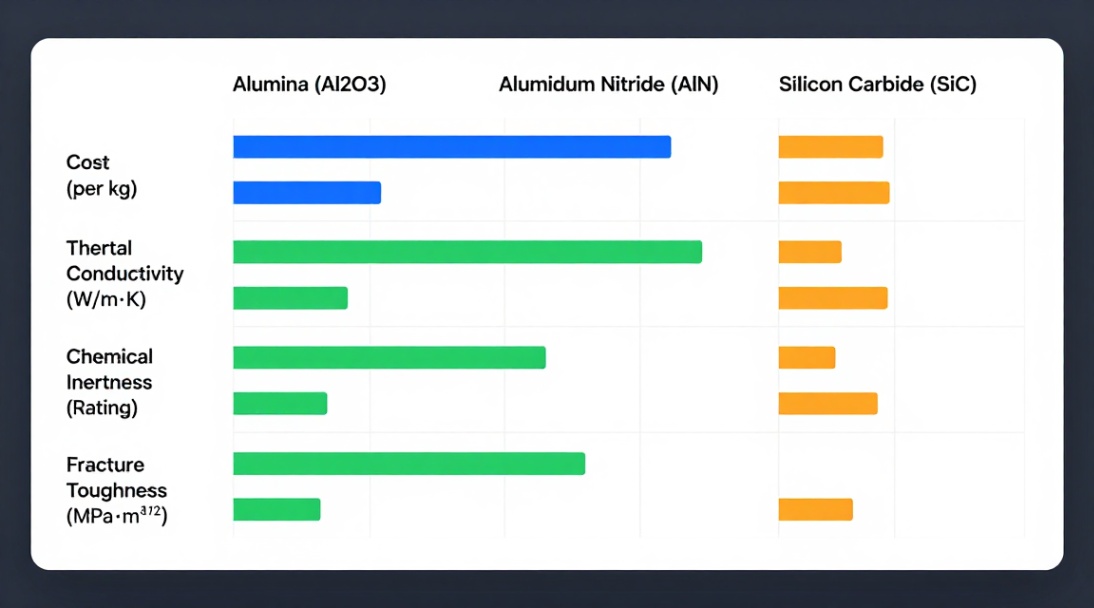
To understand alumina’s position, one must place it within the broader ceramic family. It is the baseline. Its advantages are clear: it is the most cost-effective oxide ceramic, offers excellent chemical inertness, and provides robust mechanical and electrical properties across a wide temperature range. Its disadvantages, however, dictate its boundaries. Its thermal conductivity is significantly lower than that of aluminium nitride or silicon carbide ceramic, making it a poor choice for heat sinks. Its fracture toughness is inferior to silicon nitride ceramic, limiting its use in high-impact applications. For a designer, the choice becomes a matrix. Need extreme wear and thermal shock resistance for a molten metal nozzle? Boron nitride ceramic with a special coating might be the answer. Require maximum hardness for armor? Boron carbide ceramic is superior. But for a wear plate, a laboratory crucible, an electrical insulator in a corrosive environment, or a hip implant ball, alumina’s balanced portfolio consistently wins.
The Precision of Specification: Grades Define Performance
Speaking of alumina as a single material is a gross oversimplification. Performance is dictated by purity. Standard 85-90% alumina grades contain glassy silicate phases that facilitate sintering but slightly reduce properties. They are workhorses for industrial wear parts. High-purity 99.5% and 99.9% alumina, however, are different beasts. With minimal secondary phases, they achieve higher density, superior hardness, enhanced corrosion resistance, and can operate at temperatures exceeding 1500°C. They become viable for advanced furnace tubes, semiconductor process components, and demanding biomedical applications like dental implants, where ionic leaching must be minimized. The design consideration is non-negotiable: never specify just ‘alumina’; you must define the purity grade, density, and grain size required for the service environment.
The Path Forward: Composites and Controlled Evolution
The future of alumina is not obsolescence, but augmentation. The most significant developments lie in composite structures. Alumina matrices are being reinforced with zirconia particles to dramatically improve fracture toughness, creating ceramics that rival metals in damage tolerance. Alumina fibers are being woven into preforms for high-temperature composites. Researchers are engineering nanoscale additives to tailor thermal conductivity or tribological properties for specific applications. This evolution mirrors the development of pressureless sintered silicon carbide ceramics and recrystallized silicon carbide ceramics-innovations that expanded the envelope of an established material family. The logic remains. When you require a component with reliable electrical insulation, proven chemical stability, and dependable wear resistance, the foundational data still points to aluminum oxide ceramic. The challenge for engineers is not to find a replacement, but to master its specification and understand precisely when its balanced equation solves the problem most effectively. If your current project involves abrasive, corrosive, or high-temperature electrical insulation challenges, a detailed review of modern alumina grades and their composite derivatives should be your first, not your last, step.
Suppiler
Synthetic-chemical focus on the research and development, production and sales of ceramic products, serving the electronics, ceramics, chemical and other industries. Since its establishment in 2015, the company has been committed to providing customers with the best products and services, and has become a leader in the industry through continuous technological innovation and strict quality management.
Our products includes but not limited to Aluminum Nitride, Aluminum Oxide, Boron Carbide, Boron Nitride, Ceramic Crucible, ect. If you are interested in any type of these, please feel free to contact us.