Next-Generation Ceramics: Unlocking Superior Properties for Industry

A Story of Two Valves
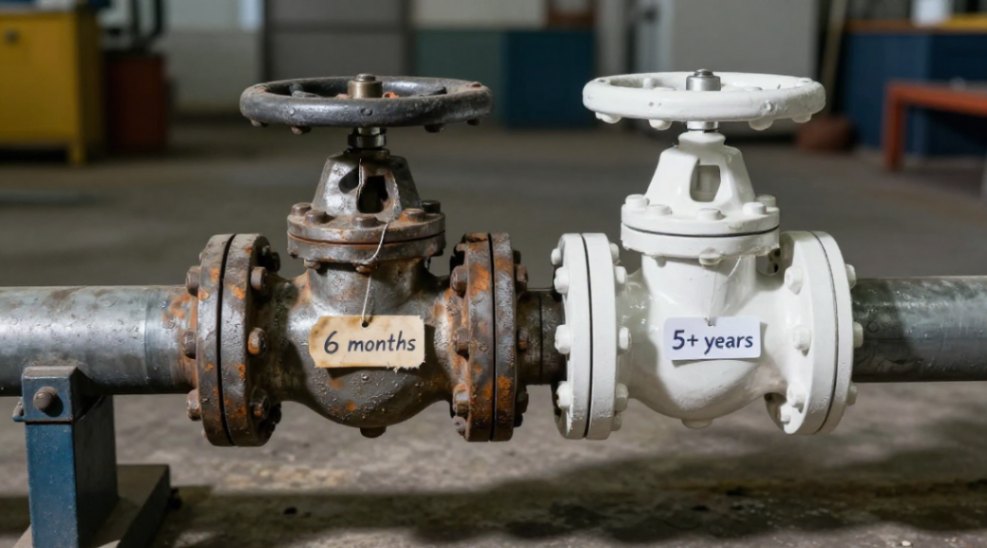
Early in my career, I saw two valves on the same production line. One was a premium metal alloy. It lasted six months before abrasive slurry ate through it, causing a costly shutdown. The other valve, which looked simpler, ran for over five years. Its secret? It was made of aluminium oxide ceramic. That was my “aha” moment. This wasn’t just another material; it was a strategic tool for solving tough problems. Let’s talk about what it is, in plain terms.
Your Aluminum Oxide Ceramic Questions, Answered
1. What is aluminum oxide ceramic, exactly?
Think of common sand. Now, refine and purify it to an extreme degree. That’s the basic idea. Aluminum oxide ceramic, or alumina, is a high-performance material made by sintering (fusing) pure Al2O3 (aluminium oxide) powder at very high temperatures. The result is a dense, crystalline structure that delivers a unique set of properties metals and plastics can’t match.
2. What are its key properties?
Alumina excels where other materials fail. Its standout traits are:
- Extreme Hardness & Wear Resistance: It’s harder than most metals, making it ideal for parts that face constant abrasion, like seals, liners, and cutting tools.
- Excellent Electrical Insulation: It doesn’t conduct electricity, even at high temperatures. This makes it the go-to choice for spark plugs, circuit boards, and insulating housings.
- High-Temperature Stability: It maintains its strength and shape in environments up to 1700°C, far beyond the limits of any metal alloy.
- Chemical Inertness: It resists attack from most acids and alkalis. This is why we use it for labware and chemical pump components.
3. How do you make aluminum oxide ceramic parts?
We start with a fine, pure powder. The process has three main stages:
- Pressing: We compress the powder into a “green” shape using a mold. Think of it like compacting snow for a snowball.
- Sintering: This is the magic step. We fire the pressed part in a kiln at temperatures often exceeding 1600°C. The powder particles fuse together, creating a dense, strong ceramic. The part shrinks, so we plan for that.
- Finishing: Sintered parts are very hard. We use diamond grinding wheels to achieve precise dimensions and a fine surface finish.
4. How does alumina compare to other engineering ceramics?
Choosing the right ceramic is critical. Here’s a quick logic check:
- Vs. Zirconia (ZrO2): Zirconia is tougher (more fracture resistant) and stronger, but more expensive. Use zirconia for parts needing high mechanical shock resistance.
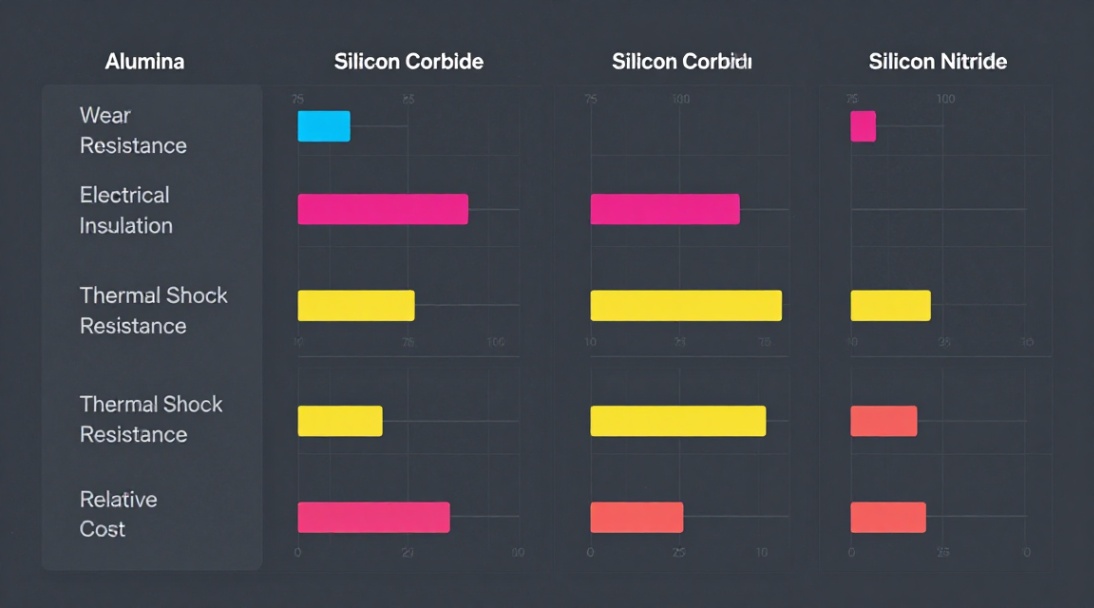
- Vs. Silicon Carbide (SiC) or Silicon Nitride (Si3N4): These materials have higher thermal conductivity and better thermal shock resistance. They’re better for high-heat-exchange applications, like burner nozzles. But alumina is a superior electrical insulator.
- Vs. Boron Carbide (B4C): Boron carbide is harder, used for extreme abrasion and armor. Alumina offers a more cost-effective balance for most industrial wear.
The decision hinges on your primary need: wear, insulation, thermal shock, or cost.
5. Where is aluminium oxide ceramic used?
You’ll find it solving problems across industries.
- Industrial Wear Parts: Pump seals, liners for pipes handling abrasive slurry, thread guides in textiles. It outlasts steel by orders of magnitude.
- Electronics & Electrical: Substrates for microchips, insulating housings for high-voltage equipment, the white insulator in a spark plug.
- Cutting Tools: Inserts for machining hardened metals and cast iron.
- Biomedical: Its biocompatibility makes it suitable for dental implants, hip joint sockets, and bone screws.
- High-Temperature & Corrosive Environments: Thermocouple tubes, furnace linings, crucibles for molten metal.
6. What does “96%” or “99.5% Al2O3” mean?
This is purity, and it dictates performance. A 96% alumina grade contains about 4% glassy silicate phase, which slightly lowers cost and aids sintering. A 99.5% or 99.8% grade is nearly pure. The higher purity means better hardness, higher operating temperature, superior electrical resistivity, and greater chemical resistance. For a sealing surface in a harsh chemical pump, we specify 99.5%. For a general wear plate, 96% may be perfectly adequate and more economical.
7. What are its main advantages over metals and polymers?
The logic is straightforward. Compared to metals, alumina is harder, more wear-resistant, doesn’t corrode, and is an insulator. It wins in abrasion and corrosion applications. Compared to polymers, it has vastly higher temperature capability, better dimensional stability, and doesn’t creep or cold-flow under load. However, it’s brittle. It has low tensile strength and poor resistance to impact. You can’t bend it.
8. How do I design with and machine alumina?
Design for its strengths, avoid its weakness. Use generous radii in corners to prevent stress concentration. Avoid sharp edges. Understand that it cannot be machined like metal after sintering. All critical dimensions and tolerances must be achieved through diamond grinding, which adds cost. This makes prototype iterations expensive, so getting the design right from the start is crucial. In our work, detailed upfront consultation with the ceramic manufacturer is non-negotiable.
9. What’s next for alumina technology?
We’re pushing the boundaries. Expect wider adoption of advanced, fine-grained grades for even better strength and surface finish. We’re also seeing more complex net-shape forming techniques to minimize costly grinding. The development of special coatings (similar to those used on boron nitride ceramic crucibles) to enhance surface properties for specific applications is a growing trend.
Putting Knowledge to Work
So, when do you consider aluminum oxide ceramic? When you face relentless wear, need insulation at high heat, or battle corrosion that eats metals alive. Its upfront cost is higher, but its longevity often makes it the most economical choice over time. The next step? Review your most troublesome component. Is it failing from abrasion, heat, or chemical attack? If so, alumina might be your solution. Start a conversation with an application engineer, armed with these fundamentals.
Suppiler
Synthetic-chemical focus on the research and development, production and sales of ceramic products, serving the electronics, ceramics, chemical and other industries. Since its establishment in 2015, the company has been committed to providing customers with the best products and services, and has become a leader in the industry through continuous technological innovation and strict quality management.
Our products includes but not limited to Aluminum Nitride, Aluminum Oxide, Boron Carbide, Boron Nitride, Ceramic Crucible, ect. If you are interested in any type of these, please feel free to contact us.