Next-Generation Ceramics: Unlocking Superior Properties for Industry

From Ore to Engine
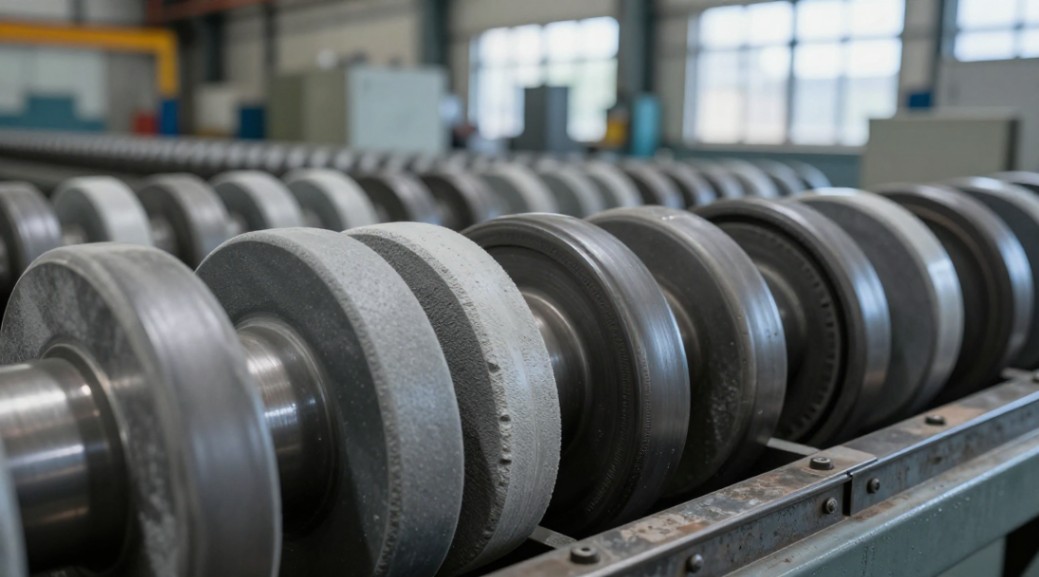
Years ago, I watched a team try to run a new production line. The feed mechanism, a set of precision rollers, kept failing. Abrasive powder wore through hardened steel guides in weeks. Replacements were expensive, downtime was crippling. The solution arrived in unassuming grey blocks: aluminum oxide ceramic liners. They looked simple, almost crude. But after a year of punishing service, they showed virtually no wear. That was my first real lesson in the quiet, relentless power of this material. It wasn’t the newest or flashiest ceramic, but it solved the problem. This is the story of alumina. It’s not about reinventing the wheel; it’s about understanding why this particular wheel keeps turning, decade after decade, in everything from your smartphone’s substrate to a hip replacement.
The Core of the Matter: More Than Just Dirt
We call it aluminum oxide ceramic, or alumina. Its chemical formula, Al₂O₃, belies a transformative journey. We start with bauxite ore, but through controlled purification and sintering, we create a crystalline structure of remarkable integrity. Think of it as taking common clay and giving it a molecular armor. This process yields a material defined by a triumphant compromise. It offers excellent hardness and wear resistance, sitting firmly between the extreme hardness of silicon carbide ceramic and the superior toughness of zirconia. It provides strong electrical insulation, a critical feature silicon nitride ceramic shares but with different thermal performance. Its chemical inertness is legendary, allowing it to handle acids and bases that would devour metals. This isn’t a material of singular, record-breaking extremes. Instead, it delivers a robust, reliable, and cost-effective portfolio of properties that match the most common engineering battles: abrasion, corrosion, heat, and electrical isolation.
Why It Works: The Engineer’s First Call
Walk any factory floor, and you’ll find it. Those white, glossy tubes protecting thermocouples in molten metal? Alumina. The wear plates in a pump pushing slurry? Alumina. The tiny, flawless substrate that carries the circuit in a power module? Alumina. Its application logic is beautifully straightforward. When you need a part to survive in a harsh environment without constant maintenance, you evaluate alumina first. It’s the default. We see this in seals and bearings where lubrication is impossible, in cutting tools for finishing tough alloys, and as liners in equipment handling abrasive materials. In electronics, its high purity levels (like 96% or 99.5% alumina) provide a stable, insulating platform for circuits. In biomedicine, its biocompatibility makes it a trusted choice for dental roots and joint replacements. The feedback loop is consistent. As one engineer on a technical forum put it, “For a wear part, I’ll prototype in alumina. It’s predictable, machinable enough, and if it survives, I know I’ve got a cost-effective solution.” It’s the workhorse you can rely on.
Facing the Reality: Trade-offs and Tougher Choices
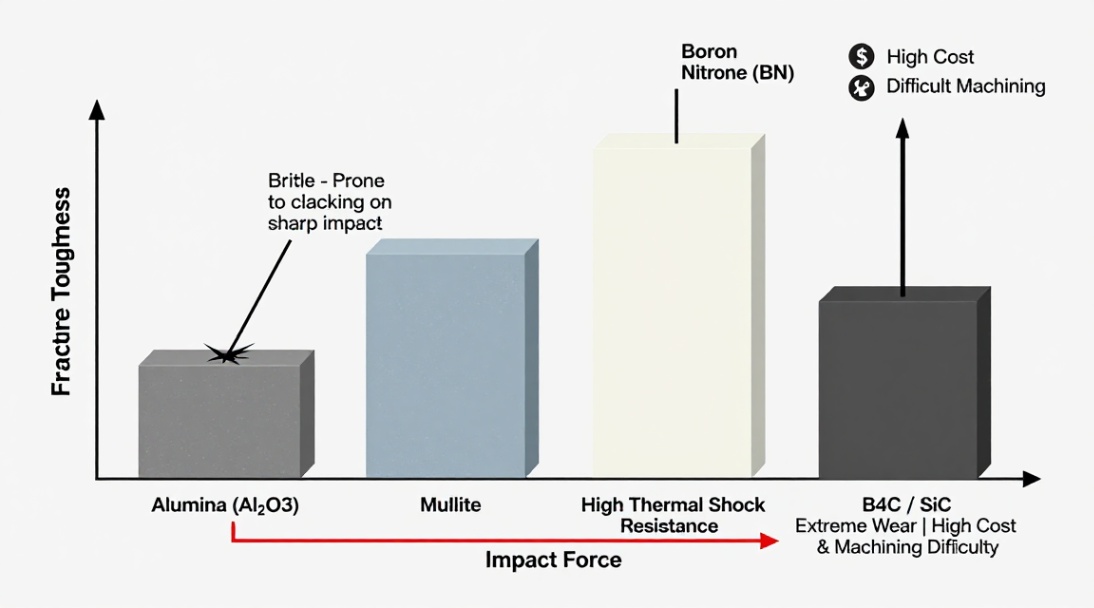
Of course, no material is perfect. We must talk about its limitations with the same clarity as its strengths. Alumina is brittle. It dislikes sharp impacts and has lower thermal shock resistance compared to boron nitride ceramic or even mullite ceramic. This brittleness also makes final machining a delicate art. You need diamond grinding tools and a careful hand to avoid micro-cracks. Furthermore, while its hardness is good, for the most extreme abrasive duties, materials like boron carbide ceramic or silicon carbide ceramic will last longer, albeit at a much higher cost and machining difficulty. This is where the real engineering begins. The choice between alumina and a more advanced ceramic like zirconia or silicon nitride ceramic often comes down to a simple question: Do I need the absolute maximum performance, or will the proven, economical alumina do the job? Nine times out of ten, the answer is the latter.
The Future Isn’t a Revolution; It’s an Evolution
So, where does an old, reliable material like alumina fit in a world of advanced composites and high-entropy ceramics? Its role is evolving, not diminishing. The frontier isn’t about replacing alumina outright; it’s about enhancing it and finding its optimal niche. Research pushes into finer, more uniform microstructures to improve strength. We see composite approaches, where alumina is combined with other phases to mitigate its brittleness. And in specialized sectors, truly novel materials are emerging. For instance, research into ultra-high-temperature ceramics for aerospace looks at complex oxides with melting points exceeding 3000 °C, a realm far beyond alumina’s capabilities. But for the vast landscape of industrial needs, alumina’s position is secure. Its manufacturing processes-from efficient dry pressing to complex injection molding-are mature and scalable. The supply chain is robust. We know its behavior inside and out. In an era obsessed with the next big thing, there’s profound value in a material that simply works, year after year. The future of alumina is one of refinement, smarter application, and continued dominance as the backbone of structural ceramics.
Making the Material Work for You
Understanding alumina is less about memorizing data sheets and more about recognizing patterns. When your challenge involves sliding wear, chemical exposure, or electrical insulation at moderate temperatures, start your evaluation here. The practical steps are clear. First, define the actual loads: abrasive, corrosive, thermal, electrical. Second, honestly assess your budget for both the part and its finishing; diamond grinding isn’t cheap. Third, talk to a specialist early. A good technical ceramic partner won’t just sell you a blank; they’ll discuss if a 96% or 99.5% grade is right, whether isostatic pressing yields a better part than dry pressing for your geometry, and how to design for its brittleness. This is where we often see projects succeed. Someone brings us a failing metal component, and we work through the material substitution together, sometimes realizing that a standard alumina formulation is the perfect, unglamorous fix. It may not be the hero of a research paper, but it’s the hero on the factory floor.
Suppiler
Synthetic-chemical focus on the research and development, production and sales of ceramic products, serving the electronics, ceramics, chemical and other industries. Since its establishment in 2015, the company has been committed to providing customers with the best products and services, and has become a leader in the industry through continuous technological innovation and strict quality management.
Our products includes but not limited to Aluminum Nitride, Aluminum Oxide, Boron Carbide, Boron Nitride, Ceramic Crucible, ect. If you are interested in any type of these, please feel free to contact us.