Next-Generation Ceramics: Unlocking Superior Properties for Industry

You’ve specified aluminum oxide ceramic for its legendary hardness, electrical insulation, or chemical resistance. Your design is perfect. Yet, the prototype arrives and cracks under load, or the machined surface is a chipped mess, or the part fails prematurely in the field. You feel that familiar pit in your stomach. Was your material choice wrong? Not necessarily. The failure often comes from subtle, overlooked mistakes in handling this deceptively simple material.
Mistake #1: Assuming “Alumina” is One Universal Material
You ask a supplier for “alumina ceramic.” You get a part. It fails. This is the most common starting point for disaster. Aluminum oxide ceramic is a family of materials, not a single product. Treating it as one guarantees problems.
- Purity is Paramount: 85%, 96%, 99.5%, 99.8% Al2O3. Each number represents a different universe of performance. Lower purity (85-96%) is excellent for wear resistance and general industrial use. High purity (99.5%+) delivers superior electrical insulation, corrosion resistance, and thermal stability for semiconductor or medical applications. Using the wrong grade is like putting regular gasoline in a jet engine.
- The Microstructure Matters: The grain size, density, and additive chemistry (like magnesium oxide for grain growth control) define toughness and strength. A coarse-grained alumina is more prone to catastrophic crack propagation than a fine-grained one. You must specify these details.
How to Avoid This:
Never just order “alumina.” Work with a specialist supplier and define your application’s core needs. Is it wear? Is it high-temperature insulation? Is it a hermetic seal? Let those needs dictate the purity, grain size, and processing method (e.g., isostatic pressing vs. slip casting).
Mistake #2: Ignoring the Brutal Reality of Brittleness in Your Design
Alumina is not metal. You cannot design it like metal. It has virtually zero ductility. It does not yield; it fractures. This is its greatest strength and its most unforgiving weakness.
- Sharp Corners are Stress Risers: A 90-degree internal corner is a crack waiting to happen. Under load, stress concentrates at that sharp point, exceeding the material’s fracture toughness instantly. This is why metal designs fail in ceramics.
- Point Loads are the Enemy: Mounting a ceramic plate with a single bolt tightened directly onto it is a recipe for immediate failure. The localized pressure creates a stress field that the brittle material cannot redistribute.
- Improper Tolerancing: Specifying metal-like press-fit tolerances on an alumina component ignores thermal expansion mismatch and the risk of tensile hoop stresses during assembly, which can cause delayed fracture.
How to Avoid This:
Design for ceramics from the ground up. Use generous fillets on all internal corners. Distribute loads over the largest possible area using compliant pads or properly designed metal interfaces. Allow for clearance fits, not interference fits, unless you have performed a detailed stress analysis. Consider the entire assembly, not just the ceramic part.
Mistake #3: Treating Machining as an Afterthought
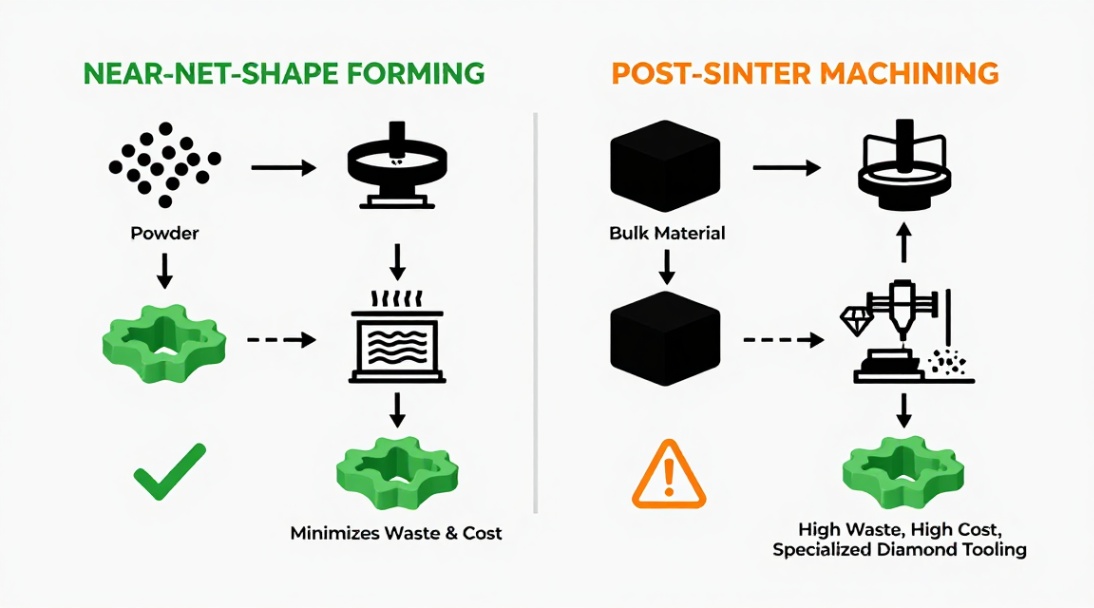
Thinking you can machine alumina like aluminum or steel will destroy your budget and your parts. This is a near-diamond-hard material. Standard tooling fails immediately.
- Wrong Tooling = Wasted Money: High-speed steel (HSS) tools are useless. Even standard carbide tools wear out in minutes. You need diamond-impregnated or polycrystalline diamond (PCD) tools for grinding, drilling, and cutting.
- Uncontrolled Processes Cause Damage: Excessive feed rates, lack of coolant, or improper fixturing introduce subsurface microcracks. These “invisible” defects dramatically reduce the part’s strength and cause unexpected failure in service, often blamed on “material quality.”
How to Avoid This:
Plan for machining from the initial design. Minimize the need for complex post-sintering machining by using near-net-shape forming processes. If machining is required, partner with a fabricator who specializes in advanced ceramics and has the diamond tooling and expertise. Factor the high cost and time of precision ceramic machining into your project plan upfront.
Mistake #4: Overlooking Thermal Shock Limitations
Alumina has excellent high-temperature capability, but a low thermal shock resistance compared to materials like silicon nitride ceramic or even mullite ceramic. Rapid temperature changes will crack it.
- Rapid Quenching Will Shatter It: Taking a red-hot alumina tube out of a furnace and placing it on a cold bench is a guaranteed failure. The surface cools and contracts faster than the interior, setting up massive internal stresses.
- Uneven Heating is a Silent Killer: In applications like a heating element substrate, if one zone heats much faster than another, the differential expansion can cause fracture. This is a critical design consideration for kiln furniture or semiconductor processing components.
How to Avoid This:
Design for gradual, uniform heating and cooling cycles. Use thermal simulations to identify hot spots. For extreme thermal cycling environments, evaluate higher-performance ceramics like silicon carbide ceramic or aluminum nitride ceramic, which offer better thermal conductivity and shock resistance, though at a higher cost.
Mistake #5: Selecting Alumina When Another Ceramic is the Better Choice
Alumina is a fantastic workhorse, but it’s not always the champion. Blindly choosing it can lead to underperformance or unnecessary cost.
- Need Extreme Fracture Toughness? For ballistics or bearing applications, silicon nitride ceramic is far superior. Its combination of hardness and toughness is unmatched in the ceramic world for these roles.
- Need Maximum Thermal Conductivity? For heat sinks or substrates where moving heat is critical, aluminum nitride ceramic or high-purity boron nitride ceramic are orders of magnitude better conductors than alumina.
- Need Extreme Chemical Purity? For crucibles in high-purity metal or crystal growth, special grades like reaction-sintered silicon carbide ceramics or ceramics with a special coating for boron nitride ceramic crucibles might be necessary to prevent contamination.
How to Avoid This:
Start with a blank slate. List your top three non-negotiable properties: Is it wear? Thermal conductivity? Dielectric strength? Corrosion resistance? Compare the property tables of alumina against zirconia, silicon nitride, and silicon carbide. The right choice will become clear. Sometimes, alumina is perfect. Other times, pushing to a more specialized ceramic is the true path to success and longevity.
Your Path Forward: From Pitfall to Performance
Success with aluminum oxide ceramic requires respect for its unique nature. It demands precise specification, intelligent design, expert machining, and careful application selection. By avoiding these five critical mistakes, you move from a cycle of frustration and failure to a position of confidence and control.
The next step is to validate your design with a true expert. Share your application requirements, operating environment, and performance goals. A qualified engineering team can help you navigate the nuances of grade selection, design for manufacturability, and prototyping to ensure your project delivers the legendary performance this material promises. Begin that conversation before you finalize your drawings. It’s the single best way to ensure your aluminum oxide ceramic component isn’t just another cautionary tale, but a resounding success.
Suppiler
Synthetic-chemical focus on the research and development, production and sales of ceramic products, serving the electronics, ceramics, chemical and other industries. Since its establishment in 2015, the company has been committed to providing customers with the best products and services, and has become a leader in the industry through continuous technological innovation and strict quality management.
Our products includes but not limited to Aluminum Nitride, Aluminum Oxide, Boron Carbide, Boron Nitride, Ceramic Crucible, ect. If you are interested in any type of these, please feel free to contact us.