Next-Generation Ceramics: Unlocking Superior Properties for Industry

Forget the hype. Aluminum oxide ceramic (Al2O3) is not a miracle material, but its brutal efficiency makes it the undisputed first choice for most industrial applications.
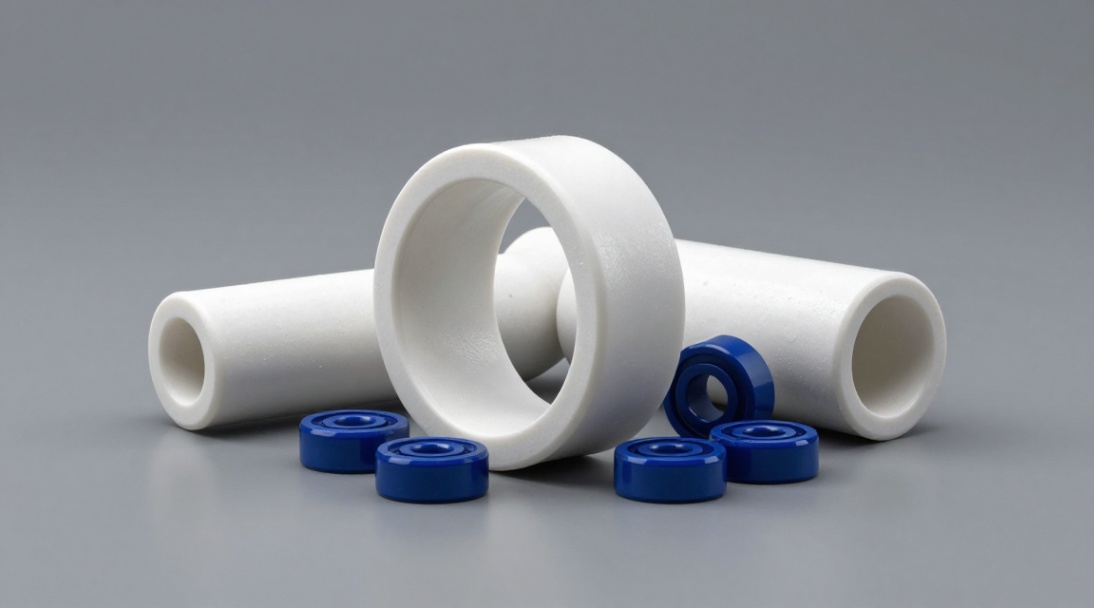
What Is Aluminum Oxide Ceramic?
Aluminum oxide ceramic is a sintered, inorganic material composed primarily of Al2O3. It’s a technical ceramic engineered from refined alumina powder. The process subjects the powder to high heat and pressure, fusing particles into a dense, polycrystalline structure. It’s the industrial workhorse for a reason.
The Core Properties: Where It Earns Its Keep
Manufacturers choose it for a brutally simple combination. It offers exceptional wear resistance and high hardness, making it ideal for components that face constant abrasion. Its electrical insulation properties are outstanding, even at high temperatures. Thermal stability is robust, though not the best in its class. Most grades resist chemical attack. The real clincher is cost-to-performance. Industry reports, like a 2022 McIlvaine analysis, consistently show alumina delivers 80% of the performance of exotic ceramics at 50% or less of the cost. The data doesn’t lie.
The Brutal Comparison: Alumina vs. the Alternatives
1. Alumina vs. Zirconia (ZrO2)
- Alumina: Superior hardness and wear resistance. Much lower cost. More stable at high temperatures (no phase changes).
- Zirconia: Significantly higher fracture toughness (less brittle). Superior flexural strength. Better thermal insulation. Can undergo transformation toughening.
Choose alumina for pure wear and cost. Use zirconia when impact resistance is non-negotiable, like in medical implants or severe mechanical stress applications.
2. Alumina vs. Silicon Nitride (Si3N4)
- Alumina: Better electrical insulator. Lower cost. Excellent abrasion resistance.
- Silicon Nitride: Vastly superior thermal shock resistance and fracture toughness. Higher strength at extreme temperatures. Lighter weight.
An industry expert once told me, ‘Using alumina for a high-thermal-shock component is like using a hammer to perform surgery.’ For engine components or severe thermal cycling, silicon nitride is the only sane choice.
3. Alumina vs. Silicon Carbide (SiC)
- Alumina: Better electrical insulator. Easier and cheaper to machine post-sintering.
- Silicon Carbide: Exceptional thermal conductivity, rivaling metals. Superior chemical inertness, especially against molten metals. Harder and stronger at very high temperatures.
In furnace fixtures or heat exchangers, silicon carbide’s thermal conductivity crushes alumina. For kiln furniture or semiconductor processing, reaction-sintered silicon carbide ceramics are the go-to.
How It’s Made: Pressing, Firing, Finishing
The dominant process is dry pressing followed by sintering. A binder-laced powder is compacted in a die under high pressure, creating a ‘green’ part. This part is then fired at 1500-1800°C, where diffusion bonds the particles. More complex shapes use isostatic pressing or slip casting. Final machining is done with diamond tools—it’s hard, unforgiving work. This is the primary manufacturing process for wear plates, insulators, and substrates.
Grades and Purity: The 96% vs. 99.5% Reality
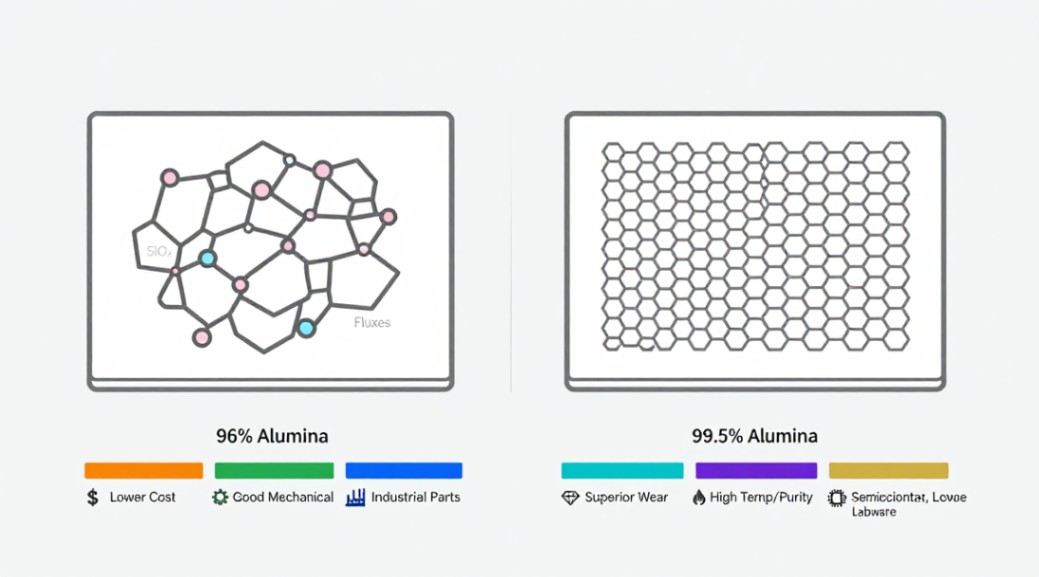
The industry runs on two main grades. 96% alumina contains silica and other fluxes, which lower the sintering temperature and cost. It has good mechanical properties and is the standard for most wear parts, liners, and industrial insulators. 99.5% alumina (and higher) is purer. It offers better wear resistance, higher temperature capability, superior electrical resistivity, and enhanced chemical purity. It’s essential for semiconductor handling, high-performance substrates, and advanced labware.
Where It Actually Gets Used
- Wear Parts: Pump seals, nozzles, liners, guides. It outlasts tool steel in abrasive slurry.
- Electrical & Electronic: Substrates for circuits, spark plugs, insulating housings. The backbone of power electronics.
- Chemical & Thermal: Crucibles, tubes, thermocouple sheaths. It handles aggressive environments most metals can’t.
- Medical: Dental implants, hip joint balls, surgical tool tips. High purity grades offer biocompatibility and sterilizability.
Designing With Alumina: Embrace the Brittleness
You must design around its fundamental weakness: low fracture toughness. Avoid sharp corners and stress concentrators. Use generous radii. Never press-fit alumina into a metal housing without a compliant layer. Design for uniform support to prevent point loading. This isn’t a suggestion; it’s a rule for preventing catastrophic failure.
The Future Isn’t Pure Alumina
The leading edge is in composites. Adding zirconia particles (Zirconia Toughened Alumina or ZTA) dramatically improves toughness while retaining cost benefits. Other formulations integrate silicon carbide whiskers or boron carbide ceramic particles for extreme wear. For niche applications like coating crucibles, a special coating for boron nitride ceramic might be specified for superior non-wetting properties.
The Final Selection Matrix: Cut Through the Noise
Use this simple logic. For the best balance of wear resistance, electrical insulation, and cost, default to alumina. When you need extreme thermal shock resistance, look at silicon nitride. For maximum toughness and strength, choose zirconia. For high thermal conductivity or molten metal resistance, select silicon carbide. Don’t overcomplicate it.
The Bottom Line and Your Next Move
Aluminum oxide ceramic is the pragmatic, high-volume champion of technical ceramics. Its reign is built on delivering proven, cost-effective reliability where it matters most. But blindly specifying it is a rookie mistake.
Your design demands precision. Stop guessing with material data sheets. You need a component engineered for your specific failure modes—abrasion, corrosion, thermal stress, or electrical load.
Act now. Forward your component drawing and operating parameters to our engineering team. We will perform a no-cost material selection and feasibility analysis, specifying the exact aluminum oxide ceramic grade or superior alternative your project requires. Click to contact our technical sales engineers today and get a definitive answer.
Suppiler
Synthetic-chemical focus on the research and development, production and sales of ceramic products, serving the electronics, ceramics, chemical and other industries. Since its establishment in 2015, the company has been committed to providing customers with the best products and services, and has become a leader in the industry through continuous technological innovation and strict quality management.
Our products includes but not limited to Aluminum Nitride, Aluminum Oxide, Boron Carbide, Boron Nitride, Ceramic Crucible, ect. If you are interested in any type of these, please feel free to contact us.