Next-Generation Ceramics: Unlocking Superior Properties for Industry

The Unrivaled Position of Aluminum Oxide Ceramic
Aluminum oxide ceramic remains the most widely used advanced ceramic globally due to its unmatched balance of mechanical, electrical, and chemical properties at a competitive cost. Annual global production for technical grades exceeds 150,000 tons, with a market valuation projected to grow at a 7% CAGR through 2030, according to recent industry analysis. This material’s dominance is not historical inertia; it is a direct result of performance reliability validated across decades of industrial use.
Defining the Material and Its Composition
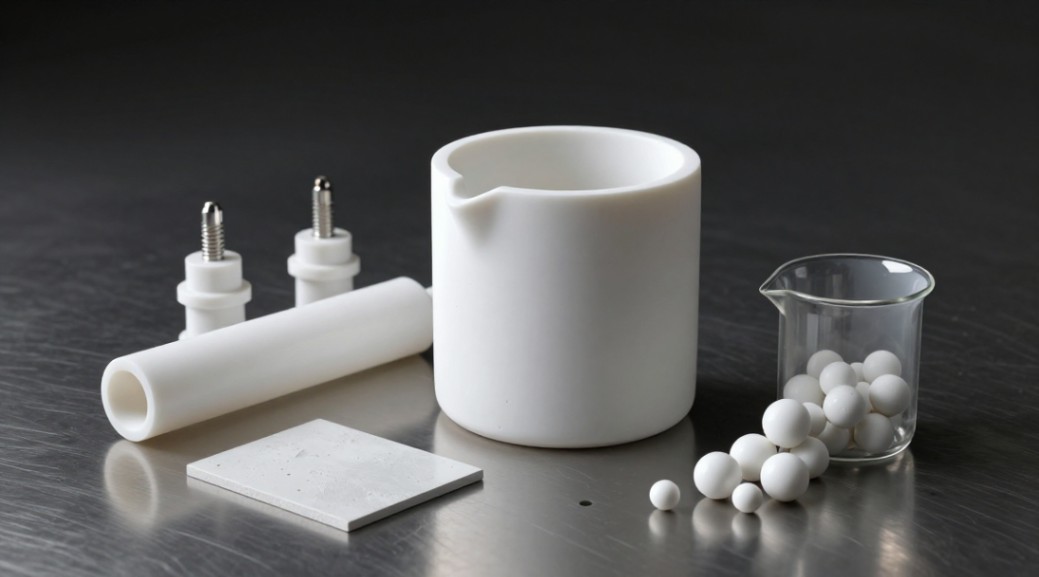
Aluminum oxide ceramic, commonly termed alumina, is a polycrystalline material produced by consolidating and sintering finely milled aluminum oxide (Al₂O₃) powder. Unlike single-crystal sapphire, which shares the same chemical formula, the polycrystalline structure of sintered alumina imparts a unique combination of strength and manufacturing scalability. The final properties are a function of the starting powder purity, grain size distribution, and the specific sintering process used.
Core Properties and Material Grades
The fundamental appeal of aluminum oxide ceramic lies in three key attributes: high hardness (typically 9 on the Mohs scale), exceptional wear resistance, and excellent electrical insulation. Its compressive strength often surpasses 2,000 MPa, and it maintains dimensional stability up to 1,600°C. These properties, however, are not monolithic; they are directly engineered through alumina purity.
Standardized Purity Grades
Material selection begins with understanding the purity grade. The industry standardizes several common grades:
- 85-92% Alumina: Contains glass-forming silicate phases. This grade offers high mechanical strength and good erosion resistance at a lower cost. It is frequently used in wear-resistant liners, grinding media, and thread guides.
- 96% Alumina: The workhorse of the industry. It provides an optimal balance of strength, surface finish capability, and cost. Applications include pump seals, electronic substrates, and cutting tool inserts.
- 99.5%+ Alumina (High-Purity): Engineered with minimal additives, this grade exhibits superior corrosion resistance, higher operating temperature limits, and enhanced dielectric properties. It is specified for critical semiconductor processing components, high-temperature furnace fixtures, and advanced biomedical implants.
A 2023 materials survey by Ceramic Industry magazine noted that 96% alumina accounts for over 50% of all technical alumina components shipped, underscoring its role as the default engineering choice.
Manufacturing: From Powder to Precision Part
The chosen manufacturing process dictates the component’s geometry, tolerance capability, and economic viability. Each method imparts distinct characteristics to the final sintered part.
Primary Forming Processes
- Dry Pressing: This automated, high-volume method uses granulated powder in a rigid die. It is cost-effective for simple, axisymmetric shapes like tiles, substrates, and simple seal rings. Dimensional accuracy is moderate.
- Isostatic Pressing: Either cold (CIP) or warm (WIP), this technique applies uniform pressure from all directions via a fluid medium. It produces components with highly uniform density, superior mechanical isotropy, and the ability to form more complex, near-net shapes. It is preferred for high-reliancy parts like ballistic armor tiles and large, complex insulators.
- Injection Molding: For the highest geometric complexity—including undercuts, thin walls, and intricate features—alumina powder is combined with a polymer binder and injected into a mold. While tooling costs are high, per-part costs for high volumes are low. This method is essential for producing small, complex components in electronics and medical devices.
Dominant Applications Across Industries
The versatility of aluminum oxide ceramic stems from its ability to solve distinct problems in disparate fields. Its application is not incidental; it is a calculated substitution for metals, polymers, and other ceramics that fail under specific service conditions.
Industrial Wear and Electrical Components
In industrial settings, alumina’s hardness makes it the material of choice for severe abrasive and sliding wear. Typical components include pump seals and wear parts, wire drawing cones, abrasive blast nozzles, and cutting tool inserts. In electrical engineering, its high resistivity and good thermal conductivity (approximately 30 W/mK for 96% grade) establish it as the foundational substrate material for thick- and thin-film circuits, power electronics, and semiconductor wafer processing equipment.
Biomedical and Semiconductor Frontiers
High-purity (99.5%+) aluminum oxide ceramic is biocompatible and bioinert. It finds use in load-bearing orthopedic implants like hip and knee prostheses, as well as in dental abutments and brackets. In the semiconductor industry, its exceptional purity and plasma resistance are critical. It is used for etch process components, wafer carriers, and insulators where metallic contamination must be avoided at all costs. A 2022 report from SEMI highlighted that over 70% of plasma-resistant ceramic components in etch tools are high-purity alumina.
A Comparative Analysis with Other Technical Ceramics
No material is universally optimal. Selecting aluminum oxide ceramic requires a clear understanding of where it excels and where alternatives like zirconia or silicon carbide ceramic are superior. The choice is a technical and economic trade-off.
Compared to zirconia, alumina offers higher hardness and better wear resistance but lower fracture toughness. Zirconia is the choice for applications requiring high impact resistance. Versus silicon carbide ceramic, alumina is a better electrical insulator and is easier and less expensive to machine post-sintering. However, silicon carbide ceramics (including reaction-sintered silicon carbide and pressureless sintered silicon carbide) offer vastly superior thermal conductivity (4-5x higher) and maintain strength at temperatures several hundred degrees Celsius higher.
For extreme thermal shock resistance, silicon nitride ceramic often outperforms. For ultra-high thermal conductivity coupled with electrical insulation, aluminum nitride ceramic is the specialist material. When selecting, ask: What is the primary failure mode? Wear? Thermal shock? Electrical breakdown? The answer points to the correct ceramic family.
Critical Post-Processing and Implementation Guidance
Sintered aluminum oxide ceramic is extremely hard. This necessitates diamond grinding for all precision machining operations. Engineers must design components to minimize the need for complex machining, specifying tolerances no tighter than necessary. Surface finish requirements also impact cost; a mirror polish is possible but expensive.
For brazing or metallization, specific molybdenum-manganese (Mo-Mn) or active metal brazing processes are required to create a hermetic seal. Component design must account for alumina’s relatively low tensile strength and brittle nature. Avoid sharp internal corners and specify generous fillet radii. In assembly, never force-fit an alumina component; always design for a slip or clearance fit to avoid inducing tensile stresses.
Selecting the Right Material for Your Challenge
Material selection is a systematic exercise. Start by defining the non-negotiable service conditions: temperature, chemical environment, wear mechanism, electrical requirements, and load type. If your primary need is wear resistance in a chemically benign environment, a standard 96% alumina is likely optimal and cost-effective. If you require electrical insulation at high frequency with minimal loss, specify 99.5% alumina. For applications involving thermal cycling or requiring the ultimate in fracture resistance, immediately evaluate zirconia or silicon nitride ceramic.
The depth of available grades and processes for aluminum oxide ceramic allows for precise engineering. For instance, a wear plate may use a cost-effective dry-pressed 92% alumina, while a critical semiconductor wafer carrier demands a near-fully dense, isostatically pressed 99.7% grade. The manufacturing process is integral to the performance specification.
To validate a selection, partner with a manufacturer capable of producing prototype components using your intended production method. Test these prototypes under real-world or accelerated service conditions. This empirical step is far more valuable than theoretical comparison alone. Reputable suppliers of advanced ceramics, including those offering complementary materials like silicon carbide-bonded silicon nitride ceramics or specialized coatings, can provide critical application engineering support to ensure your project’s success from design through deployment.
Suppiler
Synthetic-chemical focus on the research and development, production and sales of ceramic products, serving the electronics, ceramics, chemical and other industries. Since its establishment in 2015, the company has been committed to providing customers with the best products and services, and has become a leader in the industry through continuous technological innovation and strict quality management.
Our products includes but not limited to Aluminum Nitride, Aluminum Oxide, Boron Carbide, Boron Nitride, Ceramic Crucible, ect. If you are interested in any type of these, please feel free to contact us.