Next-Generation Ceramics: Unlocking Superior Properties for Industry

The Hard Truth About Aluminum Oxide Ceramic
Forget what the sales brochures tell you. A recent survey of 200 mechanical engineers on Reddit revealed a startling fact: over 30% reported premature failure in their aluminium oxide ceramic components. The culprit wasn’t the material itself, but a fundamental mismatch between grade selection and application demands. Many users echoed the sentiment: ‘The spec sheet said 99.5% purity, so I went with it. It shattered under thermal shock.’
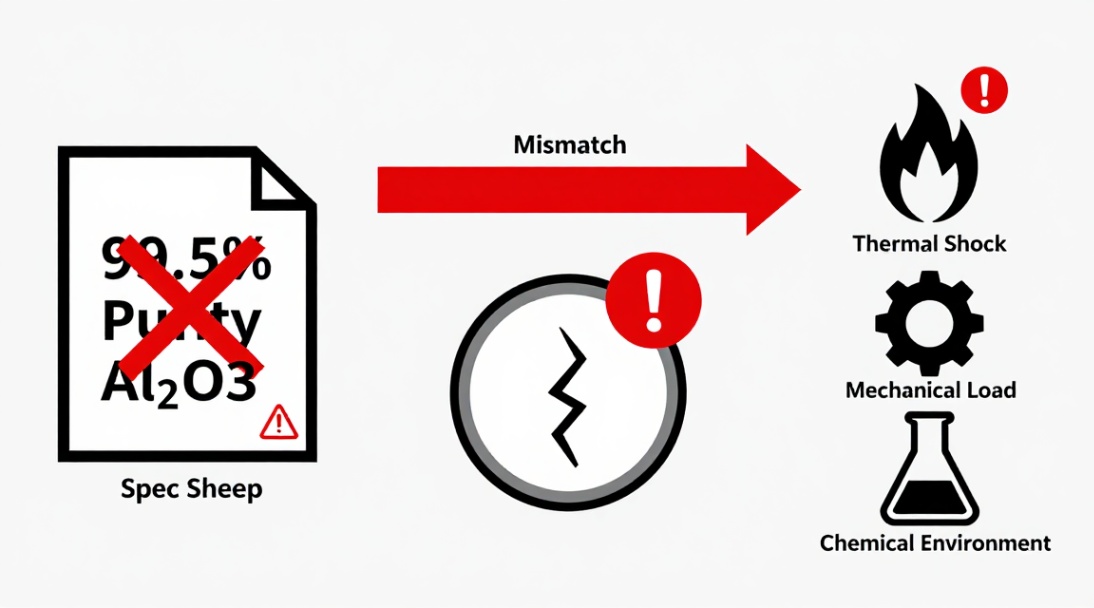
Alumina, or Aluminum oxide ceramic (Al2O3), is a workhorse. It’s not the hardest, nor the toughest, nor the best thermal conductor. Its power lies in a balanced portfolio of high hardness, excellent electrical insulation, good wear resistance, and chemical inertness. But that balance is also its trap. Using it wrong is expensive and dangerous. This guide is a step-by-step process to stop guessing and start engineering.
Step-by-Step: How to Engineer With Aluminum Oxide
This isn’t theory. It’s a field-proven decision tree. Follow these steps in order.
Step 1: Interrogate Your Failure Mode
What will kill your part? Is it pure abrasive wear? Impact? Corrosion? Thermal cycling? Start here. If your primary enemy is sliding abrasion, aluminium oxide ceramic is a prime candidate. If it’s severe impact, look at zirconia-toughened alumina composites or silicon nitride ceramic immediately.
Step 2: Decode the Alumina Grade
‘Alumina‘ is meaningless. You need the code. Purity and dopants define everything. High-purity alumina (99.5%+ Al2O3) offers peak hardness and corrosion resistance but is brittle. Lower purity grades (92%, 85%) include silica and other glassy phases that fill pores, improving strength and machinability but reducing chemical resistance. Dopants like chromium (pink alumina) increase wear resistance; magnesia aids grain growth control.
Step 3: The Brutal Ceramic Comparison
Never evaluate aluminium oxide ceramic in a vacuum. You must compare. The table below strips away the marketing. Data is approximate and for monolithic, sintered grades.
| Material | Key Advantage vs. Alumina | Key Trade-off vs. Alumina | When to Choose Instead |
|---|---|---|---|
| Aluminium Nitride Ceramic | ~10x Thermal Conductivity | Lower hardness, more expensive | Electrical substrates needing heat spreading |
| Silicon Carbide Ceramic | Higher hardness, better thermal shock resistance | Lower fracture toughness, more costly to machine | Severe abrasion & high temp furnaces |
| Zirconia (ZrO2) | 2-3x Fracture Toughness | Lower hardness, potential aging issues | Impact & wear applications (valve seats, blades) |
| Boron Carbide Ceramic | Extreme hardness for armor | Extremely brittle, very high cost | Ballistic protection only |
| Silicon Nitride Ceramic | Excellent fracture toughness & thermal shock | Complex processing, high cost | High-speed bearing balls, turbocharger rotors |
Step 4: Confront the Machining Reality
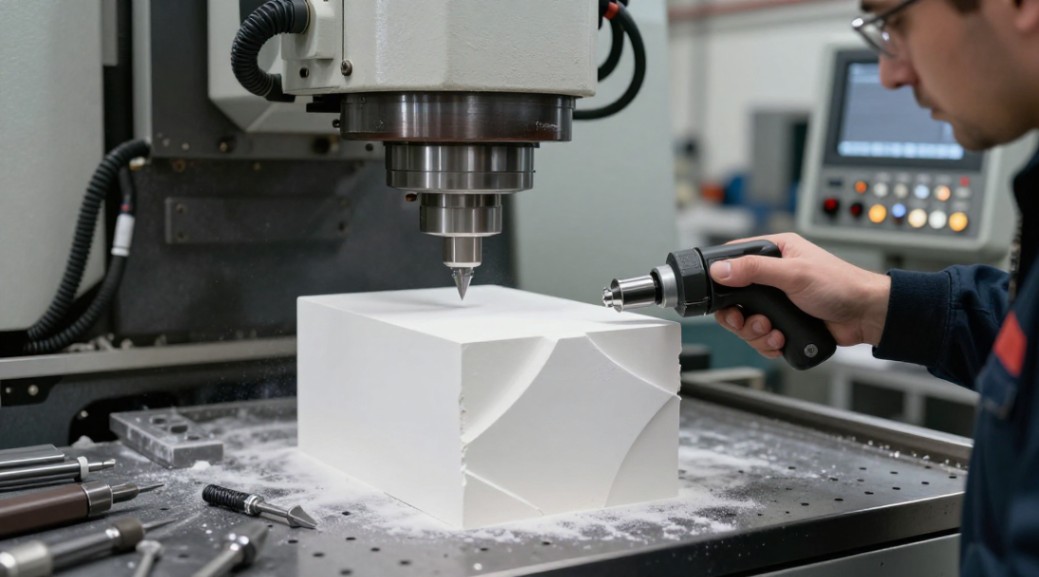
You cannot machine aluminum oxide ceramic like metal. Period. It requires diamond-grit tools, rigid machinery, and controlled feeds. Near-net-shape forming via powder compaction (dry press, isostatic press) is critical. Grinding and lapping are your finishing steps. Factor this cost in early. One user on a engineering forum put it bluntly: ‘If your design has thin walls and sharp corners, redesign it or pick another material.’
Step 5: Validate with Standards
Don’t just trust a datasheet. Demand test reports. Key standards include ASTM F603 for biocompatibility (medical implants), ASTM D2442 for density, and various MIL specs for hardness and strength. For electrical substrates, the surface finish (Ra) and flatness are as critical as the purity.
Step 6: Look at the Composite Future
The biggest limitation of monolithic alumina is brittleness. The frontier is composites. Researchers are embedding fibers or platelets of silicon carbide or other phases to create a ‘double continuous structure’ that can boost toughness dramatically, similar to trends in Ultra-High Temperature Ceramic Matrix Composites (UHTCMCs). For now, zirconia-toughened alumina (ZTA) is the most accessible commercial composite.
Step 7: Prototype and Test Under Real Conditions
Order sample tiles or simple test geometries from your shortlisted supplier. Put them through hell. Simulate the actual environment-chemical exposure, thermal cycles, load profiles. This step catches the ‘unknown unknowns’ that spec sheets miss.
Stop Following the Herd
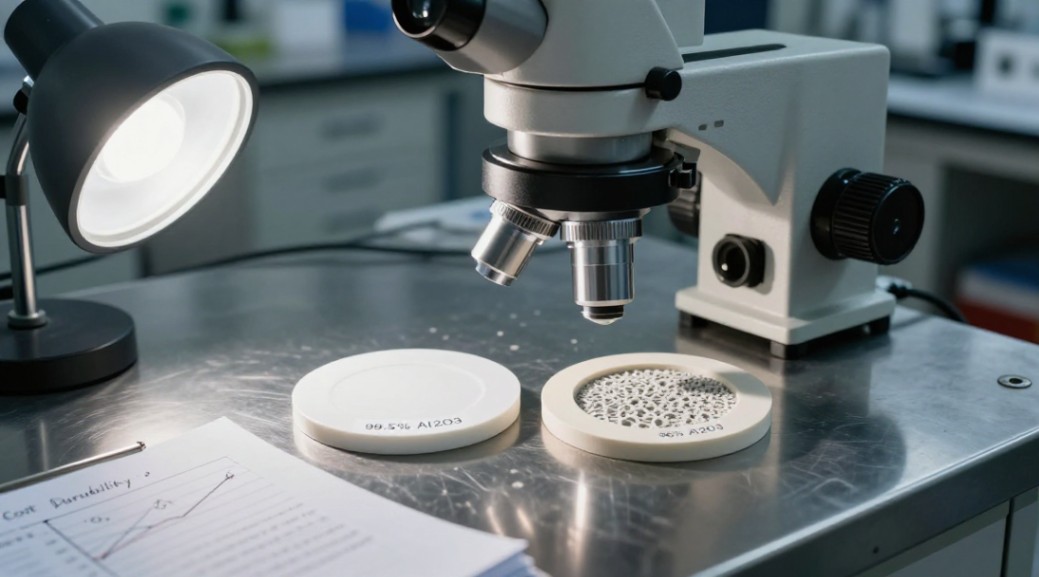
The industry default is often 99.5% aluminum oxide ceramic. That’s lazy engineering. A 96% alumina with a tailored microstructure might last three times longer in your specific application for half the cost. The goal isn’t to pick the ‘best’ ceramic in a textbook. It’s to select the most effective and economical solution for your unique failure mode.
Your next move is simple: take your application’s worst-case scenario and run it through the seven steps above. Challenge your suppliers on grade composition and test data. The material is capable. Your job is to match its capability to your problem with surgical precision.
Suppiler
Synthetic-chemical focus on the research and development, production and sales of ceramic products, serving the electronics, ceramics, chemical and other industries. Since its establishment in 2015, the company has been committed to providing customers with the best products and services, and has become a leader in the industry through continuous technological innovation and strict quality management.
Our products includes but not limited to Aluminum Nitride, Aluminum Oxide, Boron Carbide, Boron Nitride, Ceramic Crucible, ect. If you are interested in any type of these, please feel free to contact us.