Next-Generation Ceramics: Unlocking Superior Properties for Industry

I remember the first time a client insisted on using alumina, or aluminum oxide ceramic, for a high-speed pump seal. They wanted durability. They got a catastrophic failure. The part didn’t wear out; it shattered. That moment cost them six figures in downtime. It also taught me a brutal truth the glossy brochures never mention: Alumina isn’t a universal solution. It’s a compromise. For two decades, I’ve watched engineers default to this material, seduced by its reputation as a reliable workhorse. Let’s dismantle that myth. Your project deserves better than a default choice.
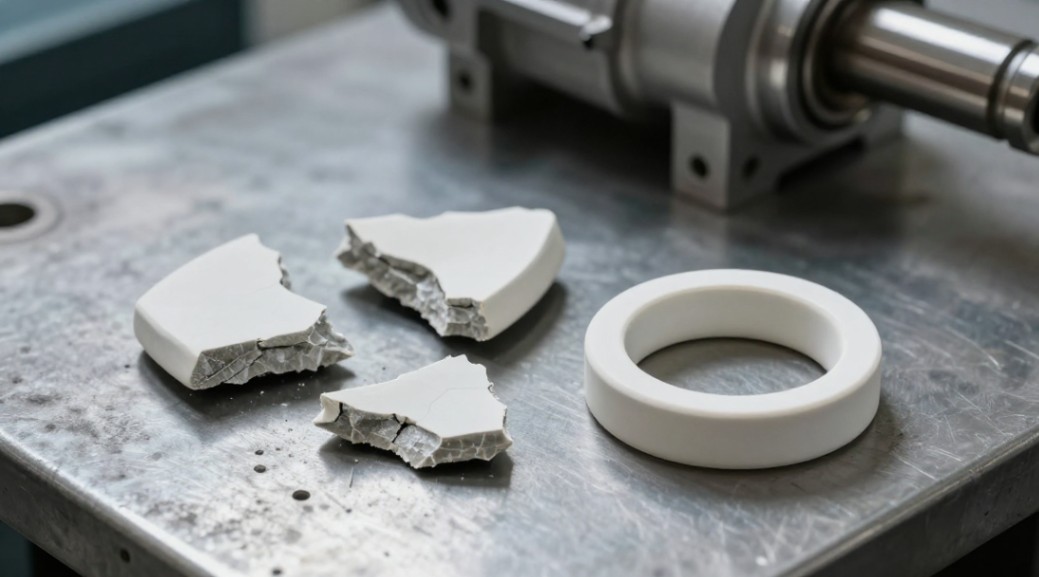
The Brutal Reality of the Baseline
Aluminium oxide ceramic, primarily Al₂O₃, is the baseline. Think of it as the cast iron of advanced ceramics. Its fame rests on three pillars: high hardness, excellent electrical insulation, and decent chemical inertness. It’s cheap to produce in volume through standard pressing and sintering methods. You’ll find it everywhere-wear plates grinding away in a conveyor, insulating sleeves in a furnace, the white substrate blinking inside your electronics. For applications demanding rigidity and insulation over pure toughness, it’s a logical pick. But logic demands comparison. When you start stacking alumina against its modern peers, the cracks in its armor become glaringly obvious.
When the Workhorse Stumbles: The Competition Speaks
Let’s talk about fracture toughness, the material’s resistance to crack propagation. This is where alumina shows its age. Compare it to zirconia ceramic. Zirconia isn’t just harder; it’s radically tougher due to a crystalline transformation at the crack tip that literally squeezes the crack shut. Where an alumina blade or bearing will chip catastrophically from a microscopic flaw, zirconia will deform and survive. The trade-off? Cost and long-term stability under stress. Now consider thermal management. Alumina’s thermal conductivity is modest. For a substrate dissipating heat from a high-power chip, it’s often inadequate. Here, aluminum nitride ceramic dominates, offering conductivity an order of magnitude higher while maintaining stellar insulation. Need to survive a hellish 1600°C oxidizing atmosphere? Mullite ceramic or silicon carbide ceramic will outlast alumina, which begins to soften and creep. Alumina sits in an awkward middle ground-never the best, often just good enough.
The Devil in the Details: Purity, Finish, and Hidden Costs
The industry sells you percentages. 96% alumina. 99.5% alumina. 99.8%. This purity directly governs properties. Higher purity means higher hardness, better wear resistance, and improved dielectric strength. But it also means a more brittle, unforgiving material and a skyrocketing price. That 96% grade is your economic workhorse for generic wear parts. The 99.5%+ grades enter the realm of semiconductor wafer carriers and precision medical implants, where ionic contamination can ruin a billion-dollar process or a human body. Now, consider finishing. Achieving a mirror surface finish on alumina is a grinding, expensive nightmare compared to machining metals. Its extreme hardness, a selling point, becomes your production department’s enemy. And forget about welding it. Joining alumina requires brazing with specialized active alloys or diffusion bonding-complex, delicate processes that add cost and risk. A silicon nitride ceramic component might have a higher raw material cost, but its superior toughness could allow a simpler, more robust design that eliminates three brazed alumina sub-assemblies. The true cost is never just on the purchase order.
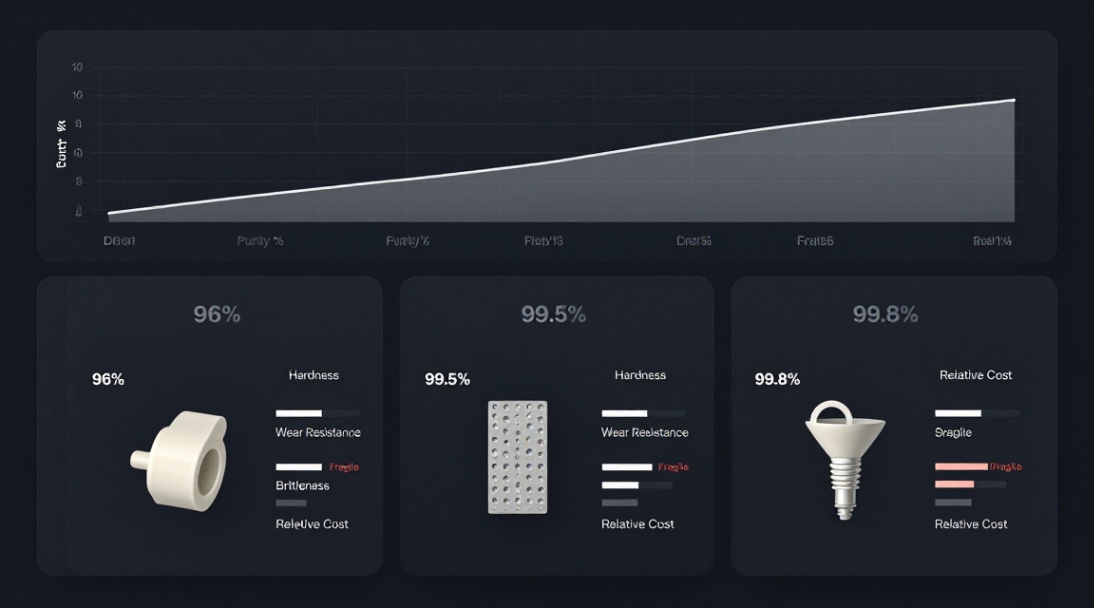
The Unflinching Selection Guide: A Material for a Moment
So when do you actually specify aluminum oxide ceramic? The decision tree is simple if you’re honest about your constraints. Choose it when your primary threat is abrasive wear in a chemically mild, room-temperature environment. Choose it when you need an electrically insulating component that won’t see severe thermal shock or high impact. Choose it for budget-conscious projects where extreme mechanical performance is secondary to consistent, predictable behavior. In short, pick alumina for its stability, not its strength. For everything else, look elsewhere. For armor? Boron carbide ceramic is lighter and vastly harder. For a high-temperature bearing? Silicon nitride ceramic is the undisputed king. For a crucible melting reactive alloys? A special coating for boron nitride ceramic crucibles will provide the non-wetting surface alumina cannot. Stop trying to make alumina something it’s not.
The Hard Truth and Your Next Move
The future of aluminium oxide ceramic technology isn’t about reinventing the core material. It’s about intelligent hybridization and accepting its role. We’ll see more alumina composites, fibers reinforcing its brittle matrix. We’ll see smarter grading, where 99.8% purity is reserved only for the critical edge of a part, not the entire bulky mass. The innovation is in application engineering, not material science. You have a choice. You can continue specifying the same old alumina formula from the same old suppliers, hoping this time it won’t fail. Or you can demand a forensic analysis of your actual operating environment. Let the failure modes-impact, heat, corrosion, wear-dictate the material, not tradition. Your project’s reliability depends on this decision. Don’t guess. Test. Procure samples of the contenders-alumina, zirconia, silicon nitride-and put them through hell in your own lab. The right material will announce itself. The wrong one will fail, loudly and expensively. Start that conversation with a specialist who isn’t trying to sell you yesterday’s workhorse. Your breakthrough awaits.
Suppiler
Synthetic-chemical focus on the research and development, production and sales of ceramic products, serving the electronics, ceramics, chemical and other industries. Since its establishment in 2015, the company has been committed to providing customers with the best products and services, and has become a leader in the industry through continuous technological innovation and strict quality management.
Our products includes but not limited to Aluminum Nitride, Aluminum Oxide, Boron Carbide, Boron Nitride, Ceramic Crucible, ect. If you are interested in any type of these, please feel free to contact us.