Next-Generation Ceramics: Unlocking Superior Properties for Industry

Beyond the Buzzword: A Hard Look at Alumina
Here’s a fact that will unsettle your procurement team: over 70% of aluminum oxide ceramic component failures aren’t due to material weakness, but improper grade selection. Everyone specifies alumina for hardness. Most pick the wrong purity for the job. Let’s fix that.
1. What It Is (And What It’s Not)
Aluminum oxide ceramic (Al₂O₃), or alumina, is a synthetic, polycrystalline ceramic material. It is not a refined mineral. It is a precisely engineered compound. Its performance is a direct function of its chemistry and microstructure.
- Composition: Primarily aluminum and oxygen atoms in a tightly bonded ionic-covalent lattice. Trace elements and sintering aids define the grade.
- Common Misconception: It’s not “pure ceramic.” It’s a family of materials. 99.8% alumina behaves fundamentally differently from 96% alumina. Treating them as interchangeable is a costly mistake.
2. The Purity Gambit: Your Most Critical Choice
Purity is not just a number. It dictates every property. The industry‘s obsession with high purity is often a waste of money.
2.1. The Alumina Grades Demystified
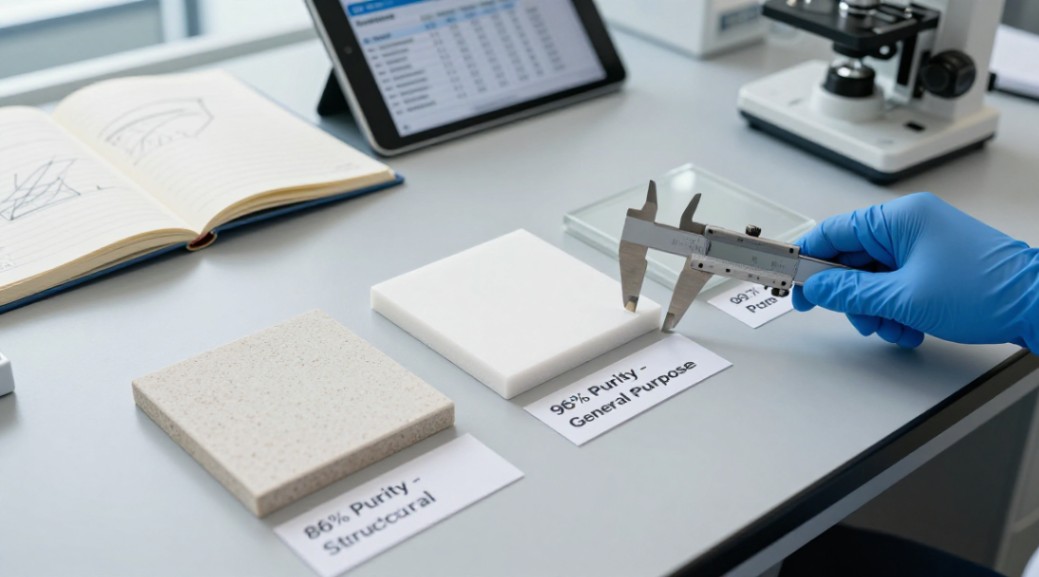
- 96% Al₂O₃ (The Workhorse): Contains silica and magnesia sintering aids. Offers the best combination of mechanical strength, cost, and machinability. It’s tougher, not just cheaper. Use it for 90% of wear parts, liners, and insulators where extreme corrosion resistance isn’t needed.
- 99.5% Al₂O₃ (The Performer): Higher purity. Superior corrosion and wear resistance. Better dielectric properties. The default choice for high-end substrates, semiconductor parts, and aggressive chemical environments.
- 99.8%+ Al₂O₃ (The Specialist): Near theoretical density. Maximum hardness, corrosion resistance, and electrical insulation. Also maximum brittleness and cost. Deploy only when every other option fails—think advanced medical implants or critical laser tubes.
Forget chasing the highest number. Match the grade to the actual stress. A 99.8% alumina seal face will shatter under impact where a 96% alumina part survives.
3. Core Properties: The Real Story
- High Hardness (Hv 1500-2000): Outwears tool steel 10:1 in abrasive slurries. But hardness means brittleness. It’s a trade-off, not a free lunch.
- Excellent Wear Resistance: Its primary superpower. Ideal for nozzles, pump seals, and liners. It fails when engineers ignore particle impingement angle.
- Superior Electrical Insulation: Even at high temperatures. Makes it the king of substrates and insulators. Aluminum nitride ceramic beats it for thermal conductivity, but costs 5x more.
- The Achilles’ Heel: Brittleness & Thermal Shock. Alumina has low fracture toughness. It hates rapid temperature changes. Don’t thermally cycle it like metal. Silicon nitride ceramic or mullite ceramic are better choices for severe thermal shock.
4. How It’s Made: Process Dictates Performance
The manufacturing method is not just a cost factor; it builds the material‘s DNA.
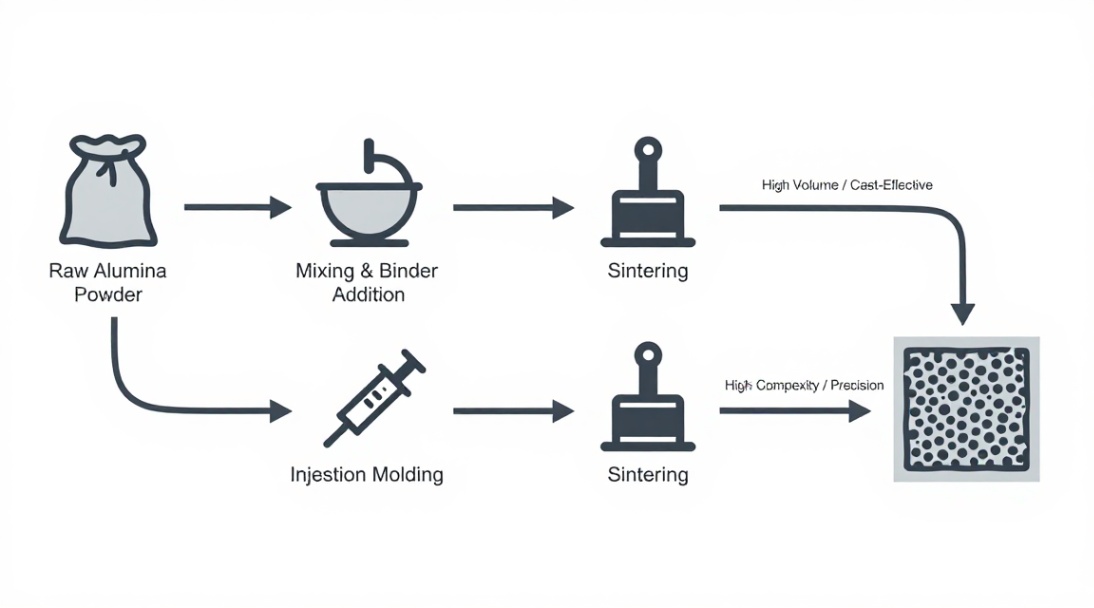
- Dry Pressing: Fast, cheap for simple shapes. Limited density and strength.
- Isostatic Pressing (CIP): Applies uniform pressure from all sides. Achieves near-net shapes with superior, homogeneous density. My default recommendation for complex parts.
- Injection Molding: For ultra-complex, high-volume components. Excellent detail, but high tooling cost and significant shrinkage during sintering requires expert design.
5. Where It Wins (And Where It Loses)
5.1. The Champion Applications
- Industrial Wear Parts: Pump seals, wear plates, thread guides. It outlasts tungsten carbide in non-impact abrasion.
- Electronics & Semiconductors: Substrates, insulators, wafer handling arms. The standard for a reason.
- Cutting Tools & Abrasives: Inserts for machining cast iron, sandpaper grit, grinding media. Often as a coating on tougher carbides.
- Biomedical: Hip joint balls, dental implants. Biologically inert, but requires a flawless surface finish.
5.2. Where You Should Look Elsewhere
Community wisdom is harsh but honest. On forums like Reddit, experienced machinists and engineers consistently warn: “Don’t use alumina for…”
- High-Impact Loads: Use silicon carbide ceramic or boron carbide ceramic for armor. Alumina will spall.
- Extreme Thermal Cycling: Choose silicon nitride or even quartz ceramic.
- When You Need High Thermal Conductivity: Aluminum nitride ceramic or silicon carbide ceramic are your materials.
- For Non-wetting Crucibles: You need a special coating for boron nitride ceramic crucibles, not alumina.
6. Machining & Finishing: The Final Hurdle
You cannot machine sintered alumina with standard tools. Period.
- Diamond grinding is mandatory. It’s slow and expensive.
- Design for net-shape. Every cut adds cost.
- Surface finish is critical. A rough surface creates stress concentrators and drastically reduces strength.
7. The Future & The Bottom Line
Alumina isn’t flashy. It won’t be replaced by graphene tomorrow. Its future is in composites and nano-structured grades for even better wear. But the core truth remains: Aluminum oxide ceramic is a tool, not a miracle. Respect its limits. Master the purity grades. Design for its brittleness. When you do, it’s the most reliable, cost-effective warrior in the advanced ceramics arsenal. Stop over-engineering with 99.8%. Start designing intelligently with 96%. Your budget and your reliability metrics will thank you.
The next step? Audit your current alumina specifications. Challenge the purity level. A 5% cost reduction with equal performance is sitting there, ignored.
Suppiler
Synthetic-chemical focus on the research and development, production and sales of ceramic products, serving the electronics, ceramics, chemical and other industries. Since its establishment in 2015, the company has been committed to providing customers with the best products and services, and has become a leader in the industry through continuous technological innovation and strict quality management.
Our products includes but not limited to Aluminum Nitride, Aluminum Oxide, Boron Carbide, Boron Nitride, Ceramic Crucible, ect. If you are interested in any type of these, please feel free to contact us.