Next-Generation Ceramics: Unlocking Superior Properties for Industry

The Broken Promise
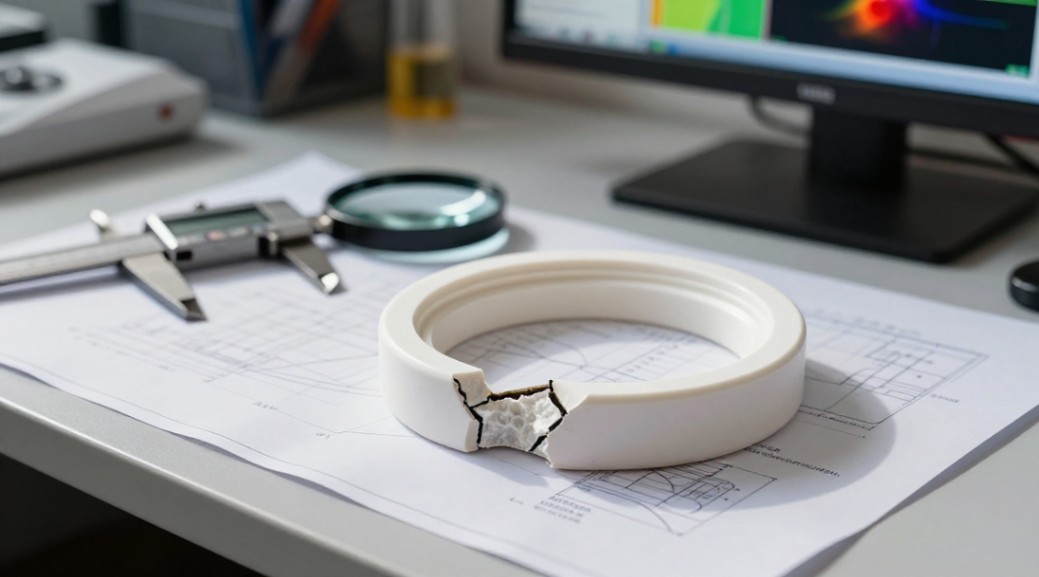
Have you ever specified an aluminum oxide ceramic component only to watch it fail prematurely? Not from the extreme wear it was supposed to resist, but from a seemingly benign thermal gradient or an unexpected impact? You trusted the data sheet. You believed the hype about hardness and chemical inertness. Yet, there it lies, fractured, taking your production line or your prototype down with it. You’re not alone. This frustration is a silent epidemic in engineering offices worldwide. We’re conditioned to see Al2O3, good old alumina, as a default, the safe choice. That mentality is precisely the problem. Let me be blunt: thinking of aluminum oxide ceramic as a universal workhorse is the fastest way to material mediocrity. It’s time to challenge the dogma.
Re-Evaluating the Old Guard
Alumina’s dominance wasn’t an accident. Its composition, Al2O3, offers a compelling blend of properties at a seemingly sensible price point. We measure its hardness on the Mohs scale at a formidable 9, just below diamond. We tout its electrical insulation capabilities, even at elevated temperatures. We design it into substrates for thick-film electronics, insulators for high-voltage systems, and wear plates for abrasive slurry pumps. It is biocompatible, finding its way into dental implants and joint prosthetics. This is the standard narrative, the one repeated in every brochure. But this narrative is incomplete. It conveniently glosses over the critical flaws hiding in plain sight: inherent brittleness and a fracture toughness that makes it look fragile next to materials like zirconia or silicon nitride. Choosing 96% alumina over 99.5% alumina for a high-reliability seal isn’t a cost-saving measure; it’s a gamble on impurity phases and grain boundaries that become failure initiation sites.
The Manufacturing Mirage
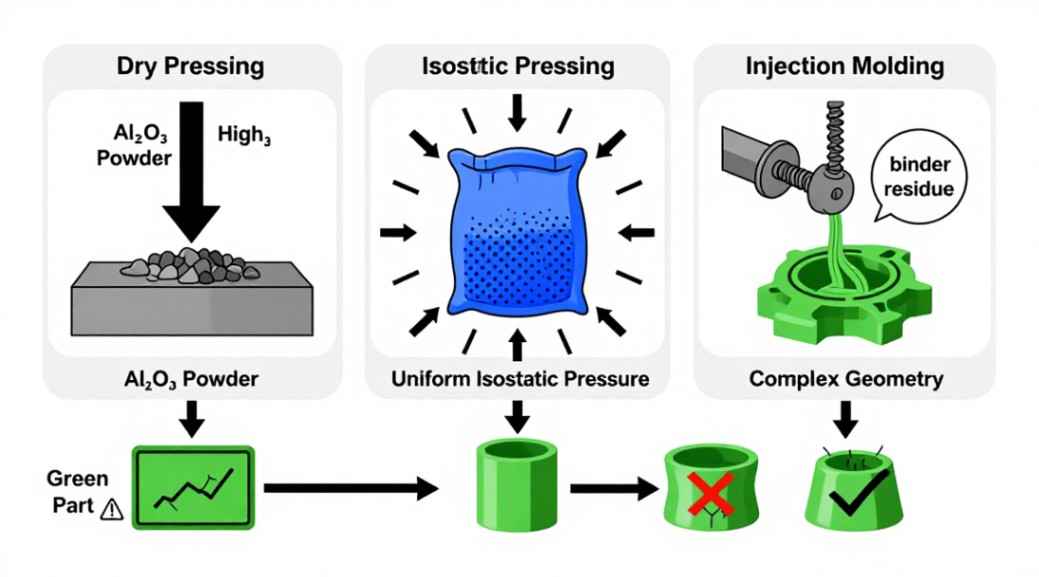
Look at the primary manufacturing processes: dry pressing, isostatic pressing, injection molding. Each method sells a dream of precision. Dry pressing offers volume. Isostatic pressing promises uniform density. Injection molding unlocks complex geometries. Yet, the final property set of your aluminum oxide ceramic component is hostage to a hundred variables within these processes. The sintering curve, the powder morphology, the binder system-get one subtly wrong, and you don’t get a 10% weaker part. You get a part with a hidden flaw, a time bomb. Compare this to the monolithic consistency achievable with advanced reaction-sintered silicon carbide ceramics or the tailored microstructures of pressureless sintered silicon carbide ceramics. The industry whispers about this but rarely shouts it. As one veteran process engineer told me over a decade ago, “With alumina, you’re often not buying a material specification. You’re buying your supplier’s process discipline.” The data from recent industry tear-down reports supports this: variance in key properties like modulus of rupture between batches from different suppliers quoting the same 99.5% alumina grade can exceed 15%. That’s not a margin of error; that’s a chasm.
The Brutal Truth of Competition
This is where we must get uncomfortable. Alumina’s throne is under siege, and for good reason. Need extreme thermal conductivity for a semiconductor substrate? Aluminum nitride ceramic runs circles around it. Facing ballistic impact or the most severe abrasive wear? Boron carbide ceramic and silicon carbide ceramic offer vastly superior hardness and wear resistance. Operating in a high-temperature, low-oxidation environment where strength retention is non-negotiable? Silicon nitride ceramic and its advanced cousins, like silicon carbide-bonded silicon nitride ceramics, laugh at alumina’s creep limitations. Even the humble mullite ceramic can outperform alumina in thermal shock resistance for certain furnace applications. The selection criteria can no longer be “What can alumina do?” It must be “What is the specific failure mode here, and which material defeats it most efficiently?” Cost-per-part is a naive metric. You must calculate cost-per-operating-hour, cost-per-mean-time-between-failure. In that harsh light, alumina often loses.
Navigating the New Material Reality
So, is aluminum oxide ceramic obsolete? Absolutely not. But its role has fundamentally shifted. It is no longer a default. It is a precision tool for specific, well-understood conditions. Its future lies in hybrid systems and engineered surfaces. Think of it as the foundation, not the final solution. The real innovation is happening at the boundaries. Consider the emergence of specialized surface treatments or the special coating for boron nitride ceramic crucibles that marry different material strengths. The next generation of components won’t be monolithic alumina or monolithic silicon carbide. They will be layered, graded, and composite architectures. Your task is to deconstruct your application’s true environmental stressors-thermal flux, stress state, chemical exposure, wear mechanism-and map them against a material property matrix without legacy bias. Start with the assumption that alumina is wrong. Force yourself to justify its use against the entire pantheon of technical ceramics. That is the mindset shift the data demands. That is how you avoid the next broken component and build something that truly endures.
Suppiler
Synthetic-chemical focus on the research and development, production and sales of ceramic products, serving the electronics, ceramics, chemical and other industries. Since its establishment in 2015, the company has been committed to providing customers with the best products and services, and has become a leader in the industry through continuous technological innovation and strict quality management.
Our products includes but not limited to Aluminum Nitride, Aluminum Oxide, Boron Carbide, Boron Nitride, Ceramic Crucible, ect. If you are interested in any type of these, please feel free to contact us.