Next-Generation Ceramics: Unlocking Superior Properties for Industry

Feeling the Burn? When Standard Materials Just Won’t Cut It
You’re an engineer or designer. You’ve watched a critical component degrade, wear through, or catastrophically fail. Maybe a pump seal faces a chemical slurry. Perhaps an electronic substrate overheats and compromises an entire circuit. You’re under pressure to find a material that can handle extreme conditions-high temperature, aggressive wear, corrosive media-without breaking the bank. Sound familiar? You are not alone. Let’s talk about the workhorse that often solves these problems: aluminum oxide ceramic.
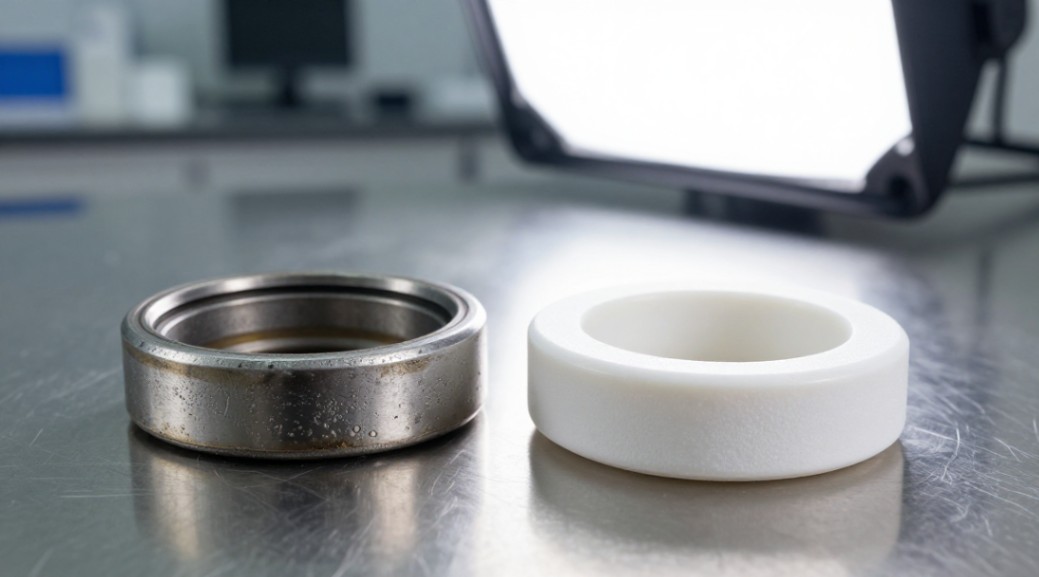
The Unshakeable Core: What is Aluminum Oxide Ceramic?
At its heart, aluminium oxide ceramic (Al₂O₃) is a dense, crystalline material made from refined bauxite. We call it alumina. It’s not a single, monolithic material but a family. The properties shift dramatically with purity and processing. A 96% alumina component behaves differently from a 99.5% or 99.9% part. This isn’t just about chemistry; it’s about engineering the microstructure for your specific battle.
The Alumina Advantage: A Side-by-Side Reality Check
We often see online communities like Reddit and engineering forums buzzing with questions. “Should I use alumina or silicon carbide ceramic for my wear plate?” “Is aluminum nitride ceramic worth the extra cost for this heat sink?” Let’s cut through the noise. The true power of aluminum oxide ceramic comes from its balanced portfolio. It rarely tops the chart in any single property, but it offers a Goldilocks zone of high performance at a practical cost.
Material Selection Head-to-Head
To make an informed choice, you need to see the trade-offs. This table compares aluminum oxide ceramic against common alternatives. It’s based on decades of application data and real-world failure analysis.
| Material | Key Strengths | Primary Weaknesses | Typical Cost Index (vs. Alumina) | Best For When You Need… |
|---|---|---|---|---|
| Aluminium Oxide (Alumina) | Excellent wear resistance, high hardness, superb electrical insulation, good chemical inertness, biocompatible grades available. | Brittle (low fracture toughness), challenging to machine post-sintering, moderate thermal conductivity. | 1.0 (Baseline) | A robust, cost-effective solution for wear parts, electrical insulators, and chemically resistant seals. |
| Silicon Carbide (SiC) | Exceptional thermal conductivity, extreme hardness, excellent wear/erosion resistance, retains strength at high temps. | More expensive, very brittle, can be conductive depending on grade. | 2.0 – 4.0 | Ultimate thermal management or abrasion resistance in non-impact applications. |
| Aluminium Nitride (AlN) | Outstanding thermal conductivity (close to metals), excellent electrical insulation. | High cost, sensitive to moisture during processing, lower mechanical strength than alumina. | 5.0 – 10.0 | High-power electronics where heat dissipation is the #1 priority. |
| Advanced Steels/Alloys | High toughness, excellent impact resistance, readily machined, good thermal conductivity. | Susceptible to corrosion, wear, and high-temperature softening. | 0.5 – 2.0 | Complex shapes with high impact loads and lower chemical/thermal stress. |
The feedback is clear. Many users on platforms like Reddit note: “For a general-purpose industrial ceramic that won’t send procurement into a panic, alumina is our first call.” It’s a testament to its reliability.
Bridging the Gap: How Modern Alumina Solves Its Own Limitations
Yes, traditional alumina is brittle. This is its Achilles’ heel. But the field isn’t static. Research is directly attacking this flaw, and the results are moving from the lab to the factory floor. This is where the future gets exciting.
The key trend is composite alumina ceramics. Scientists are embedding reinforcements-like zirconia particles or even specialized fibers-into the alumina matrix. Think of it like rebar in concrete. One advanced strategy, akin to the ‘double continuous structure’ used in ultra-high-temperature composites, involves creating an interpenetrating network. This can significantly boost fracture toughness.
Early data shows these composites can push toughness from the typical 3-5 MPa·m¹/² for standard alumina toward 10 MPa·m¹/² or higher. They’re also exploring sintering aids that allow full densification at lower temperatures (closer to 1300°C vs. 1700°C+), saving energy and enabling new composite possibilities. This isn’t just theory; it’s the next generation of aluminium oxide ceramic designed to fail less.
Your Practical Path Forward with Alumina
So, where does this leave you? Let’s get specific. Here’s a straightforward guide based on your design goal:
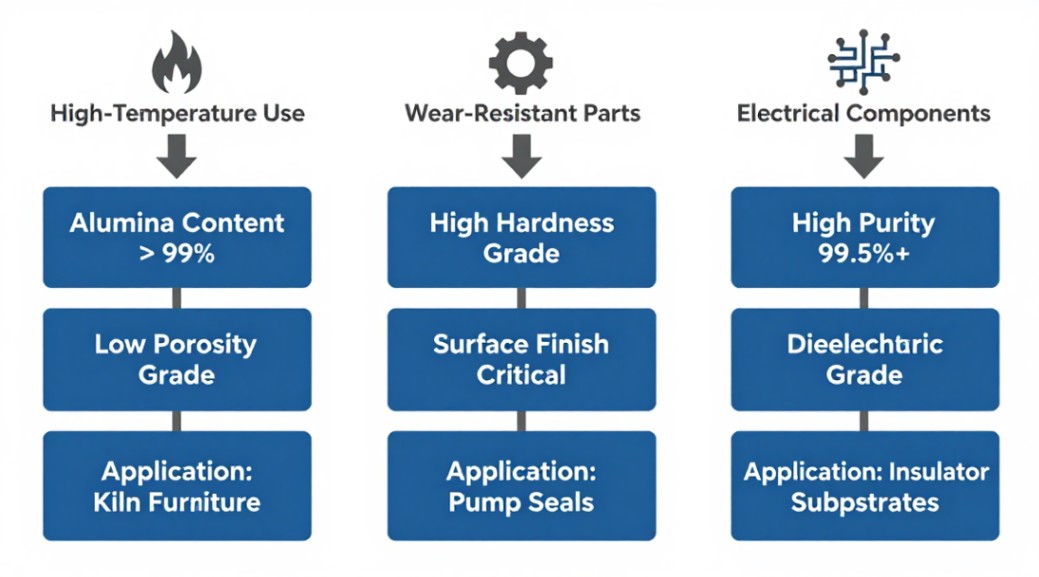
For Wear Components (Seals, Liners, Bearings): Start with 96% or 99.5% alumina. Specify a fine-grain, fully dense microstructure. Prioritize a superior surface finish (often < 0.4 µm Ra) to minimize friction and crack initiation. For extreme abrasion, consider a silicon carbide ceramic overlay or coating.
For Electronics (Substrates, Insulators): Use 99.5%+ high-purity alumina. Its electrical resistivity and dielectric strength are outstanding. If thermal management is critical, you must evaluate aluminium nitride, but know the cost multiplier. For many applications, alumina’s balance is perfect.
For Medical/Biotech (Implants, Labware): You must use medical-grade, bio-inert 99.9%+ alumina with a polished, ultraclean surface. The biocompatibility is proven and trusted.
When to Look Elsewhere: If your part faces high thermal shock, consider silicon nitride. For extreme temperatures above 1800°C in inert atmospheres, look at boron nitride ceramic (often with a special coating for boron nitride ceramic crucibles). For the ultimate in lightweight armor, boron carbide ceramic is the choice, though it is costly.
Stop Experimenting. Start Succeeding with Confidence.
You don’t have to navigate this complex material landscape alone. After 20+ years, I’ve seen designs succeed and fail based on these precise choices. The data and trends point to aluminum oxide ceramic remaining a foundational material because it works. But you need the right grade, from the right process, for your specific application.
Here is your clear next step: Stop compromising with subpar materials. Engage with a specialist ceramic manufacturer who can consult on your design from the start. Provide them with your operating environment-stresses, temperatures, chemicals, and required lifespan. Let them recommend the optimal alumina grade (96%, 99.5%, or a composite) and manufacturing process (dry pressing, isostatic pressing, or injection molding). This upfront collaboration is the single biggest factor in achieving a reliable, high-performance ceramic component.

Make the call. Share your specs. Turn your material problem into a solved equation.
Suppiler
Synthetic-chemical focus on the research and development, production and sales of ceramic products, serving the electronics, ceramics, chemical and other industries. Since its establishment in 2015, the company has been committed to providing customers with the best products and services, and has become a leader in the industry through continuous technological innovation and strict quality management.
Our products includes but not limited to Aluminum Nitride, Aluminum Oxide, Boron Carbide, Boron Nitride, Ceramic Crucible, ect. If you are interested in any type of these, please feel free to contact us.