Next-Generation Ceramics: Unlocking Superior Properties for Industry

Have you ever watched a brand-new alumina ceramic seal or pump component fail far sooner than promised? The frustration is real. You specified a high-hardness, wear-resistant material. You expected thermal stability and chemical inertness. Yet there it sits, cracked or worn through, bringing your line to a halt. We’ve been there. Over decades, we’ve seen the same patterns of disappointment, often stemming from a few widespread misunderstandings about aluminum oxide ceramic. Many users on forums like Reddit echo this, sharing stories of premature failures that almost always trace back to a mismatch between the grade selected and the brutal reality of the application.
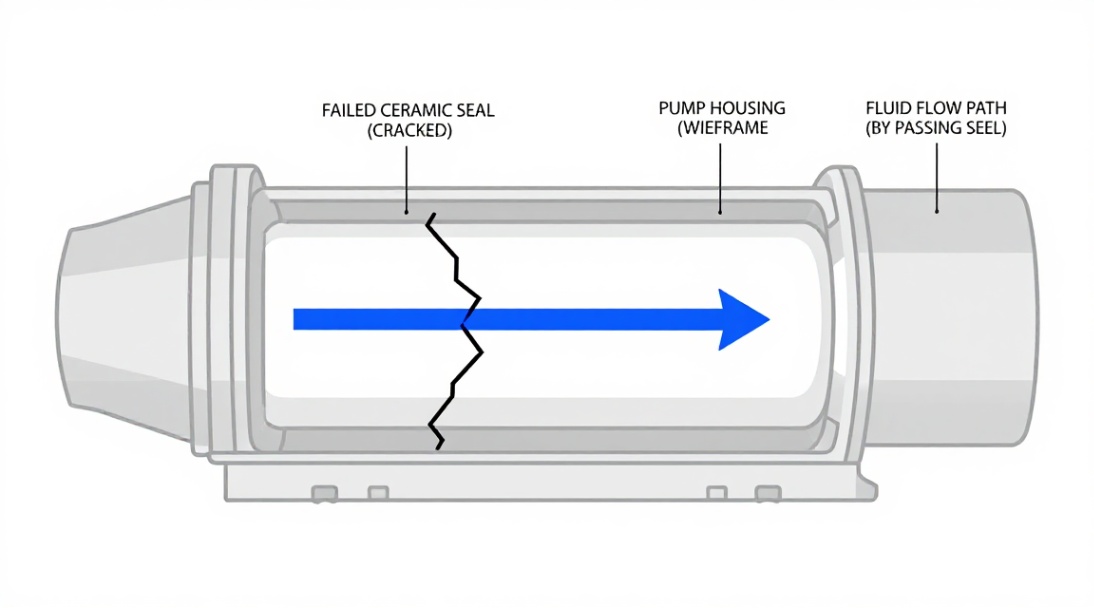
Let’s start with the biggest trap: purity. When we say aluminum oxide ceramic or Al2O3, we’re talking about a family, not a single material. Walking into a project and just asking for ‘alumina’ is like asking for ‘steel’ without specifying the grade. The two most common grades are 96% and 99.5% (or 99.8%) alumina. That missing few percent isn’t just empty space; it’s a carefully formulated glassy phase, typically silica and other oxides, that acts as a sintering aid. This is the first ‘do not.’ Do not assume higher purity is always better. That 99.5% alumina is harder and more corrosion-resistant, yes. But it’s also more expensive and, critically, more brittle. The 96% alumina, with its glassy phase, sinters at a lower temperature and often has slightly better mechanical shock resistance. For a wear liner in a chute battling constant impact? 96% might be the tougher, more economical choice. For a high-purity semiconductor wafer handling arm where ionic contamination is a killer? 99.5% is non-negotiable. Choosing the wrong purity is a fast track to failure.
It’s Not Just About Hardness
The second major pitfall is focusing solely on hardness and wear resistance. Yes, aluminum oxide ceramic is hard. But its fracture toughness is low. It’s brittle. This isn’t a flaw; it’s a fundamental characteristic we must design around. The real world doesn’t apply perfectly distributed loads. It delivers point impacts, thermal shocks, and uneven clamping forces. I’ve seen beautifully machined alumina substrates crack because an engineer used a steel bolt and torqued it down just a bit too much, creating a stress concentration the ceramic couldn’t handle. The solution isn’t to blame the ceramic. It’s to design for it: use compliant layers, avoid sharp corners, and specify proper mounting techniques. This brittleness is precisely why materials like zirconia, with its transformational toughening, or silicon nitride, with its exceptional strength and thermal shock resistance, get chosen for dynamic, high-stress applications like bearings or cutting tools.
The Competition You’re Not Considering
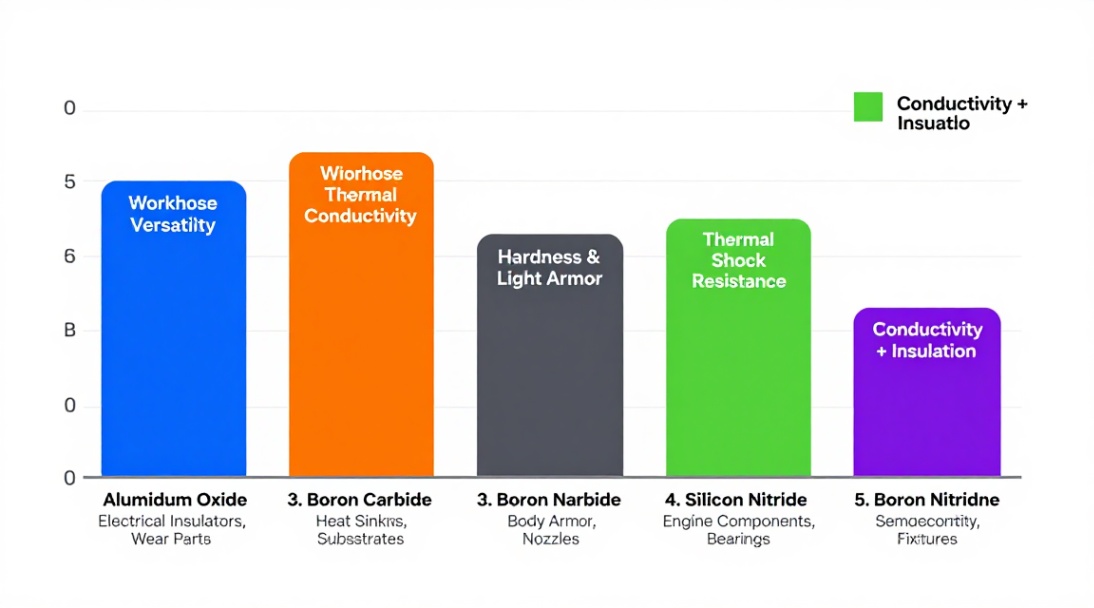
This leads us to the third critical mistake: not doing a true comparative analysis. Aluminum oxide ceramic is a fantastic, versatile workhorse. But it’s not the only advanced ceramic in the stable. When your application involves extreme thermal conductivity, aluminum nitride ceramic is the champion. For pure, unadulterated hardness and lightweight armor applications, boron carbide is king. Need phenomenal thermal shock resistance and high-temperature strength? Silicon nitride ceramic and silicon carbide ceramic are often superior. Boron nitride ceramic offers that unique combination of high thermal conductivity and electrical insulation, especially with special coatings for crucibles. Mullite ceramic excels in sustained high-temperature environments with low creep. The point is, selecting alumina by default, without a hard look at pressureless sintered silicon carbide ceramics or reaction-sintered silicon carbide ceramics for severe abrasion, can leave performance and lifetime on the table.
Even the manufacturing process is a minefield. Sintering is the heart of the process, where the powdered compact becomes a dense, strong ceramic. But the finishing-the grinding, lapping, and polishing-is where hidden costs and defects emerge. Specify a surface finish that’s tighter than you actually need, and you’ll pay for it exponentially. Tolerances tighter than ±0.1% of a dimension on a complex part? That’s often a recipe for scrap. We must work with our ceramic suppliers early, discussing design-for-manufacturability. Can we radius that inside corner? Can we simplify this geometry? This collaboration prevents heartache later.
The Future and a Final Warning
Where is this all heading? The frontier is in overcoming those inherent limitations. Research is pushing into continuous fiber reinforcement to tackle brittleness, creating composites that bridge cracks and boost fracture toughness dramatically. We’re seeing developments in new oxide systems and high-entropy oxides that promise to shatter temperature ceilings. Strategies like slurry infiltration are lowering the insane sintering temperatures traditionally needed for ultra-high-temperature ceramics. The material science is advancing. But the core principle for us, the engineers and designers, remains the same: understand the fundamental properties, respect the limitations, and match the material-be it a 96% alumina wear tile or a silicon carbide-bonded silicon nitride ceramics component-to the true, gritty demands of the job.
So, what’s the next step? Don’t just search for a supplier. Start with a brutally honest assessment of your operating environment: load types, thermal cycles, chemical exposures, and the true cost of failure. Then, have that conversation. Talk to applications engineers who live in this world. Bring them your worst-case scenario, not just the ideal operating conditions. The right aluminium oxide ceramic, applied with wisdom and careful design, is incredibly reliable. The wrong one, chosen from a catalogue without context, is a guaranteed point of failure. We’ve learned this the hard way so you don’t have to.
Suppiler
Synthetic-chemical focus on the research and development, production and sales of ceramic products, serving the electronics, ceramics, chemical and other industries. Since its establishment in 2015, the company has been committed to providing customers with the best products and services, and has become a leader in the industry through continuous technological innovation and strict quality management.
Our products includes but not limited to Aluminum Nitride, Aluminum Oxide, Boron Carbide, Boron Nitride, Ceramic Crucible, ect. If you are interested in any type of these, please feel free to contact us.