Next-Generation Ceramics: Unlocking Superior Properties for Industry

Foundations and Fidelity
Consider this: in a world obsessed with exotic materials like boron nitride ceramic and silicon nitride ceramic, a single compound-aluminum oxide ceramic (Al₂O₃)-remains the undisputed, pragmatic workhorse. It’s not the hardest. It’s not the toughest. Yet, it is the one we have built entire industries upon. This wasn’t an accident of marketing. It is a logical conclusion drawn from decades of engineering. We choose materials based on a balance of properties, cost, and manufacturability. Aluminum oxide ceramic often presents the most rational point on that curve. Its story isn’t about being the best at any one thing; it’s about being reliably excellent at nearly everything. Let’s walk through the logic, from its atomic structure to the parts in your hand right now.
The Inherent Logic of Alumina
The properties of any ceramic stem from its atomic bonds. In alumina, strong ionic bonds between aluminum and oxygen create a lattice that is inherently stable and resistant to change. This is the root of its defining characteristics. Think about thermal stability. When a material heats up, atoms vibrate and can slip past each other, leading to deformation or failure. Alumina’s bonds resist that movement. This gives it excellent high-temperature performance, though we must be honest-it’s not the ultimate champion. For extreme thermal conductivity, we look to aluminium nitride ceramic. For sheer refractoriness, silicon carbide ceramic or mullite ceramic might step in. But alumina offers a superb, cost-effective baseline of thermal capability that satisfies a vast majority of real-world conditions. Its high hardness and wear resistance follow the same logical thread. The hard, covalent nature of the Al-O bond simply doesn’t yield easily to abrasion. Is it as hard as boron carbide ceramic? No. But for grinding media, wear plates, and thread guides, its balance of hardness and fracture toughness is often the most sensible economic choice.
Then there’s the electrical story. This is where alumina’s logic becomes overwhelmingly compelling. That same stable, ionic lattice creates a wide bandgap. This makes it an exceptional electrical insulator with high dielectric strength. This property, more than any other, cemented its dominance. It allowed us to create robust, thermally conductive platforms for electronic circuits. The vast majority of thick and thin film substrates are alumina. We don’t use silicon carbide-bonded silicon nitride ceramics here because they can be conductive. We don’t use quartz ceramic because its thermal performance and mechanical strength are often inferior. Alumina provided the perfect trifecta: it insulated, it dissipated heat, and it could be manufactured into complex, flat shapes with fine tolerances. The industry standardized around it for a reason.
The Nuance of Purity and Process
Not all alumina is created equal. This is a critical nuance. We typically discuss grades like 96% and 99.5% (or higher) purity. The percentage refers to the Al₂O₃ content; the remainder is often silica and other metal oxides that act as sintering aids. This isn’t an impurity in the negative sense-it’s a deliberate formulation. The 96% alumina sinters at a lower temperature, is easier to machine, and is more cost-effective. It’s the go-to for mechanical components like seals, nozzles, and wear parts. The 99.5% and above grades trade some ease of manufacturing for superior properties: higher hardness, better corrosion resistance, and significantly improved electrical insulation. This is the grade for high-performance semiconductor components or advanced medical implants.
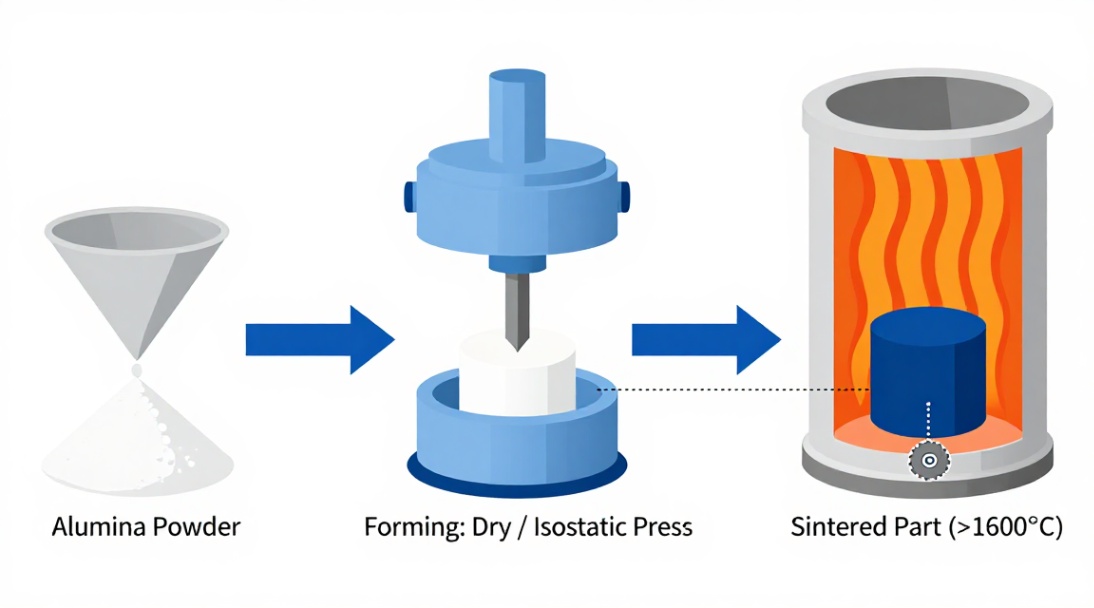
The manufacturing process itself is a dance of powder, pressure, and heat. We start with fine, meticulously controlled alumina powder. We form it-through dry pressing, isostatic pressing, or injection molding-into a “green” body. Then, we fire it in a kiln at temperatures often exceeding 1600°C. During sintering, the particles fuse, densify, and the part shrinks predictably. This predictable shrinkage is key to engineering. We design the green part oversized, knowing exactly how much it will contract. After sintering, we often need to machine it to final tolerances using diamond-grit tools. This is expensive. Therefore, smart design aims to achieve “net-shape” or “near-net-shape” parts straight from the furnace to minimize costly diamond grinding.
Alumina in the Wild: From Circuits to Hips
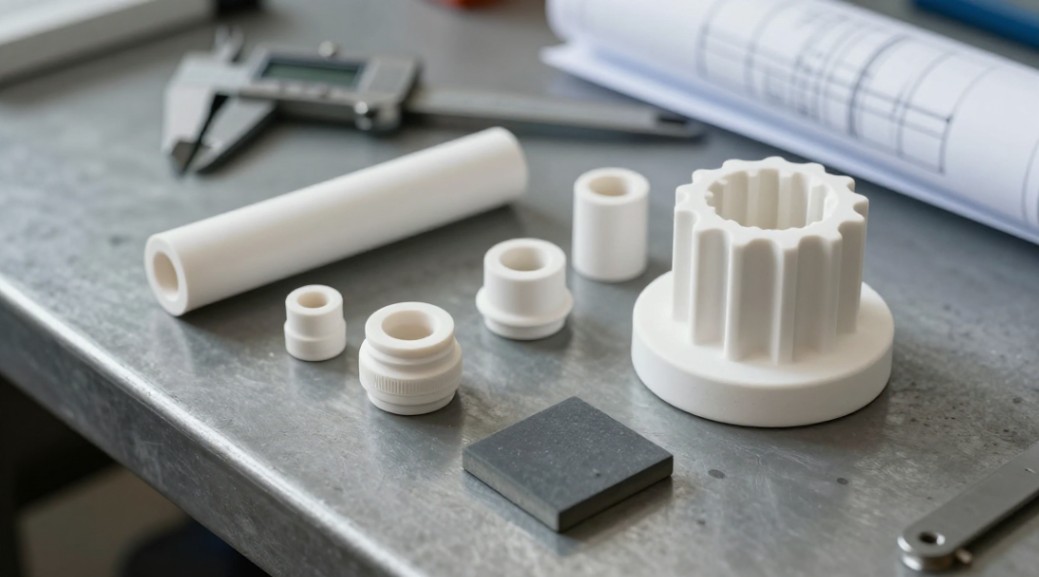
Its applications are a testament to its balanced portfolio. In electronics, it’s the substrate. In industrial machinery, it’s the wear-resistant liner, the seal face that outlasts metal tenfold, the guide for molten metal or abrasive slurry. In medical technology, its biocompatibility is paramount. When we need a material that is inert in the body, resistant to sterilization, and capable of being polished to an exceptionally smooth, low-friction surface, high-purity alumina answers the call. It’s used in hip joint bearings and dental implants. It doesn’t corrode. It doesn’t elicit a negative biological response. Compared to a material like zirconia, which offers higher fracture toughness, alumina provides superior hardness and wear resistance. The choice between them isn’t about which is better, but which property is mission-critical for the specific implant design.
How do you choose? Price is a function of three things: material purity, manufacturing complexity, and required precision. A simple, pressed 96% alumina washer is relatively inexpensive. A complex, injection-molded 99.8% alumina component with ultra-tight tolerances and a mirror finish is not. Before you get dazzled by exotic options, ask the fundamental questions. What is the operating temperature? Is electrical insulation required? What are the mechanical load and wear conditions? What is the chemical environment? For a vast swath of answers, aluminum oxide ceramic will emerge as the most logical, proven, and economical solution. It’s the material we default to when the problem is well-defined and the budget is real.
The Workhorse Endures
The landscape of advanced ceramics is rich. We have reaction-sintered silicon carbide ceramics for exceptional chemical resistance. We have special coatings for boron nitride ceramic crucibles for handling molten metals. New composites and formulations emerge constantly. Yet, alumina persists. It’s the benchmark. Its dominance isn’t a legacy artifact; it’s a continuing testament to a material that got the fundamentals right. It solved the core engineering problems of insulation, wear, and stability with such elegant efficiency that displacing it requires a truly compelling, specific advantage. For most applications, that compelling case simply doesn’t exist. That’s the power of pragmatic excellence. That’s why, after twenty years, we still reach for the alumina datasheet first.
If your project requires a material with proven reliability, excellent electrical properties, and strong mechanical performance, the logical starting point is high-quality alumina. Don’t waste time reinventing the wheel. Contact us directly for a consultation. Share your application requirements, and let our decades of experience with aluminium oxide ceramic machining and design guide you to the most efficient, cost-effective solution. We’ll help you specify the right grade, the right process, and deliver a component that performs exactly as the logic predicts it will.
Suppiler
Synthetic-chemical focus on the research and development, production and sales of ceramic products, serving the electronics, ceramics, chemical and other industries. Since its establishment in 2015, the company has been committed to providing customers with the best products and services, and has become a leader in the industry through continuous technological innovation and strict quality management.
Our products includes but not limited to Aluminum Nitride, Aluminum Oxide, Boron Carbide, Boron Nitride, Ceramic Crucible, ect. If you are interested in any type of these, please feel free to contact us.