Next-Generation Ceramics: Unlocking Superior Properties for Industry

You’re Probably Overpaying for Your ‘Industry Standard’
Have you ever specified aluminum oxide ceramic for its high hardness and excellent wear resistance, only to discover a batch of parts shattered under a load the datasheet promised they’d handle? Or perhaps you’ve celebrated the switch from a costly superalloy to an aluminium oxide ceramic component for its thermal stability, only to find your production line bottlenecked by its agonizingly slow machining and hidden costs from secondary finishing. You are not alone. For decades, alumina has been the default, the safe choice, the industrial workhorse sold on a handful of spectacular property tables. Yet this reliance on brochure metrics blinds us to a more complex reality. Let’s discard the marketing. The true story of Al2O3 isn’t just about its impressive 9 Mohs hardness or its 2000°C melting point. It’s a story of brutal trade-offs, of understanding where its crystalline structure is a relentless ally and where it becomes a fundamental limitation. It is the paradox of a material that is simultaneously indispensable and, in many advanced applications, increasingly obsolete.
1. The Inescapable Physics of the Crystalline Lattice
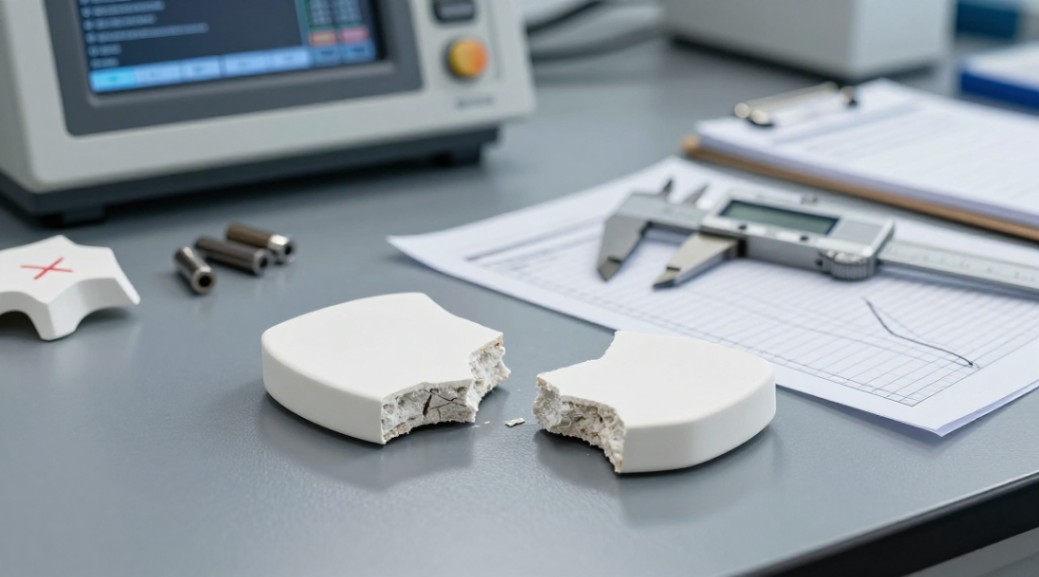
To grasp why aluminum oxide ceramic behaves as it does, you must visualize its atomic prison. Its crystalline structure, a densely packed arrangement of aluminum and oxygen ions, is the source of both its legendary strengths and its crippling weaknesses. This rigid lattice grants it superb hardness, surpassing most steels, and gives it the thermal fortitude to stand firm in furnace linings and thermocouple tubes where metals would melt into a puddle. Its electrical insulation capabilities are formidable, making high-purity grades like 99.5% Al2O3 the undisputed king for circuit substrates and spark plug insulators. But this same lattice is unforgiving. It has no mechanism for plasticity. No ductility. Under a sharp, focused stress, it cannot yield. It can only fracture. This brittleness isn’t a manufacturing defect; it is the core identity of the material. When we compare it to other technical ceramics, this identity is thrown into sharp relief. Silicon nitride ceramic trades some hardness for remarkable fracture toughness, making it superior for bearing balls under dynamic load. Zirconia leverages a phase transformation mechanism to resist crack propagation in ways alumina can only dream of. Even aluminium nitride ceramic deliberately sacrifices the raw dielectric strength of alumina for an order-of-magnitude leap in thermal conductivity, a critical trade for high-power electronics. Choosing alumina is therefore not about picking the ‘best’ ceramic. It is about choosing the specific combination of properties where its crystalline strengths outweigh its brittle nature.
2. The Manufacturing Mirage and the Purity Paradox
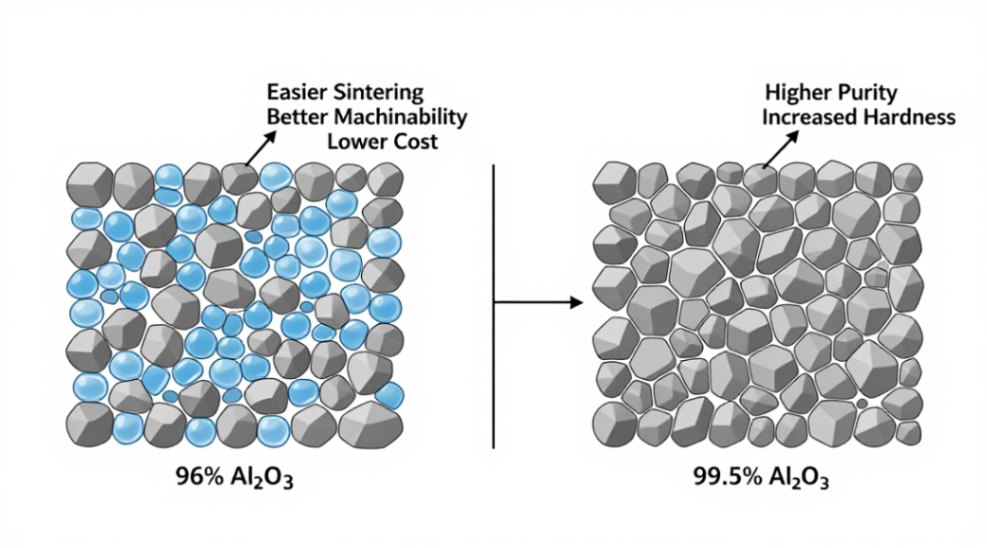
Walk any trade show floor and you’ll hear about grades: 96% alumina, 99.5% alumina, 99.9%. The implication is linear-higher purity, better performance. This is a dangerous oversimplification. The 96% Al2O3 grade incorporates a silicate glass phase that fills the pores between alumina grains. This dramatically eases sintering, lowers cost, and, crucially, improves machinability with standard tooling. Its mechanical strength is lower, yes, but for thousands of wear plates, thread guides, and sealing faces, it is more than sufficient. The 99.5% grade, sintered at higher temperatures, eliminates most of that glassy phase. The result is a harder, stronger, more corrosion-resistant part with superior dielectric properties. But it becomes exponentially more difficult to machine, often requiring diamond grinding or laser cutting. The manufacturing process itself dictates the final part’s limitations. A dry-pressed part is cost-effective for simple shapes but can hide density gradients. Isostatic pressing delivers uniformity for complex, high-reliability components like medical implant sleeves or advanced pump seals. Injection molding allows for intricate geometries unimaginable with pressing but introduces binders that must be meticulously removed. Selecting a grade without mapping it to your fabrication path is a recipe for cost overruns and performance gaps.
3. The Silent Revolution and Its Coming Obsolescence
Here is the uncomfortable truth the traditional alumina supply chain doesn’t want you to focus on: for frontier applications, aluminum oxide is reaching its fundamental limits. In extreme wear environments involving high-velocity abrasives, silicon carbide ceramic and boron carbide ceramic offer vastly superior performance, their covalent bonds laughing at erosion that would scar alumina. In high-temperature structural applications where thermal shock is the killer, silicon nitride and mullite ceramic exhibit far greater resistance. The future belongs to composites and engineered architectures. We are moving beyond monolithic slabs of aluminum oxide ceramic. The trend is toward laminates, where layers of alumina are fused with compliant materials to arrest cracks. It is toward fiber-reinforced matrices and functionally graded structures where the composition changes spatially to meet localized demands-hardness on one face, toughness in the core. Even coatings are leapfrogging the bulk material; a special coating for boron nitride ceramic crucibles can enable processing of reactive metals in ways a solid alumina crucible never could. The role of standard alumina is shifting. It is becoming a foundational material, a reliable substrate, a cost-effective solution for the vast middle ground of industrial demand, while the performance envelope is being redrawn by more advanced and specialized materials.
4. A Pragmatic Path Forward
So, what should you do? First, abandon the checklist mentality. Do not start with ‘I need a ceramic.’ Start with the failure mode. Is it abrasive grain-by-grain wear? Alumina’s hardness serves well. Is it a high-energy impact? Look immediately to toughened zirconia or silicon nitride ceramic. Is thermal conductivity the primary driver? Aluminum nitride or silicon carbide are your only real options. Second, design for the brittleness. Avoid sharp corners. Specify generous radii. Use compressive loading whenever possible. Third, engage with your fabricator at the concept stage. The choice between dry pressing, isostatic pressing, or injection molding will constrain your geometry, tolerances, and economics more profoundly than any minor variation in purity. Finally, pressure-test the assumption. For your next wear plate, insulator, or seal, run the calculation: could a high-performance polymer, a surface-treated metal, or a composite fulfill 80% of the function at 50% of the total system cost? Often, the answer surprises you. The goal is not to use aluminum oxide ceramic. The goal is to solve a problem with the most effective toolkit available. Alumina is a powerful, often optimal, but never a default tool. Use it with respect for its history and a clear eye on its limits, and you will stop buying specs and start engineering solutions.
Suppiler
Synthetic-chemical focus on the research and development, production and sales of ceramic products, serving the electronics, ceramics, chemical and other industries. Since its establishment in 2015, the company has been committed to providing customers with the best products and services, and has become a leader in the industry through continuous technological innovation and strict quality management.
Our products includes but not limited to Aluminum Nitride, Aluminum Oxide, Boron Carbide, Boron Nitride, Ceramic Crucible, ect. If you are interested in any type of these, please feel free to contact us.