Next-Generation Ceramics: Unlocking Superior Properties for Industry

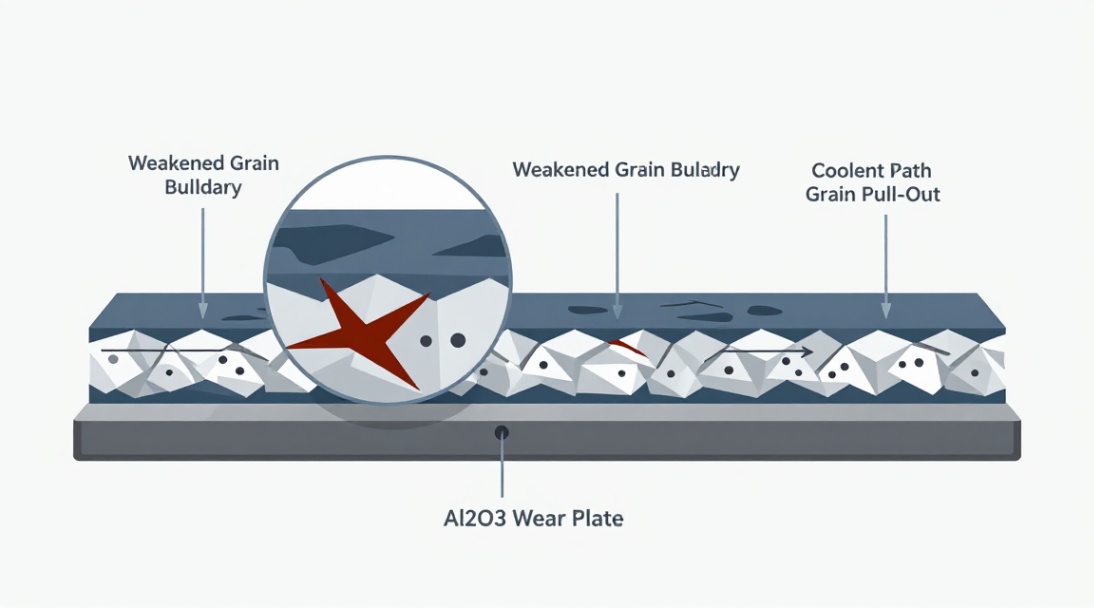
I once watched a $250,000 press tool fail in under a week. The engineering team specified standard aluminum oxide ceramic for a wear plate, assuming its legendary hardness guaranteed success. They didn’t consider grain boundary attack from a specific chemical coolant. The result was catastrophic grain pull-out and rapid, abrasive wear. The cost wasn’t just the component. It was the unplanned downtime, the scrapped production run, and the bruised confidence in a superb material. This is not a story of material failure, but of selection failure. Let’s ensure you avoid these pitfalls.
Common Mistakes & Critical Questions About Aluminum Oxide Ceramic
What is the biggest misconception about aluminum oxide ceramic?
The most dangerous misconception is treating “alumina” as a single, uniform material. Engineers often say, “Just use ceramic,” without specifying purity or grade. Aluminum oxide ceramic (Al2O3) spans a vast performance spectrum. A 85% purity alumina used for a sandblasting nozzle behaves fundamentally differently than a 99.8% purity grade for a semiconductor wafer plate. Their mechanical strength, thermal conductivity, and surface finish capabilities differ by orders of magnitude. Never assume generic alumina will suffice.
Why is choosing the wrong purity grade a fatal error?
Purity dictates performance boundaries. The silica-based glassy phase in lower-purity grades (e.g., 96% Al2O3) lowers sintering temperature and cost. However, it also reduces thermal conductivity, increases dielectric loss, and can be vulnerable to chemical attack. For high-frequency insulation or in corrosive environments, this is unacceptable. Conversely, specifying 99.5% alumina for a simple mechanical spacer is wasteful. The 2023 Advanced Ceramics Report from MarketsandMarkets highlights a 15-20% annual increase in failure analysis cases linked to purity-grade mismatch in aggressive service.
When should I never use aluminum oxide for thermal management?
Never use standard alumina as a primary heat sink in high-power-density electronics. Its thermal conductivity (~30 W/mK) pales against alternatives. For comparison, aluminium nitride ceramic can exceed 170 W/mK, and silicon carbide ceramic ranges from 120-270 W/mK. In a power module, using alumina where AIN is needed creates a thermal bottleneck. Component temperatures rise, leading to premature failure. If your design involves moving significant heat, alumina is rarely the optimal conductor.
What is the hidden risk in assuming all ceramics are “wear-proof”?
Alumina is exceptionally hard and wear-resistant. But its brittleness is the catch. Under high point-load or impact, it can fracture. For applications involving heavy pounding or sharp impacts, tougher ceramics like zirconia (with transformation toughening) or silicon nitride ceramic are superior. I’ve seen alumina guide rollers shatter from tramp material impact, while silicon nitride versions lasted for years. Assess the load type: for pure abrasion, alumina excels; for impact, look elsewhere.
How does a “one-size-fits-all” approach fail in machining and finishing?
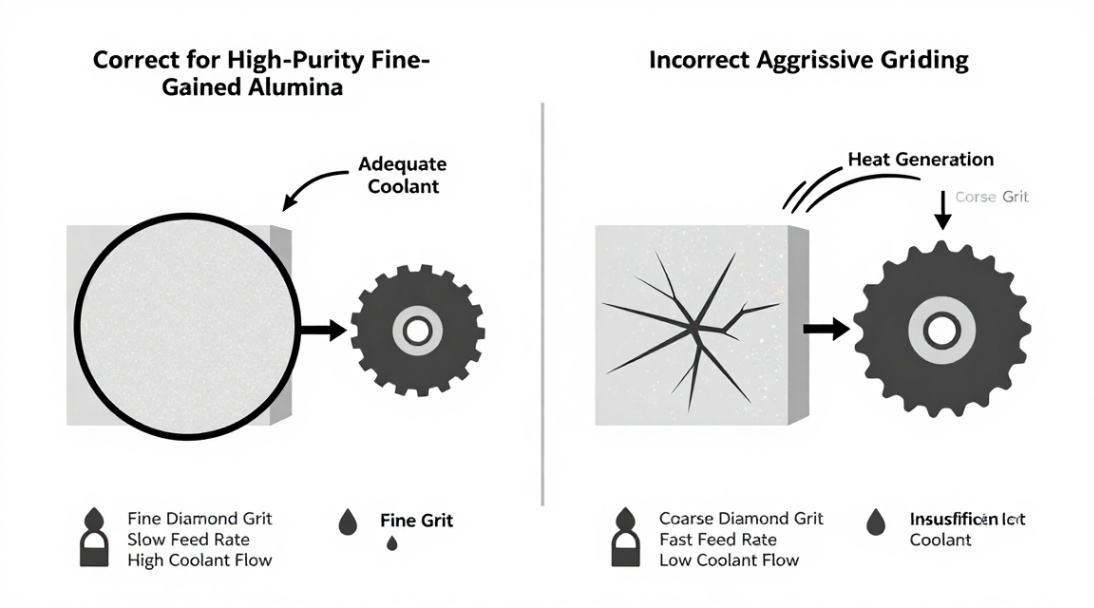
Post-sintering, alumina is near impossible to machine with conventional tools. It requires diamond grinding. A critical mistake is applying the same grinding parameters to all grades. A high-purity, fine-grained alumina requires a different diamond grit, feed rate, and coolant than a coarser, 88% alumina. Aggressive grinding on a high-purity part can introduce subsurface microcracks, creating latent failure points. The finishing process must be a specified part of the design, not an afterthought.
Why is corrosion resistance not a universal guarantee?
Alumina is chemically inert in many environments. However, it is susceptible to attack by strong alkalis and hydrofluoric acid. The glassy phase in lower-purity grades is particularly vulnerable. In one case, a 96% alumina seal failed rapidly in a hot, concentrated caustic solution. The solution was a shift to a higher-purity (99.5%) alumina or a different ceramic like boron nitride ceramic or reaction-sintered silicon carbide ceramics, which offer superior alkali resistance. Always consult a corrosion chart for your specific chemical milieu.
What is the critical error in joint design with alumina components?
The number one error is ignoring thermal expansion mismatch. Alumina’s coefficient of thermal expansion (CTE) is about 7-8 x 10⁻⁶/°C. Steel’s is roughly 12. Rigidly clamping an alumina plate to a steel frame over a large temperature swing will induce massive stress, guaranteed to crack the ceramic. Successful designs use compliant layers, flexible metal bellows, or clever mechanical floating supports. Never design a rigid, constrained assembly between alumina and common metals without a thermal expansion analysis.
How do I correctly select between alumina and other advanced ceramics?
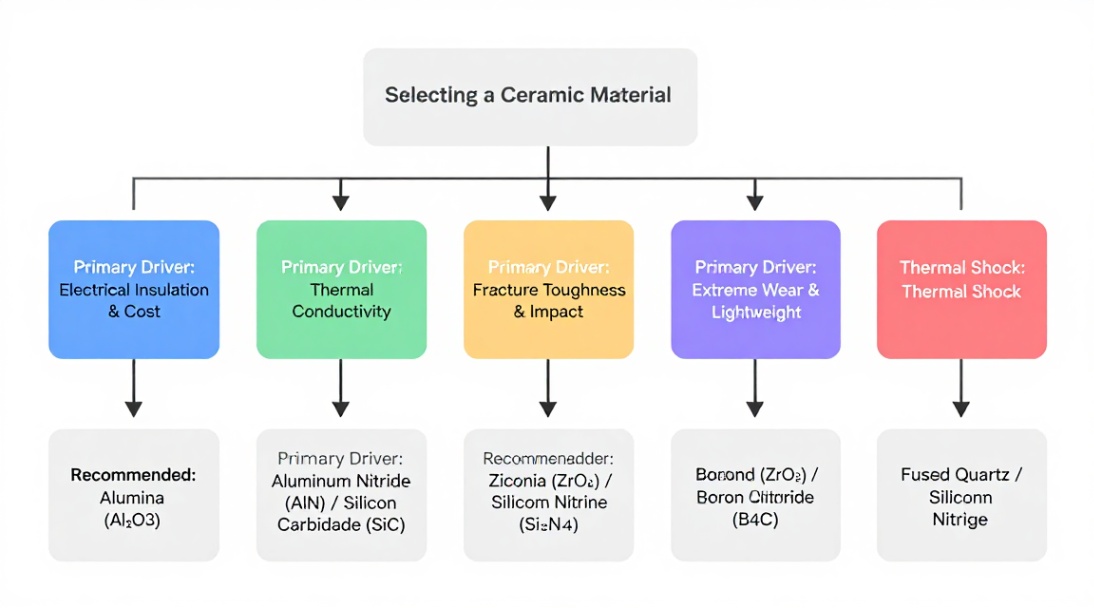
Use a decision matrix based on primary driver.
- Primary Driver: Electrical Insulation & Cost. Alumina is the default winner. It outperforms most polymers in temperature and wear.
- Primary Driver: Thermal Conductivity. Look at aluminum nitride or silicon carbide ceramic.
- Primary Driver: Fracture Toughness & Impact Resistance. Evaluate zirconia or silicon nitride ceramic.
- Primary Driver: Extreme Wear & Lightweight. Consider boron carbide ceramic.
- Primary Driver: Thermal Shock. Fused quartz ceramic or silicon nitride are superior. Alumina’s moderate thermal shock resistance is a key limitation.
The Path Forward: Informed Material Selection
The goal is not to dissuade you from using aluminum oxide ceramic. It is a workhorse material for good reason. The goal is to prevent its misuse. Start your next design review with a ruthless assessment of the actual operating environment: thermal profile, load type, chemical exposure, and electrical requirements. Then, match those needs precisely to a material’s datasheet properties, not its reputation. Consult with experienced materials engineers early. The right ceramic, specified correctly, is an engineering asset. The wrong one, or the right one used incorrectly, becomes the most expensive component in your assembly.
Suppiler
Synthetic-chemical focus on the research and development, production and sales of ceramic products, serving the electronics, ceramics, chemical and other industries. Since its establishment in 2015, the company has been committed to providing customers with the best products and services, and has become a leader in the industry through continuous technological innovation and strict quality management.
Our products includes but not limited to Aluminum Nitride, Aluminum Oxide, Boron Carbide, Boron Nitride, Ceramic Crucible, ect. If you are interested in any type of these, please feel free to contact us.