Next-Generation Ceramics: Unlocking Superior Properties for Industry

The Persistent Challenge of Component Failure
Are you specifying parts that need to survive environments where metals corrode and plastics melt? Have you faced costly downtime due to premature wear in abrasive processes, or struggled with thermal management in high-voltage applications? These are not isolated incidents. They signal a fundamental mismatch between material capabilities and operational demands. Many engineers default to traditional materials, only to encounter predictable limitations. This is precisely where the empirical logic behind selecting aluminium oxide ceramic becomes not just relevant, but essential.
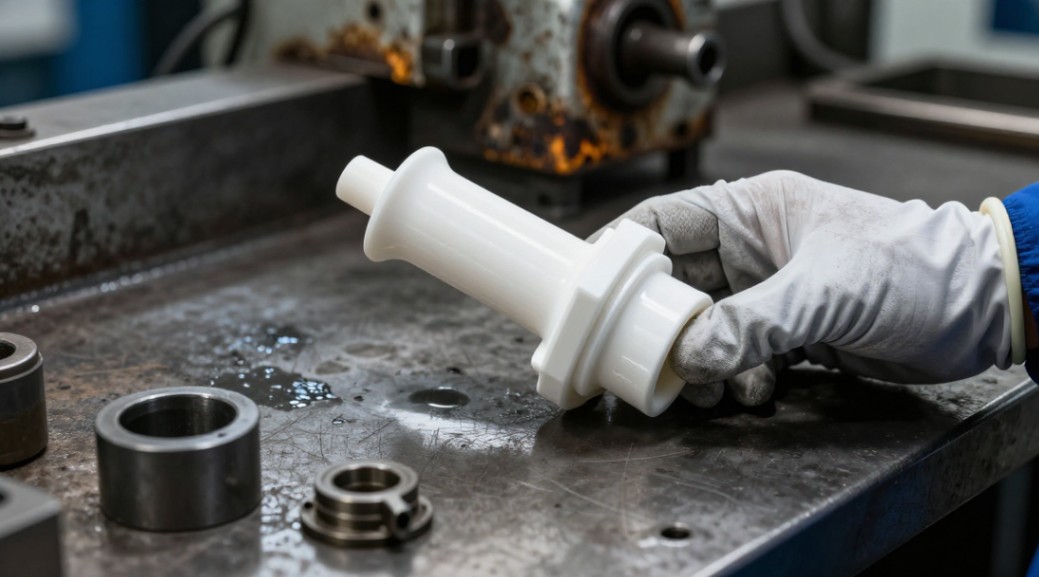
The Foundational Logic of Aluminium Oxide Ceramic
Aluminum oxide ceramic, or Al2O3, is not a modern novelty. Its dominance stems from a balanced, predictable suite of properties derived directly from its strong ionic bonds and stable crystal structure. Engineers do not choose it for a single standout feature, but for its reliable, multi-variable performance envelope. Let’s examine the core attributes through a logical, application-driven lens.
1. The Mechanical Argument: Predictability Under Stress
In applications involving friction, impact, or sustained load, material behavior must be calculable. Aluminum oxide provides this through intrinsic hardness and compressive strength.
- High Hardness & Wear Resistance: Its Mohs hardness of 9 (second only to diamond and boron carbide) makes it the default choice for abrasive and sliding wear. Components like seal faces, liners, and cutting tool inserts leverage this property to outlast metals by orders of magnitude.
- High Compressive Strength: Unlike metals that yield and deform, high-purity alumina fails in a brittle, predictable manner under excessive compressive load. This allows for precise engineering of support structures and load-bearing components.
2. The Electrical & Thermal Argument: Stable Insulation
Electrical and thermal management are often interconnected challenges. Aluminium oxide ceramic addresses both with inherent stability.
- Excellent Dielectric Strength & Volume Resistivity: This is why it forms the backbone of the electronics industry as substrates and insulators. It maintains insulation integrity at high temperatures where organic materials fail.
- Good Thermal Conductivity: While not matching aluminum nitride ceramic or silicon carbide ceramic, its thermal conductivity is sufficient to dissipate heat from sensitive electronic components, preventing hot spots and thermal runaway.
- High Melting Point (~2050°C): This provides a vast thermal operating window, ensuring dimensional and chemical stability in high-temperature furnaces or as thermocouple protection tubes.
3. The Chemical Argument: Inertness as a Strategic Advantage
Corrosion is a thermodynamic inevitability for most materials. Aluminum oxide ceramic resists this through thermodynamic stability itself.
- Near-Universal Chemical Inertness: It withstands attack from strong acids, alkalis, and molten metals. This makes it indispensable in chemical processing equipment, semiconductor manufacturing baths, and biomedical implants where ionic contamination is unacceptable.
- No Oxidation: Unlike non-oxide ceramics like silicon carbide or silicon nitride, which can oxidize in air at extreme temperatures, alumina is already in its fully oxidized, stable state.
The Critical Decision: Grade Purity and Manufacturing Logic
Specifying “alumina” is insufficient. Performance is dictated by purity and process. The logic chain is straightforward: higher purity and finer microstructure lead to enhanced properties, but at increased cost.
The 96% vs. 99.5%+ Al2O3 Dilemma
- 96% Alumina: Contains glassy silicate phases that sinter at lower temperatures. It offers good mechanical properties and is cost-effective for wear parts, insulators, and general industrial components where extreme corrosion resistance or ultra-high electrical properties are not critical.
- 99.5%+ High-Purity Alumina: The silicate phases are minimized. This results in higher hardness, superior wear and corrosion resistance, better high-temperature strength, and optimal electrical insulation. Use this for semiconductor wafer handling, advanced medical implants, high-performance mechanical seals, and demanding laboratory equipment.
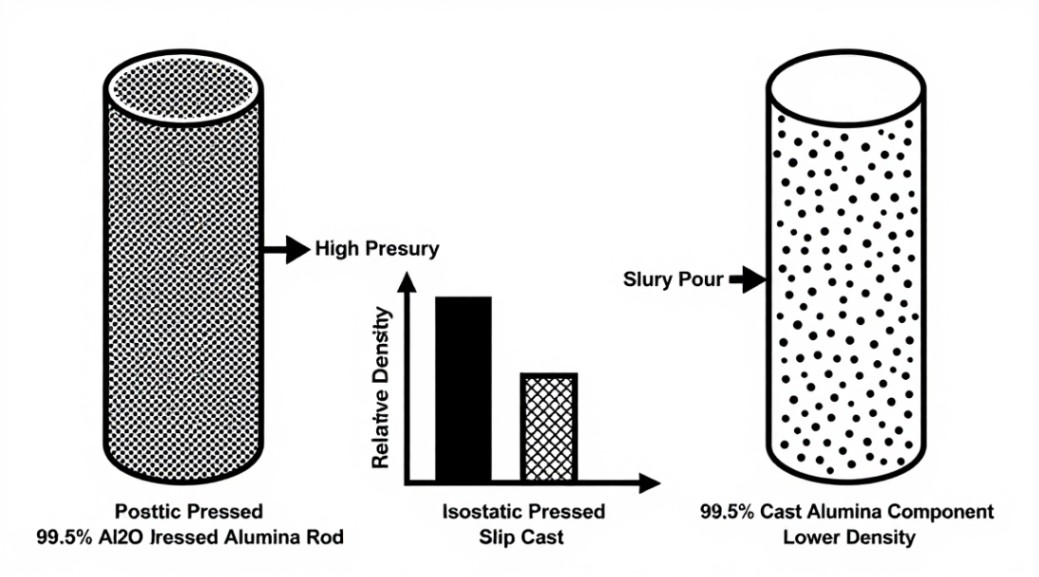
The manufacturing process-isostatic pressing, injection molding, or slip casting-further dictates final density and geometry capabilities. A pressed 99.5% alumina rod will outperform a cast one of the same purity due to higher density.
Industry Trends: The Context for Alumina’s Evolution
Aluminum oxide ceramic is not static. Its role is evolving within the broader advanced ceramics landscape, defined by two clear trajectories.
1. The Composite Trajectory: Addressing Brittleness
The principal drawback of monolithic alumina, like all advanced ceramics, is brittleness. The industry trend is toward composite structures to impart toughness.
- Fiber Reinforcement: Incorporating continuous ceramic fibers (e.g., alumina fibers into an alumina matrix) creates a composite that deflects cracks, significantly improving fracture toughness. This mirrors development paths for silicon carbide-bonded silicon nitride ceramics and other systems.
- Strategic Additions: Adding secondary phases like zirconia (via transformation toughening) can increase the fracture toughness of alumina composites for demanding mechanical applications.
2. The Ultra-High Temperature (UHT) Trajectory: Pushing Limits
While alumina’s melting point is high, next-generation aerospace and propulsion systems demand materials surviving beyond 2000°C. Research focuses on new oxide systems with melting points exceeding 3000°C. The key insight for all UHT ceramics, including alumina-based composites, is the necessity of forming a dense, continuous, and low-oxygen-permeability oxide layer in service. This layer is the primary barrier against ablation and erosion in extreme environments. Advances in sintering and infiltration strategies, similar to those used for Ultra-High Temperature Ceramic Matrix Composites (UHTCMCs), aim to achieve dense, tough microstructures at lower processing temperatures.
Making the Rational Material Choice
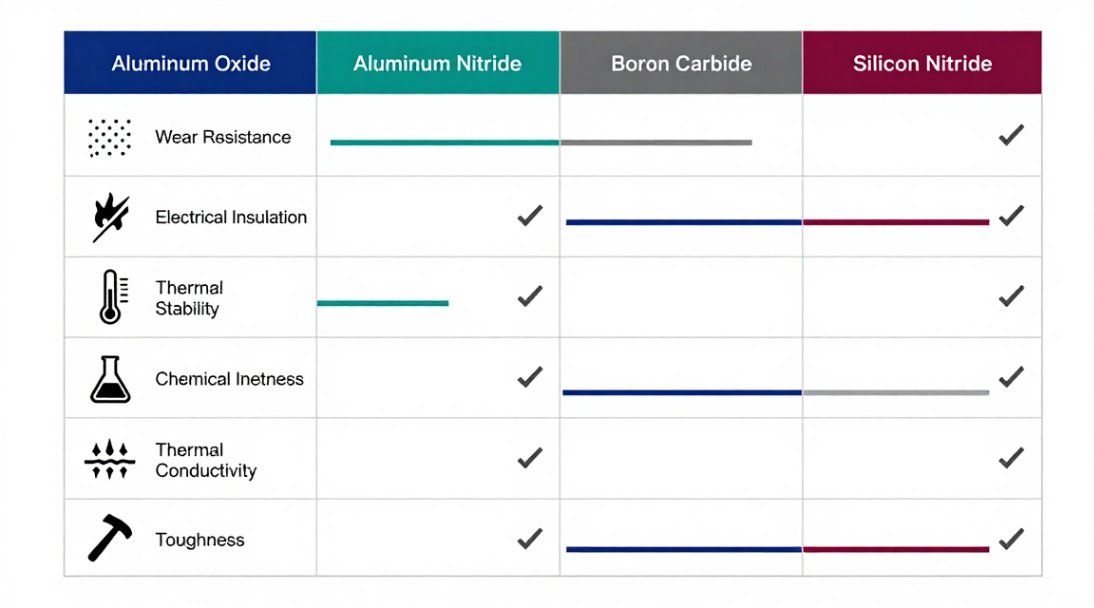
The selection of aluminum oxide ceramic is a decision based on eliminating failure modes. It is the rational choice when your application requires a simultaneous combination of wear resistance, electrical insulation, thermal stability, and chemical inertness. For applications requiring higher thermal conductivity, consider aluminum nitride. For extreme wear and lightweight armor, evaluate boron carbide. For very high toughness and thermal shock, look to silicon nitride.
Start your specification by defining the primary failure mechanism you must prevent. Then, select the alumina grade and manufacturing process that directly counteracts that mechanism. This logical, failure-mode-centric approach ensures material performance is a solved variable, letting you focus on system design.
Suppiler
Synthetic-chemical focus on the research and development, production and sales of ceramic products, serving the electronics, ceramics, chemical and other industries. Since its establishment in 2015, the company has been committed to providing customers with the best products and services, and has become a leader in the industry through continuous technological innovation and strict quality management.
Our products includes but not limited to Aluminum Nitride, Aluminum Oxide, Boron Carbide, Boron Nitride, Ceramic Crucible, ect. If you are interested in any type of these, please feel free to contact us.