Next-Generation Ceramics: Unlocking Superior Properties for Industry

Don’t Let Its Ubiquity Fool You
Aluminum oxide ceramic is not a generic commodity. It’s a precision-engineered material where a single overlooked detail-wrong purity, improper sintering, or a misguided substitution-can transform a reliable component into a costly, dangerous failure point. We’ve seen it happen too many times. This isn’t just theory; it’s a warning from the trenches of material science and engineering.
Mistake #1: Assuming All Aluminum Oxide Ceramic is the Same
This is the cardinal sin. Specifying ‘alumina’ without defining purity is like ordering ‘metal’ for a critical bearing. You might get cast iron when you needed tool steel.
The Purity Gamble
The performance chasm between 85% and 99.9+% aluminum oxide ceramic is vast. Lower purity grades (85%-96%) use silica-based fluxes for sintering. This creates a glassy phase at grain boundaries. It’s cheaper and easier to process, but that glass phase softens around 800°C, drastically reducing high-temperature strength and creep resistance. In corrosive environments, that glass can leach out, leading to pitting and failure.
Our Warning: Never use sub-99% alumina for applications above 1000°C or in strong acids/alkalis. The cost savings vanish with the first premature failure. For electrical substrates or ultra-high vacuum components, 99.5% purity is the bare minimum to ensure consistent dielectric strength and outgassing properties.
Mistake #2: Ignoring the Thermal Shock Achilles’ Heel
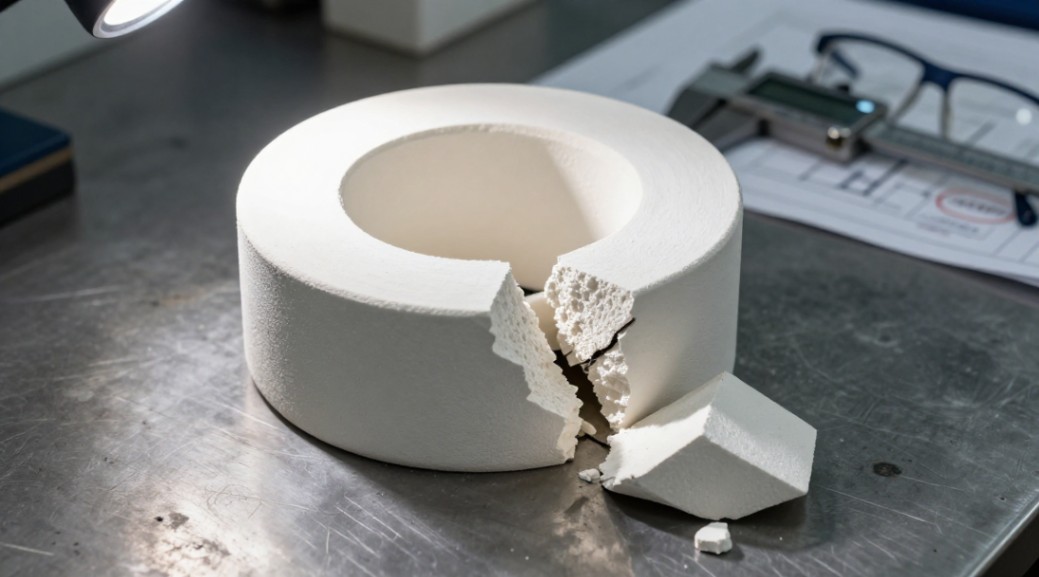
Yes, aluminum oxide ceramic has excellent high-temperature capability. But its relatively high coefficient of thermal expansion and moderate thermal conductivity make it vulnerable to rapid temperature changes. We’ve watched parts literally crack in half during a rapid cooldown cycle that a silicon nitride ceramic or silicon carbide ceramic would have shrugged off.
Designers often forget this. They design a sturdy alumina fixture for a furnace, not realizing that opening the door introduces a thermal shock the material can’t handle. The fracture toughness of standard alumina is low, typically 3-4 MPa·m¹/². A small surface flaw from machining can become the origin point for catastrophic crack propagation under thermal stress.
The Workaround You Need
If your design involves thermal cycling, you have two paths. First, design to minimize stress concentrators-use generous radii, avoid sharp corners. Second, seriously consider a composite or a different material. Mullite ceramic offers better thermal shock resistance. For extreme cases, the research into continuous fiber reinforcement, which can boost fracture toughness to 10-20 MPa·m¹/², points to the future of overcoming brittleness.
Mistake #3: Underestimating the Machining Cost Trap
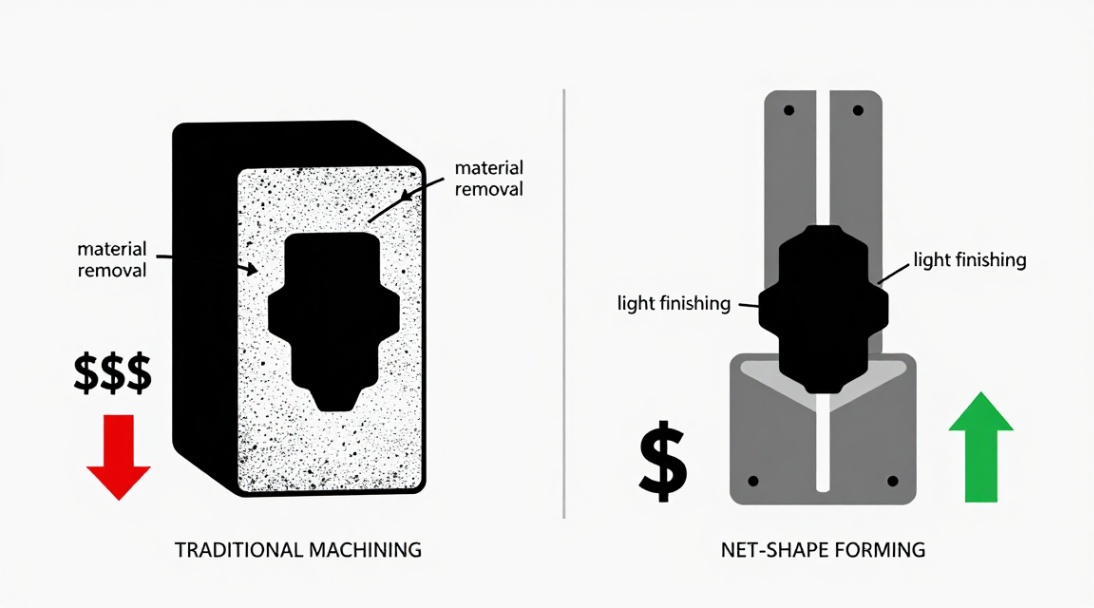
You’ve saved money on the raw material. Now prepare to spend ten times that amount on machining. Aluminum oxide ceramic in its sintered state is harder than most steels. Grinding it requires diamond-impregnated tools, specialized coolants, and slow, careful work. Complex geometries become exponentially more expensive.
Our Urgent Advice: ‘Net-shape’ or ‘near-net-shape’ forming is not just a buzzword; it’s a financial imperative. Work with your ceramic supplier during the design phase. Can you press, cast, or injection mold the part to its final geometry, minimizing the amount of material that needs to be ground away? This single decision often dictates project viability.
Mistake #4: Using It Where You Shouldn’t (The Wrong Tool)
Alumina is a fantastic workhorse, but it’s not always the champion. Blindly applying it will backfire. Here’s the quick comparison that saves projects:
- Vs. Zirconia: Need higher fracture toughness for a wear plate or biomedical implant? Zirconia (especially Y-TZP) is far tougher. Alumina’s hardness wins for pure abrasion, but zirconia resists impact.
- Vs. Silicon Nitride Ceramic: For high-stress, high-thermal-shock applications like turbine blades or bearing rollers, silicon nitride’s combination of strength and shock resistance is superior.
- Vs. Aluminum Nitride Ceramic: If thermal conductivity is your primary goal for a heat sink substrate, aluminum nitride ceramic conducts heat 8-10 times better than alumina.
- Vs. Boron Carbide Ceramic: For extreme lightweight armor, boron carbide is significantly harder and lighter.
Mistake #5: Neglecting Surface Finish & Compatibility
The surface is where your component interacts with the world. A poor finish on a medical implant invites bacterial colonization. A rough surface on a sealing face guarantees leaks. The as-sintered surface of alumina is rarely suitable for final use.
Furthermore, in high-temperature oxidizing environments, some metals can react with alumina. Think carefully about metallic holders or clamps. For crucibles, specialized coatings like those for boron nitride ceramic crucibles are often required to prevent reaction with molten metals. The ‘dense, continuous, oxide layer’ that ensures ablation resistance in ultra-high-temperature ceramics (UHTCs) is a principle to remember: your surface condition dictates longevity.
The Right Way Forward: A Strategic Material Partnership
Avoiding these pitfalls means treating aluminum oxide ceramic selection as a strategic decision, not a checkbox. You must match the purity, processing method, and design to the exact mechanical, thermal, and chemical demands of your application.
The future is in smart composites and advanced formulations. Research into high-entropy oxides, like the record-setting Hf0.85Ta0.15O with a melting point over 3000°C, shows the potential. Techniques like slurry infiltration for creating dense ceramic matrix composites at lower temperatures are game-changers for complex parts.
Stop Guessing. Start Succeeding.
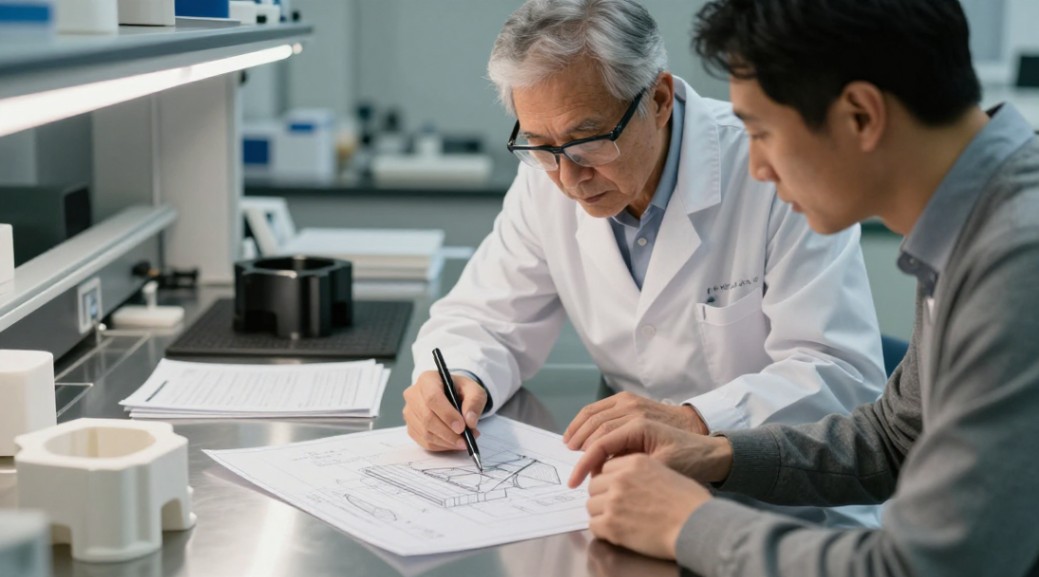
You don’t have to navigate this minefield alone. The single most effective action you can take is to consult with a true specialist before you finalize your design. We strongly recommend partnering with an experienced ceramic engineering firm who can guide you on grade selection, manufacturing feasibility, and design-for-ceramics principles.
Do not risk your project’s success on assumptions. Get a professional technical review and quote today. The right expertise turns aluminum oxide ceramic from a potential liability into your most reliable component.
Suppiler
Synthetic-chemical focus on the research and development, production and sales of ceramic products, serving the electronics, ceramics, chemical and other industries. Since its establishment in 2015, the company has been committed to providing customers with the best products and services, and has become a leader in the industry through continuous technological innovation and strict quality management.
Our products includes but not limited to Aluminum Nitride, Aluminum Oxide, Boron Carbide, Boron Nitride, Ceramic Crucible, ect. If you are interested in any type of these, please feel free to contact us.