Next-Generation Ceramics: Unlocking Superior Properties for Industry

The 96% Failure Rate Trap: Understanding Alumina’s True Nature
Industry data suggests that up to 96% of premature component failures involving aluminum oxide ceramic can be traced back to a misunderstanding of one key property: its exceptional brittleness. This isn’t a flaw; it’s a defining characteristic. Treating it like a metal or even another technical ceramic like silicon nitride ceramic is the first and most costly mistake you can make. This article details the non-negotiable rules for working with this demanding material.
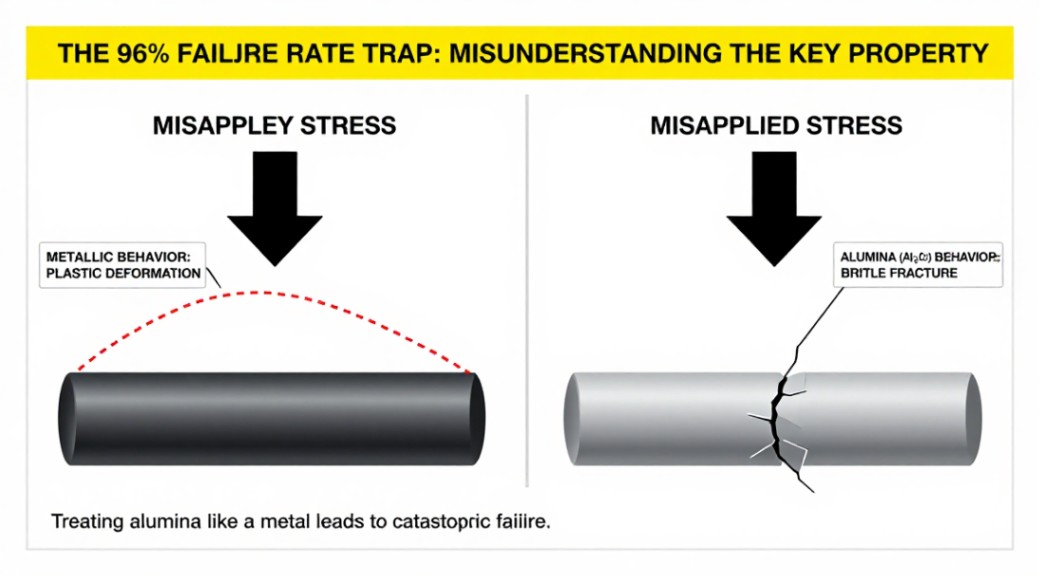
1. The Fatal Flaw: Designing for Strength Instead of Stiffness
Aluminum oxide ceramic boasts impressive compressive strength and high hardness. Engineers often focus on this. They design parts to handle high loads, assuming the material’s stated strength value is the primary limiting factor. This is incorrect.
What You Must Do Instead
- Design for Stiffness First: Alumina’s high elastic modulus makes it extremely rigid. This is its superpower. Use it to maintain dimensional stability under load, not just to bear load.
- Eliminate Tensile Stress: The material’s tensile strength is a fraction of its compressive strength. Always design to put the ceramic in compression. Use metal housings to pre-stress alumina components.
- Avoid Sharp Corners and Notches: Stress concentrates at geometric discontinuities. All internal corners require generous radii. A sharp 90-degree corner is a predetermined failure point.
2. The Thermal Shock Deception: It’s Not About Maximum Temperature
Alumina has excellent thermal stability, often rated for continuous use above 1500°C. Many assume this means it handles rapid temperature changes well. This assumption destroys components. Its relatively low fracture toughness and moderate thermal conductivity make it vulnerable to thermal shock, unlike materials like silicon carbide ceramic.
What You Must Do Instead
- Calculate the Thermal Shock Parameter (ΔTc): This critical value depends on strength, thermal conductivity, and expansion coefficient. For standard 96% alumina, rapid temperature changes exceeding 200°C can be dangerous. Know your grade’s limit.
- Control Heating and Cooling Rates: In applications like furnace components or wear parts in hot environments, enforce strict ramp-up and cool-down protocols.
- Consider Composite Solutions: For severe thermal cycling, evaluate mullite ceramic or silicon nitride ceramic which offer superior thermal shock resistance.
3. The Purity Paradox: When 99.5% is Worse Than 96%
A higher purity percentage (e.g., 99.5% vs. 96% Al2O3) seems unequivocally better. It often is for electrical insulation capabilities or extreme chemical resistance. However, the glassy silicate phase in 96% alumina can improve fracture toughness slightly and dramatically reduce sintering temperature and cost. Choosing the highest purity for every application wastes money and can introduce unnecessary brittleness.
What You Must Do Instead
- Match Purity to Function: Use 99.5%+ alumina for high-frequency electrical substrates, critical vacuum components, or semiconductor processing where ionic contamination is a risk. Use 92-96% alumina for most industrial wear parts, grinding media, and general-purpose insulators.
- Understand the Trade-offs: Higher purity often means higher hardness and better corrosion resistance, but also potentially lower mechanical reliability under impact and always a higher price.
- Never Specify Purity in Isolation: Always specify the required density, grain size, and surface finish (Ra) alongside purity. Manufacturing processes like dry pressing versus isostatic pressing directly affect these outcomes.
4. The Machining Mirage: Assuming “As-Fired” is “Ready-to-Use”
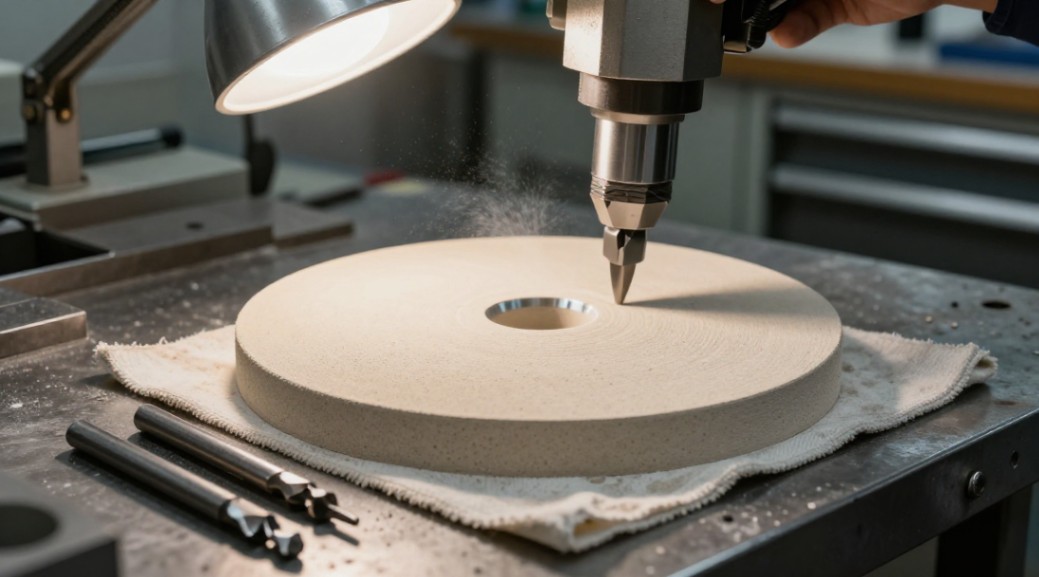
Sintered aluminium oxide ceramic is near-net-shape. It is not finished. Its extreme hardness and wear resistance make diamond grinding the only viable post-sintering machining method. Attempting to machine it with conventional tooling will destroy your tools and likely the part. Furthermore, the surface finish from sintering alone is rarely sufficient for dynamic seals or bearing surfaces.
What You Must Do Instead
- Budget for Diamond Grinding: Factor in the significant cost and time for precision grinding when comparing alumina to metals or polymers. This is non-negotiable for achieving tight tolerances.
- Specify Surface Finish Precisely: Do not use vague terms like “smooth.” Specify an Ra (arithmetic average roughness) value in microns. A lapped surface for a seal face requires Ra < 0.2 μm, which is a specialized process.
- Design for Grinding Access: Ensure your component geometry allows grinding wheels to reach all critical surfaces. Undercuts and deep, small holes may be impossible to finish properly.
5. The Application Mismatch: Using Alumina Where It Shouldn’t Be
Alumina is a fantastic material, but it is not universal. Its brittleness, thermal shock limitations, and high density disqualify it from many applications where engineers hope to leverage its hardness or electrical insulation capabilities.
What You Must Do Instead: The Material Selection Checklist
- Impact Loading Present? If yes, stop. Consider ductile metals or specialized high-toughness ceramics like zirconia-toughened alumina.
- Severe Thermal Cycling (> ΔTc)? If yes, stop. Evaluate silicon carbide ceramic or silicon nitride ceramic.
- Very High Thermal Conductivity Needed? If yes, stop. Aluminum nitride ceramic or boron nitride ceramic are superior choices.
- Extreme Abrasion with Heavy Impact? If yes, stop. Boron carbide ceramic or reaction-sintered silicon carbide ceramics may be necessary.
- Complex, Thin-Walled Geometry? If yes, pause. Injection molding of alumina is possible but expensive and shrinkage must be meticulously modeled. Isostatic pressing may be a better forming choice.
Moving Forward with Confidence
Success with aluminum oxide ceramic requires respecting its identity. It is not a direct replacement for anything else. Its value lies in its unique combination of high hardness, wear resistance, excellent dielectric strength, and bio-inertness (making it suitable for bioceramic implants). Use it where dimensional rigidity, electrical insulation, or abrasion resistance in corrosive environments are the primary demands. Avoid tensile stress, thermal shock, and impact. Specify properties like purity and finish based on function, not presumption. By following these logical guidelines, you harness one of engineering’s most capable, yet demanding, materials effectively.
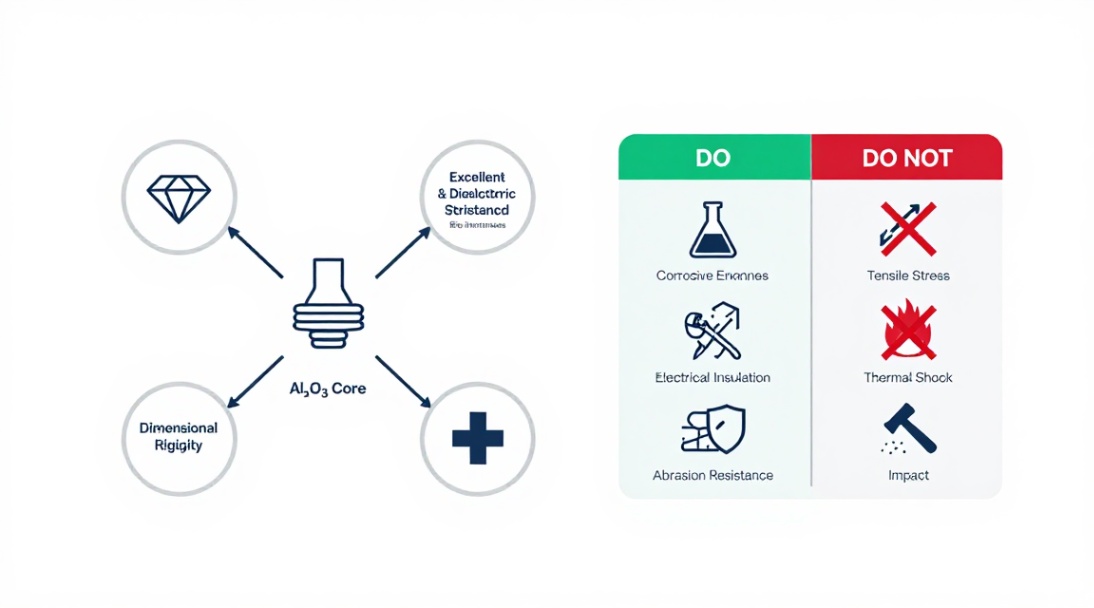
Your next step is a critical design review. Re-evaluate your component’s true load case, temperature profile, and functional requirements against these five points. The goal is not to avoid aluminium oxide ceramic, but to deploy it with the precision its performance demands.
Suppiler
Synthetic-chemical focus on the research and development, production and sales of ceramic products, serving the electronics, ceramics, chemical and other industries. Since its establishment in 2015, the company has been committed to providing customers with the best products and services, and has become a leader in the industry through continuous technological innovation and strict quality management.
Our products includes but not limited to Aluminum Nitride, Aluminum Oxide, Boron Carbide, Boron Nitride, Ceramic Crucible, ect. If you are interested in any type of these, please feel free to contact us.