Next-Generation Ceramics: Unlocking Superior Properties for Industry

The Silent Killer of Ceramic Performance
More than 60% of premature failures in aluminium oxide ceramic components stem from a single, overlooked choice made before the part is even fired. It’s not the service environment. It’s not the loading. The failure is locked in at the design stage by selecting the wrong purity grade. This mistake costs industries millions annually in downtime and replacement parts. Let’s fix that.
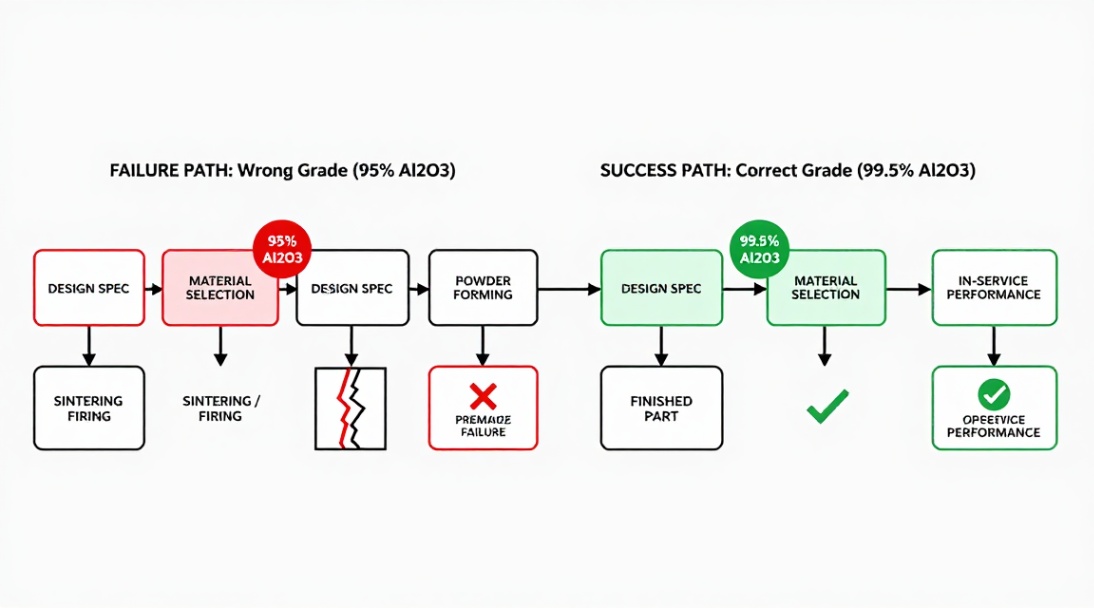
Critical Mistake #1: Ignoring Purity for “Strength”
You think higher purity always means better. It’s logical. For aluminum oxide ceramic, that logic fails under load. Choosing 99.8% alumina for a heavy-duty wear plate is a classic error. The ultra-high purity sacrifices fracture toughness for hardness. A 96% alumina grade, with its carefully engineered glassy phase, often handles impact and thermal shock far better. The wrong choice leads to catastrophic brittle fracture. Match the purity level to the mechanical stress profile, not a spec sheet.
The Purity-Performance Tradeoff
96% Al2O3 offers superior cost-effectiveness and thermal shock resistance for most industrial wear parts. 99.5% Al2O3 provides excellent corrosion resistance and electrical insulation for substrates. Reserve 99.8% Al2O3 for applications demanding ultimate hardness and purity, like certain biomedical implants or high-vacuum components. Never assume.
Critical Mistake #2: Treating It Like Metal
This is the most expensive error. You cannot machine aluminum oxide ceramic like stainless steel. Attempting to drill, mill, or turn it with standard tools guarantees ruined components and destroyed tooling. The extreme hardness demands diamond grinding, ultrasonic machining, or laser cutting from the start. Design for these processes. Incorporate radii, avoid sharp internal corners, and understand that tight tolerances require specialized, costly finishing.
Critical Mistake #3: Underestimating Thermal Expansion
Alumina’s thermal expansion coefficient is low, but it’s not zero. Designing a large ceramic-metal assembly without accounting for differential expansion invites disaster. The metal will contract and expand more than the ceramic, creating immense interfacial stresses. The ceramic part will crack. Always use compliant layers, designed clearances, or flexible adhesives. Never rigidly clamp a large alumina component to a dissimilar material across a wide temperature range.
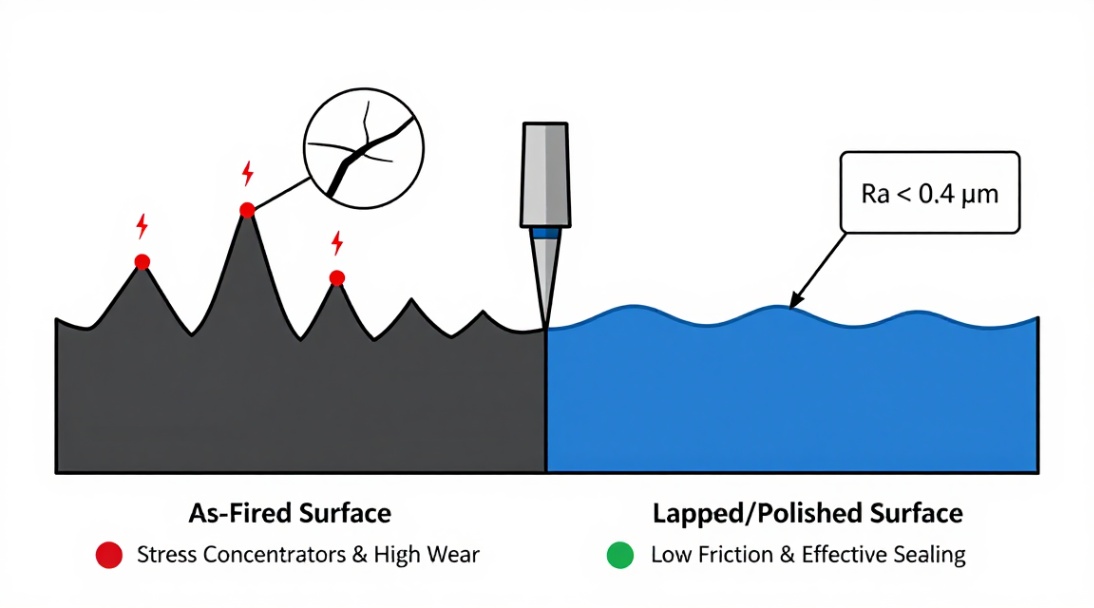
Critical Mistake #4: Overlooking Surface Finish Specs
“As-fired” is not a sufficient specification. The surface condition of your aluminum oxide ceramic directly controls performance. A rough, as-fired surface creates stress concentrators, weakening the part. For wear applications, a polished surface reduces friction and particle generation. For a sealing face, lapping to a specific Ra (roughness average) is non-negotiable. Vague requirements here lead to parts that technically meet the print but fail in function.
Beyond Aluminum Oxide: When to Consider Alternatives
Alumina excels in hardness, wear, and electrical insulation. But know its limits. For extreme thermal conductivity, look at aluminium nitride ceramic or silicon carbide ceramic. For the ultimate in toughness and biocompatibility, evaluate zirconia. For chemical inertness against molten metals, boron nitride ceramic is superior. Using alumina in the wrong extreme environment is a guaranteed breakdown. Silicon nitride ceramic offers better mechanical shock resistance for high-demand bearings.
Critical Mistake #5: Neglecting the Manufacturing Method
The process defines the properties. Dry pressed alumina parts are economical but can have density variations. Isostatically pressed components offer uniform, high density for critical applications. You would not use a dry-pressed tile as a high-pressure seal. The manufacturing method influences grain structure, porosity, and final strength. Specify the forming process with your supplier based on the part’s duty cycle.
Your Path to Success
Avoid these five pitfalls. Start by defining the actual operational environment: mechanical load, thermal cycle, chemical exposure, and electrical needs. Then, and only then, consult with an experienced ceramic engineer or fabricator to select the correct alumina grade, design for manufacturability, and specify the necessary post-processing. The material is capable of remarkable performance. Your design unlocks it.
Share this hard-won knowledge with your team. A five-minute conversation about purity grades and thermal expansion can prevent a six-month project delay. That’s the real value of understanding aluminium oxide ceramic.
Suppiler
Synthetic-chemical focus on the research and development, production and sales of ceramic products, serving the electronics, ceramics, chemical and other industries. Since its establishment in 2015, the company has been committed to providing customers with the best products and services, and has become a leader in the industry through continuous technological innovation and strict quality management.
Our products includes but not limited to Aluminum Nitride, Aluminum Oxide, Boron Carbide, Boron Nitride, Ceramic Crucible, ect. If you are interested in any type of these, please feel free to contact us.