Next-Generation Ceramics: Unlocking Superior Properties for Industry

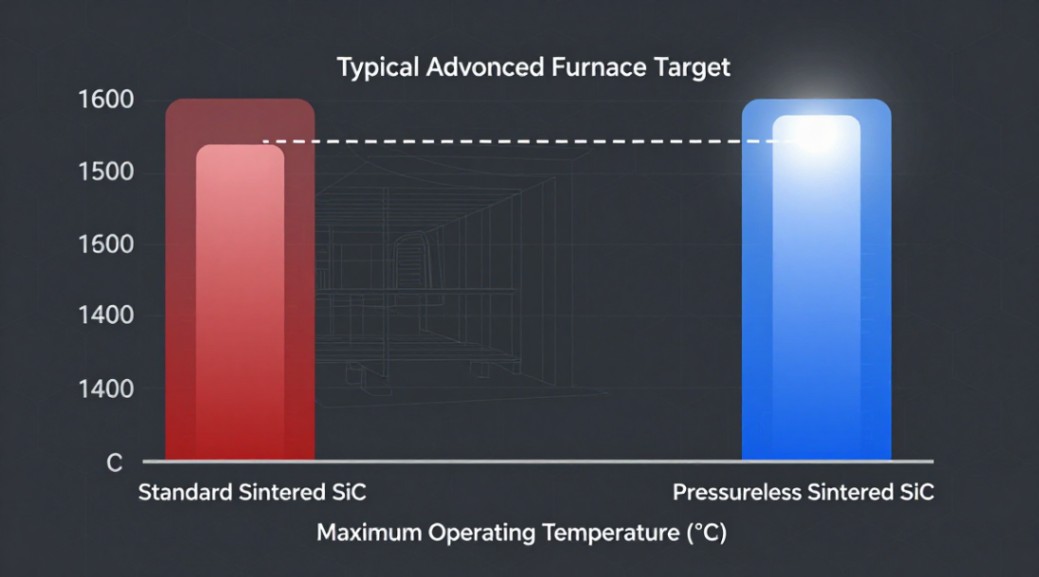
I remember the project that really drove this point home for me. A client was designing a new high-temperature furnace, pushing past 1500°C, and they were stuck deciding on the kiln furniture. They had quotes for standard sintered silicon carbide and something called pressureless sintered silicon carbide. The price difference was significant. “Just how much hotter can this pressureless stuff really go?” the lead engineer asked me over the phone, the fatigue audible. “Is the extra cost just for bragging rights, or is it a real solution?” It’s a moment I’ve lived through dozens of times. That gut-check, where theoretical material datasheets meet the hard limits of a real budget and a real thermal profile. So let’s talk about that number everyone chases: the pressureless sintered silicon carbide maximum operating temperature. More importantly, let’s understand what it means, how it compares, and when you absolutely need it.
The Engine Under the Hood: Why Pressureless Sintered SiC Can Take the Heat
First, we need to strip away the mystery from the name. Pressureless sintering is a manufacturing method. Think of taking ultra-fine, high-purity silicon carbide powder, mixing in a small amount of sintering aids (like boron and carbon), and forming it into a shape. Then, you fire it in a furnace at extreme temperatures-well over 2000°C-but crucially, without applying external pressure. The magic happens through solid-state diffusion. The particles essentially weld themselves together at the atomic level, creating a body that is nearly fully dense. This process is key. It eliminates most of the internal pores and creates a uniform, fine-grained microstructure. That microstructure is the foundation of its thermal fortress.
Two properties from this process become our heroes for high-temperature use: oxidation resistance and creep resistance. In an oxidizing atmosphere, the silicon carbide at the surface reacts with oxygen to form a thin, protective layer of silica (SiO2). This glassy scale acts as a barrier. It drastically slows down further oxidation. As long as this scale remains stable and adherent, the component is protected. Creep resistance is the material’s ability to resist slowly deforming under a mechanical load at high temperature. The strong, direct grain bonds formed during pressureless sintering give it exceptional resistance to this gradual, plastic flow. Without those bonds, a support beam in a kiln would slowly sag over time. That’s a failure no one wants to discover during a production run.
Navigating the Real-World Temperature Limits
So, what is the actual maximum operating temperature? This is where we move from a single, flashy number to a more nuanced conversation. The environment dictates the limit. In an inert atmosphere like argon or a vacuum, where oxidation isn’t a factor, the ceiling is extraordinarily high. We’re talking about continuous use in the range of 1650°C to 1800°C (3000°F to 3270°F). At these extremes, the limiting factor often becomes the gradual onset of sublimation or very slight microstructural coarsening, but the material remains functionally robust for a long time.
The story changes in air. The protective silica scale I mentioned has its own stability limit. Around 1700°C to 1750°C, that scale begins to break down. It can become more volatile or less protective. This establishes a practical, continuous maximum operating temperature in oxidizing atmospheres at about 1650°C (3000°F). Push beyond that, and the oxidation rate accelerates, consuming your component. You also must consider whether the part is under load. A radiant tube in a heat exchanger operating at 1550°C is under constant stress from internal pressure and thermal gradients. For such mechanically demanding roles, the safe continuous temperature might be prudently derated to 1550-1600°C to ensure decades of service. A static, unloaded insulation component in the same atmosphere could ride closer to that 1650°C limit.
The Comparison That Matters: Pressureless vs. The Alternatives
This is where the decision gets concrete. Let’s place pressureless sintered SiC next to its common cousins.
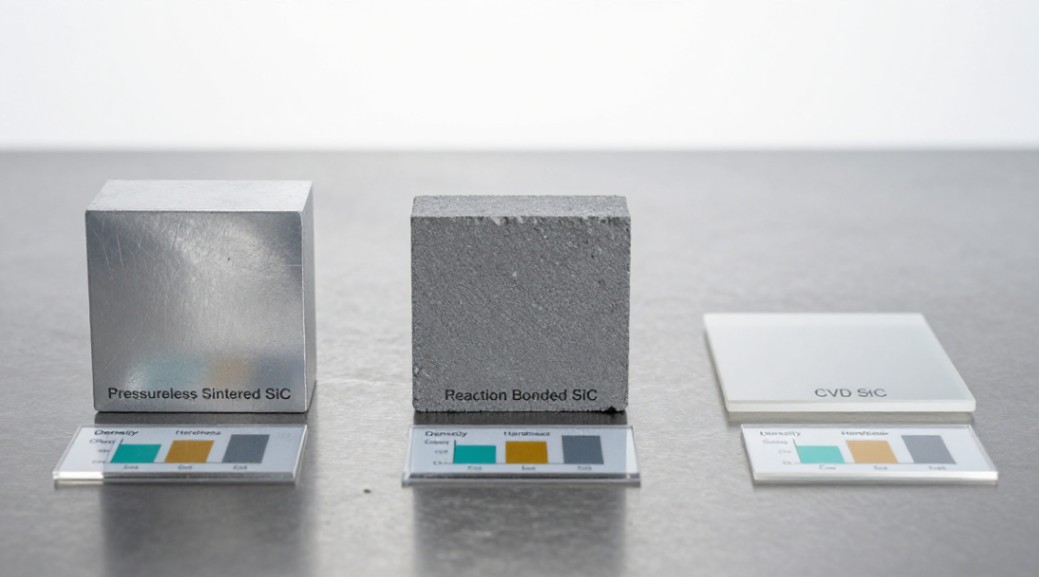
- Reaction-Bonded Silicon Carbide: This material is made by infiltrating a silicon carbide-carbon preform with molten silicon. It’s tough and has great thermal shock resistance. However, it contains free, unreacted silicon metal within its microstructure. That silicon melts at 1414°C. So, while the silicon carbide skeleton might be fine, the material loses a significant portion of its mechanical strength above that point. Its practical load-bearing limit is often around 1350°C. For high-temperature applications, this is a decisive disadvantage.
- Conventional Sintered Silicon Carbide: Here lies the most common point of confusion. Many sintered SiC grades use aluminium-based sintering aids. These aids help densification but can create secondary phases at grain boundaries that soften at high temperatures. This reduces creep resistance. You might see a datasheet claim a 1600°C limit, but under mechanical load, it may creep noticeably at 1500°C. Pressureless sintered SiC, typically using boron and carbon aids, maintains its grain boundary strength much higher. Its creep resistance is superior, granting it that extra 50-100°C of trustworthy performance under stress.
The purity of the starting powder and the type of sintering additives directly control this high-temperature performance. Higher purity means fewer impurities to form low-melting-point glasses at grain boundaries. Boron and carbon additives promote cleaner, stronger boundaries. When you’re evaluating grades, don’t just look at the density. Ask about the sintering aid system. The answer tells you everything about its true high-temperature intent.
Putting It to Work and Making Your Choice
You’ll find pressureless sintered silicon carbide earning its keep in the toughest spots. It’s the setter tile holding advanced ceramics at 1600°C for hours on end. It’s the recuperator tube in a glass melter, exposed to corrosive flue gases at blistering temperatures. It forms the burner nozzle in a high-velocity thermal oxidizer, where flame temperatures are extreme. In every case, the decision came down to a need for long-term dimensional stability and oxidation resistance where other materials would falter.
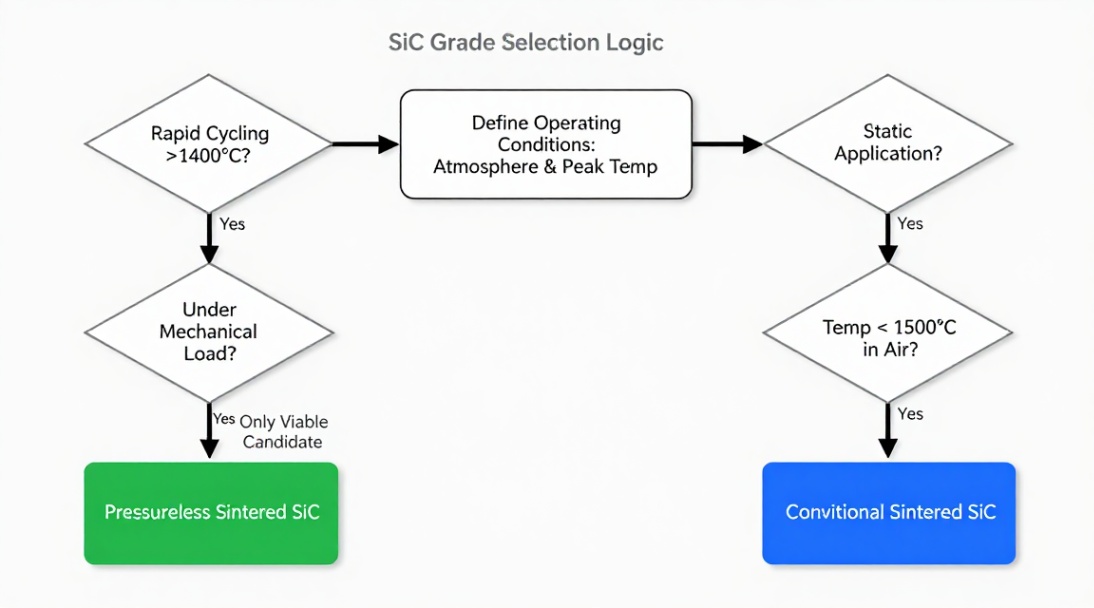
Selecting the right grade is a straightforward logic chain. First, define your actual operating atmosphere and peak temperature. Be honest about the mechanical load. Then, factor in thermal shock. Here’s a practical guideline: if your application involves rapid cycling above 1400°C under load, pressureless sintered SiC’s combination of high temperature strength and good thermal shock resistance often makes it the only viable candidate. For static, lower-stress applications in oxidizing conditions below 1500°C, a high-quality conventional sintered SiC might suffice and save cost. But when your design temperature flirts with 1600°C in air, or you need assured creep resistance for a critical load-bearing component, the investment in pressureless sintered silicon carbide transitions from an option to a necessity. It’s the material you specify when failure is not an equation you’re willing to solve.
For our furnace client, the choice became clear. Their process required stable, loaded supports at 1580°C in an oxidizing atmosphere for thousands of hours. The conventional sintered grade posed a creeping risk. They opted for the pressureless sintered silicon carbide. Five years later, those kiln supports are still in service, unchanged. That’s the real measure of a maximum operating temperature. It’s not a lab number. It’s the peace of mind that comes from a material engineered to hold the line, year after year, at the very edge of the thermal frontier. When you’re looking at your own thermal challenge, start by asking not just “how hot,” but “how hard, for how long, and at what cost of failure?” The answer will point you in the right direction.
Suppiler
Synthetic-chemical focus on the research and development, production and sales of ceramic products, serving the electronics, ceramics, chemical and other industries. Since its establishment in 2015, the company has been committed to providing customers with the best products and services, and has become a leader in the industry through continuous technological innovation and strict quality management.
Our products includes but not limited to Aluminum Nitride, Aluminum Oxide, Boron Carbide, Boron Nitride, Ceramic Crucible, ect. If you are interested in any type of these, please feel free to contact us.