Next-Generation Ceramics: Unlocking Superior Properties for Industry

I remember the first time a junior engineer brought me a failed part. A high-temperature furnace nozzle had shattered after only three thermal cycles. The root cause was obvious: they had chosen a 96% alumina grade for an application that required 99.5% purity. The lesson was hard, but it stuck. Aluminum oxide ceramic is not a single material. It is a family of materials, and picking the wrong member can cost you thousands.
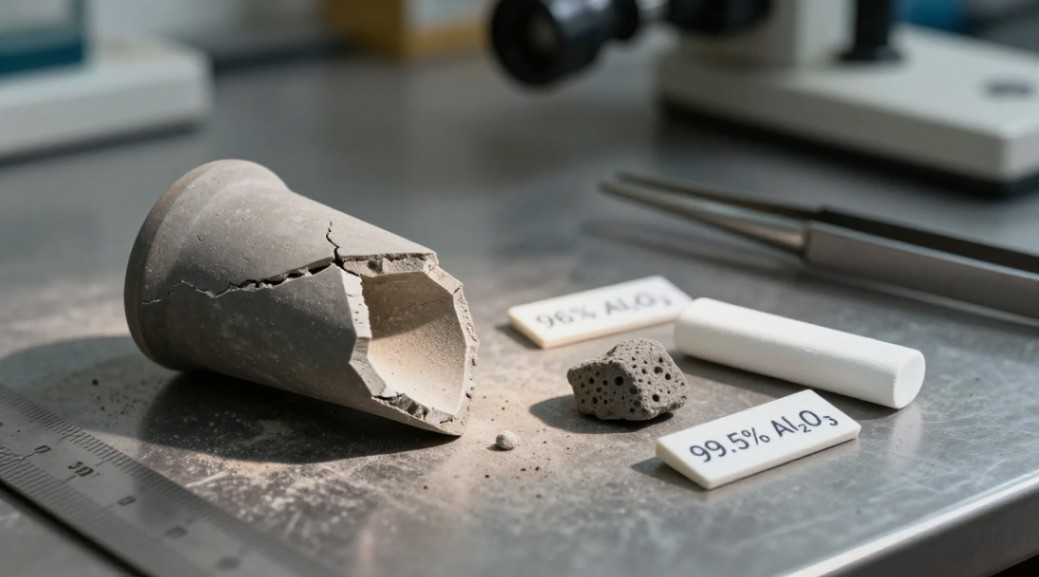
Step 1: Determine Your Service Conditions
Before you write a purchase order, you must answer three questions. What is the maximum operating temperature? Is the part exposed to corrosive chemicals or molten metals? Will it see cyclic thermal shock or steady-state heat? These answers dictate the grade of aluminum oxide ceramic you need.
| Service Condition | Recommended Alumina Grade | Key Limitation |
|---|---|---|
| Temperature up to 1600°C, steady state | 99.5% or 99.8% alumina | Avoid rapid temperature changes |
| Corrosive acid or alkali environment | 99.5% alumina (dense sintered) | 85% grades may leach impurities |
| Moderate wear, low cost priority | 85% or 90% alumina | Lower flexural strength |
| Electrical insulation at high frequency | 96% or 99.5% alumina | Surface finish must be controlled |
| Thermal shock resistance needed | Consider Mullite ceramic or a composite | Pure alumina is poor under thermal shock |
I have seen engineers specify aluminum oxide ceramic for thermal shock applications and then wonder why parts crack. Pure logic says: alumina has low thermal conductivity and high elastic modulus. When a hot surface suddenly cools, internal stresses exceed material strength. If you need thermal shock resistance, look at silicon carbide ceramic or silicon nitride ceramic composites. Do not blame alumina for a design mistake.
Step 2: Select the Correct Manufacturing Route
Aluminum oxide ceramic parts are made by powder pressing, sintering, and sometimes hot isostatic pressing (HIP). Your choice depends on part complexity, dimensional tolerance, and required density.
| Process | Relative Density | Tolerance Capability | Typical Use Case |
|---|---|---|---|
| Dry pressing + sintering | 95-98% | ±1% of dimension | Simple shapes: tubes, discs, plates |
| Isostatic pressing + sintering | 98-99.5% | ±0.5% | Long rods, crucibles, complex profiles |
| Hot Isostatic Pressing (HIP) | >99.9% | ±0.1% | High-performance seals, transparent alumina (sapphire) |
| Injection molding + sintering | 95-97% | ±0.3% | Small, intricate parts like insulators and nozzles |
Pick the simplest method that meets your density requirement. If you need maximum mechanical strength, go for HIP. If cost is king and the part is a simple liner, dry pressing works fine. Do not over-engineer the process. I have seen companies waste money on HIP for parts that only needed a standard sintered body.
Step 3: Specify Purity and Additives
Alumina grades are defined by purity. The rest is sintering aids like silica, magnesia, or calcia. These additives lower sintering temperature but degrade high-temperature performance and chemical inertness.
- 85% alumina: Contains significant glass phase. Good for wear-resistant tiles at room temperature. Not for corrosive environments.
- 96% alumina: The workhorse grade. Balances cost, strength, and electrical insulation. Used in electrical feedthroughs and mechanical seals.
- 99.5% alumina: High purity. Resists chemical attack. Retains strength up to 1600°C. Used for furnace components and semiconductor parts.
- 99.8% alumina (sapphire): Single crystal form. Optically transparent. Used for watch crystals and LED substrates.
If your application involves molten glass, aggressive acids, or high-temperature vacuum, choose 99.5% or higher. Lower purity aluminas will leach additives into your process. That contaminates your product. Logic dictates: the purer the material, the lower the risk of contamination.
Step 4: Account for Post-Sintering Machining
Aluminum oxide ceramic is hard. You cannot machine it like metal. All final dimensions must be achieved by diamond grinding, lapping, or polishing. This step controls surface finish, which directly determines flexural strength and fracture toughness.
| Surface Finish (Ra) | Effect on Strength | Application |
|---|---|---|
| <0.1 μm | Maximum flexural strength, no stress raisers | High-reliability mechanical seals, optical windows |
| 0.1 – 0.4 μm | Good performance, typical for engineered parts | Bearings, pump sleeves, electrical insulators |
| 0.4 – 1.0 μm | Reduced strength, risk of micro-crack initiation | Coarse wear liners, non-critical components |
| >1.0 μm | Significantly degraded, not recommended for structural use | Only for refractory aggregate or filler |
I tell every team: specify your surface finish on the drawing. Do not assume the manufacturer will deliver a polished surface if you only ask for a ‘smooth finish.’ The difference between a 0.2 μm and a 0.5 μm Ra surface can be the difference between a part that lasts ten years and one that fails in six months.
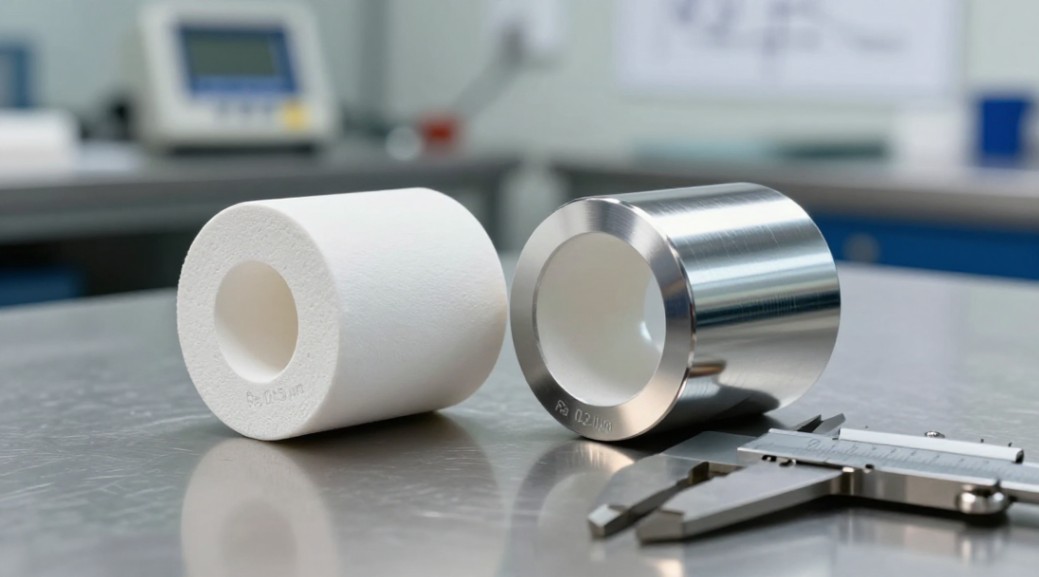
Step 5: Verify Performance with Logic, Not Hype
Once you have your aluminum oxide ceramic part in hand, test it against your service conditions. Do not trust a datasheet alone. Create a mock-up. Run a thermal cycle. Check dielectric strength at operating temperature. Measure dimensional change after exposure.
Common verification checks:
- Density measurement by Archimedes method (should match theoretical density per grade).
- Dielectric breakdown test per ASTM D149 (if used as an insulator).
- Thermal shock test: heat to 800°C, quench in water. If it survives, it is robust.
- Hardness test (Rockwell 45N or Vickers).
If your part fails in testing, go back to Step 1. Re-evaluate your service conditions. Perhaps you need a silicon carbide ceramic for thermal shock, or a boron nitride ceramic for non-wetting applications. Do not force aluminum oxide ceramic where it does not belong. It is a star performer in the right role, but it cannot be everything.
Comparison: Aluminum Oxide vs. Common Alternatives
Here is a quick reference for when you should choose aluminum oxide ceramic versus other technical ceramics.
| Property Requirement | Best Choice | Why Not the Other? |
|---|---|---|
| Cost-sensitive, good all-around performance | Aluminum oxide ceramic | Silicon nitride is more expensive, overkill for moderate wear. |
| Highest fracture toughness | Zirconia ceramic | Alumina is brittle by comparison. |
| Thermal shock resistance | Silicon carbide ceramic or Mullite ceramic | Alumina cracks under rapid temperature change. |
| High thermal conductivity (heat dissipation) | Aluminum nitride ceramic | Alumina conducts heat poorly. |
| Low friction / non-wetting | Boron nitride ceramic | Alumina has moderate friction and wets easily. |
| Extreme hardness (abrasion) | Boron carbide ceramic | Alumina is hard but boron carbide is harder. |
| Chemical inertness in acids | Aluminum oxide ceramic (99.5%+ grade) | Silicon carbide can be etched in strong alkalis. |
Use this table as a sanity check. If your application demands thermal shock resistance, do not fight the physics. Choose reaction-sintered silicon carbide ceramics or pressureless sintered silicon carbide ceramics. If you need electrical insulation with heat dissipation, look at aluminum nitride ceramic. But if you need a tough, affordable, chemically resistant ceramic for steady-state high-temperature work, aluminum oxide ceramic is your first choice.
Your Next Move: Stop Guessing, Start Testing
You now have a logical, step-by-step process. Do not jump to a random purity grade. Do not assume one process fits all. Use the tables in this guide. Match your service conditions to the correct alumina grade. Specify the manufacturing route. Control the surface finish. Verify the performance.
I strongly recommend you start with a sample order of aluminum oxide ceramic components from a supplier who offers at least three purity grades (85%, 96%, and 99.5%). Test each grade against your specific environment. The small cost of testing will save you from a catastrophic failure later.
Contact our technical sales team today. Tell us your operating temperature, chemical exposure, and mechanical load. We will provide you with a matched grade, a manufacturing route recommendation, and a sample for validation. Do not leave your next project to chance. Engineer it correctly from the start.
Suppiler
Synthetic-chemical focus on the research and development, production and sales of ceramic products, serving the electronics, ceramics, chemical and other industries. Since its establishment in 2015, the company has been committed to providing customers with the best products and services, and has become a leader in the industry through continuous technological innovation and strict quality management.
Our products includes but not limited to Aluminum Nitride, Aluminum Oxide, Boron Carbide, Boron Nitride, Ceramic Crucible, ect. If you are interested in any type of these, please feel free to contact us.