Next-Generation Ceramics: Unlocking Superior Properties for Industry

Why I Almost Gave Up on Aluminum Oxide Ceramic (And You Don’t Have To)
Five years ago, I watched a prototype fail right on the test bench. A custom mechanical seal, made from a 92% alumina grade, cracked at the first thermal cycle. My boss wasn’t happy. I felt stupid. We had chosen the material based on price alone, ignoring the real operating conditions. Sound familiar?
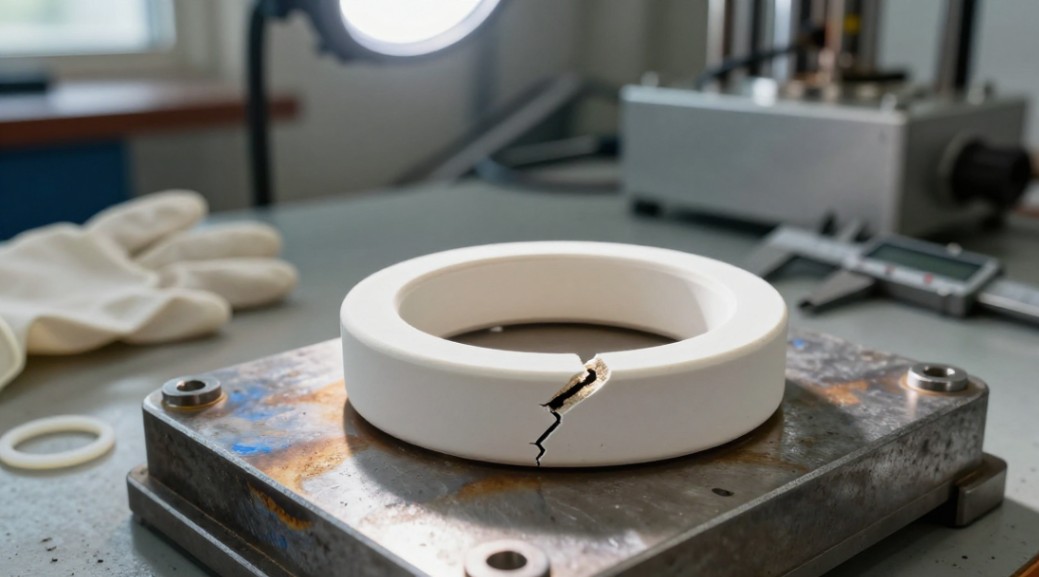
A lot of us have been there. We see “Aluminum oxide ceramic” on a spec sheet, see the low cost compared to silicon carbide or zirconia, and assume it is a universal fix. It isn’t. But once you understand the basic rules, it becomes one of the most reliable workhorses in advanced ceramics. Let me show you exactly what I learned the hard way.
1. First Step: Understand What Makes Aluminum Oxide Ceramic Tick
Before you even call a supplier, you need to know what you are dealing with. Aluminum oxide ceramic (specifically alpha-alumina) has a hexagonal crystal structure. This isn’t just chemistry trivia; it directly controls the material’s behavior.
Here is the short list of what that crystal structure gives us:
- Hardness and wear resistance. This is why we use it for cutting tools and abrasive media. It just does not wear out easily.
- Electrical insulation. High dielectric strength. Great for electronic substrates where you cannot afford a short.
- Chemical inertness. It shrugs off most acids and bases. We use it in chemical pump seals all the time.
- Thermal stability. It can handle continuous service up to 1600°C in oxidizing atmospheres. That is hot.
- Biocompatibility. Doctors trust it for hip implants and dental prosthetics. It does not react with body fluids.
2. Second Step: Pick the Right Grade (Don’t Guess)
This is where most people get tripped up. Aluminum oxide ceramic is not one material; it is a family. The grade depends heavily on the alumina purity and the manufacturing method.
Here is a quick rule of thumb. If your application needs maximum wear resistance and chemical purity, go for 99.5% or higher. If you need a good balance of strength and cost, stick with 96%. For cheap, high-volume parts where performance is secondary, 92% works. But be careful. Lower purity grades have more glassy phase at the grain boundaries, which can soften at high temperatures.
Common Manufacturing Methods: Sintering, Hot Pressing, Isostatic Pressing
How the part is made matters just as much as the purity.
- Sintering (Pressureless): This is the standard. Powder is compacted and heated. It is cost-effective for simple shapes and high volumes.
- Hot Pressing: We apply heat and pressure simultaneously. This gives a denser, stronger ceramic with finer grain size. Use this for critical high-stress parts.
- Isostatic Pressing (HIP or CIP): This applies pressure from all directions. It gives excellent uniformity in complex geometries. Great for armor tiles and large rods.
3. Third Step: Compare It Against the Competition (The Table You Need)
We hear a lot about other advanced ceramics. Silicon carbide, zirconia, aluminum nitride. Each has a place. But for many jobs, aluminum oxide ceramic is the smart choice. Here is a no-nonsense comparison based on real field performance.
| Property | Aluminum Oxide Ceramic | Zirconia (TZP) | Silicon Carbide |
|---|---|---|---|
| Hardness (Toughness context) | Very High (brittle) | High (Tougher, higher KIC) | Very High (brittle) |
| Cost | Low to Moderate | High | Moderate to High |
| Thermal Conductivity | Low | Low | Very High |
| Max Use Temperature (Air) | ~1600°C | ~1000°C | ~1600°C |
| Electrical Insulation | Excellent | Good | Conductive (Semi) |
| Chemical Resistance | Excellent (except strong alkalis) | Good (susceptible to steam aging) | Excellent |
| Best Use Case | Wear parts, electrical insulators, armor, refractories | Knives, dental crowns, structural components needing toughness | Mechanical seals, bearings, high-heat exchangers |
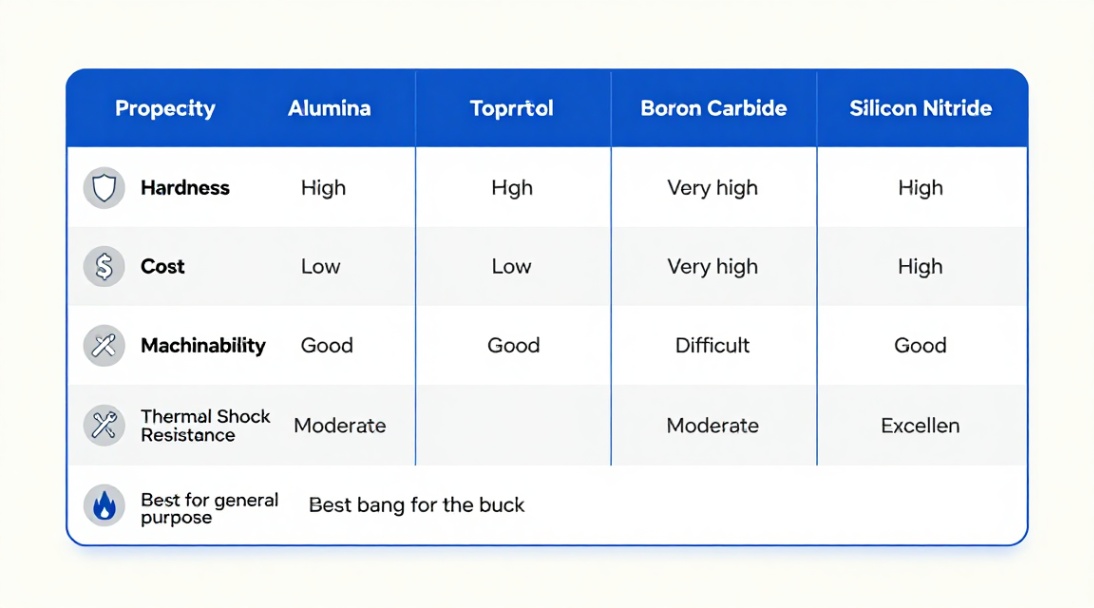
You will notice I did not put mullite, quartz, boron carbide, or silicon nitride in the main table for simplicity. But here is a quick tip: Boron carbide ceramic is lighter and harder than alumina for armor, but it is far more expensive and difficult to machine. Silicon nitride ceramic wins on thermal shock resistance. But for general purpose, aluminum oxide ceramic gives the best bang for the buck. Many users on Red’s Ceramics forum and Reddit flat-out say: “If you don’t need extreme thermal shock or ultra-high conductivity, just use alumina. It will save your budget.”
4. Fourth Step: Master the Machining and Finishing (This is Where It Gets Tricky)
Here is the honest truth: Aluminum oxide ceramic is hard to machine. It is brittle. If you try to cut it like metal, you will get chipping, cracking, and a lot of expensive scrap.
Follow these steps if you need secondary finishing:
- Always use diamond tooling. Carbide tools dull instantly. Diamond grinding wheels or drills are mandatory.
- Watch the feed rate. Too fast, and you fracture the surface. Too slow, and you generate excess heat that causes micro-cracks. A steady, moderate feed with coolant is best.
- Consider grinding. For tight tolerances, grinding is safer than single-point cutting. It distributes the load better.
- Lapping and polishing. If you need a mirror finish (like for a mechanical seal face), use a series of progressively finer diamond slurries. Start with coarse, end with 1-micron or finer. This reduces the surface roughness and improves sealing performance.
A common complaint we see: “I ordered finished parts, and they cracked during assembly.” This usually happens because the design has sharp internal corners. Always specify a radius in corners. Sharp edges are stress risers for ceramic.
Where You Will Actually Use This Stuff (Real Scenarios)
Let me paint you a picture of where this material thrives:
- Armor: You know those heavy plates in a bulletproof vest? Often, they are aluminum oxide ceramic (though boron carbide and silicon carbide are also used for lighter weight). It stops projectiles by being hard enough to shatter them.
- Mechanical Seals: In pumps handling corrosive chemicals, a seal face made of aluminum oxide ceramic outlasts metal seals by a factor of 10. It does not corrode.
- Refractory Liners: Furnace tubes and kiln furniture. It handles the heat and resists slag attack.
- Electronic Substrates: Thin sheets of high-purity alumina are the foundation for many microchips. They dissipate heat (reasonably well) and insulate electrically.
We also get questions about specialized materials like silicon carbide-bonded silicon nitride ceramics or reaction-sintered silicon carbide ceramics. These are niche solutions for extreme environments (like molten metal handling). For 90% of industrial wear, erosion, and high-temperature insulation problems, aluminum oxide ceramic is the simpler, cheaper answer.
Your Next Move (The Hard Sell)
Look, I have been where you are. Staring at a ceramic spec, wondering if you are going to make a costly mistake. The good news? You don’t have to learn it all by trial and error.
If you need aluminum oxide ceramic components that actually work on the first try, stop guessing. Our team has been manufacturing precision alumina parts for two decades. We source the right grade, use hot isostatic pressing for critical applications, and finish them with diamond grinding to your exact drawing. No chipping. No surprises.
Click here to get a free engineering review of your ceramic part design. We will tell you which grade to use, what tolerances are realistic, and give you a firm price. Do not let another prototype fail. Get the right part the first time.
Suppiler
Synthetic-chemical focus on the research and development, production and sales of ceramic products, serving the electronics, ceramics, chemical and other industries. Since its establishment in 2015, the company has been committed to providing customers with the best products and services, and has become a leader in the industry through continuous technological innovation and strict quality management.
Our products includes but not limited to Aluminum Nitride, Aluminum Oxide, Boron Carbide, Boron Nitride, Ceramic Crucible, ect. If you are interested in any type of these, please feel free to contact us.