Next-Generation Ceramics: Unlocking Superior Properties for Industry

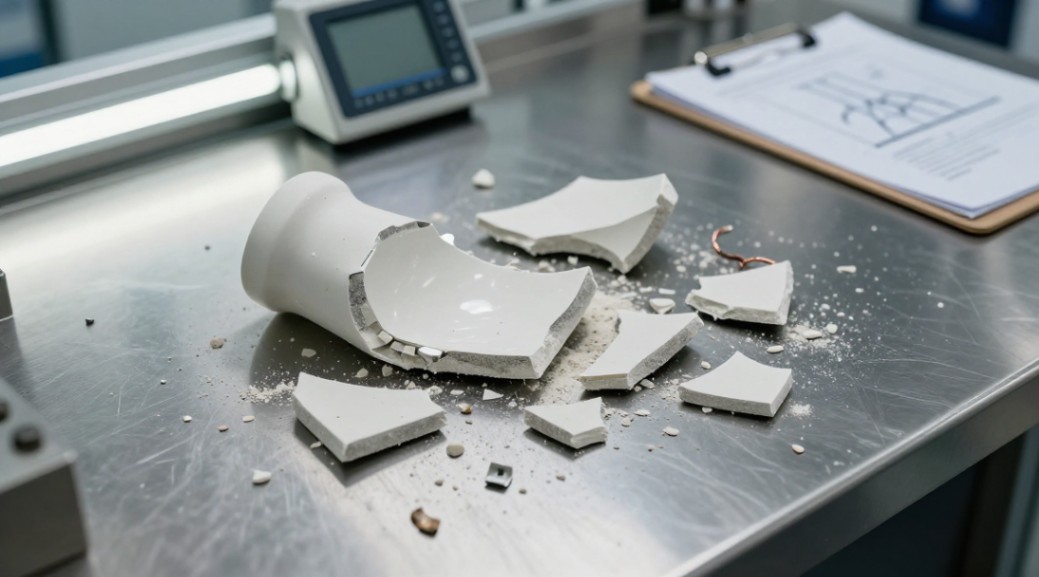
Twenty years ago, a colleague called me in a panic. A batch of high-voltage insulators—aluminum oxide ceramic, 94% purity—had shattered during final testing. The client was furious. The project was behind schedule. My colleague had assumed a standard grade would handle the thermal cycling. He was wrong. The parts failed because he overlooked one critical specification: the grain size distribution. That costly mistake taught me a lesson I want to share with you today. This article is a warning. Avoid these common traps with aluminum oxide ceramic.
1. Can I Use Any Aluminum Oxide Ceramic For High-Temperature Applications?
No. You cannot.
This is a classic error. Engineers grab a datasheet for “aluminum oxide ceramic” and assume it works at 1600°C. Pure alumina melts at 2072°C. But your 92% grade contains glassy phases—sintering aids like silica and calcia. These melt around 1400°C. Your part warps. Your seal leaks. Your process stops.
Use 99.5% aluminum oxide ceramic for sustained operation above 1400°C. For thermal shock resistance, consider Mullite ceramic or even Silicon carbide ceramic. Check your exact service temperature. Do not guess.
What about purity levels?
Three common grades dominate the market: 92% alumina, 96% alumina, and 99.5% alumina.
- 92% alumina: Good for general electrical insulation. Lower cost. Lower mechanical strength.
- 96% alumina: The workhorse. Excellent for thick-film substrates and mechanical seals. Good balance of properties.
- 99.5% alumina: High purity. Superior hardness, chemical resistance, and high-temperature stability. Use this for semiconductor components and medical implants.
Do not substitute a lower purity grade to save money on a critical part. I have seen this cause catastrophic field failures in pump seals. The repair cost was ten times the savings.
2. Is Aluminum Oxide Ceramic Harder Than Silicon Carbide Ceramic?
No. Silicon carbide ceramic is harder.
On the Mohs scale, aluminum oxide ceramic ranks 9. Silicon carbide ceramic ranks 9.5—next to diamond. For abrasive applications like grinding wheels and sandblasting nozzles, silicon carbide often outperforms alumina. However, Boron carbide ceramic (Mohs 9.5+) is even harder, used in armor and nuclear shielding.
If you need extreme wear resistance, consider Boron nitride ceramic for its unique lubricity, or Silicon nitride ceramic for its toughness. Match the material to the specific wear mechanism. Don’t assume alumina is the only answer.
3. Can I Machine Aluminum Oxide Ceramic Like Metal?
Never try conventional machining on a sintered aluminum oxide ceramic part.
Attempting to drill, tap, or mill a fired alumina component will shatter your tool and your workpiece. Aluminum oxide ceramic is extremely hard and brittle. It fractures easily under localized stress.
You must machine the part in its “green” (unsintered) state. Or use diamond grinding on the fired part. Grinding is slow and expensive. Plan your net shape before sintering. Use dry pressing, isostatic pressing, or injection molding to achieve the final geometry as much as possible.
For complex shapes, consider Pressureless sintered silicon carbide ceramics or Reaction-sintered silicon carbide ceramics which can be machined more easily than alumina. But check your cost budget.
What about grinding and polishing?
Diamond grinding is the standard method. It generates heat. Use coolant. Surface finish down to 0.1 µm Ra is possible. But expect cost increases. Grinding can add 30–50% to the part price.
4. Is Aluminum Oxide Ceramic Chemically Inert In All Environments?
No. It has specific weaknesses.
Aluminum oxide ceramic resists most acids and alkalis. But it dissolves in hot concentrated alkalis like sodium hydroxide. It also reacts with fluorine gas and certain molten salts. I have seen pump components fail in a caustic process stream because the engineer assumed “ceramic = invincible.”
Check your chemical compatibility. For extreme corrosive environments, consider Silicon carbide-bonded silicon nitride ceramics or special coating for boron nitride ceramic crucibles to protect the surface. Do not rely solely on the alumina’s natural resistance.
5. Why Does My Aluminum Oxide Ceramic Part Crack Under Load?
Because you ignored its fracture toughness.
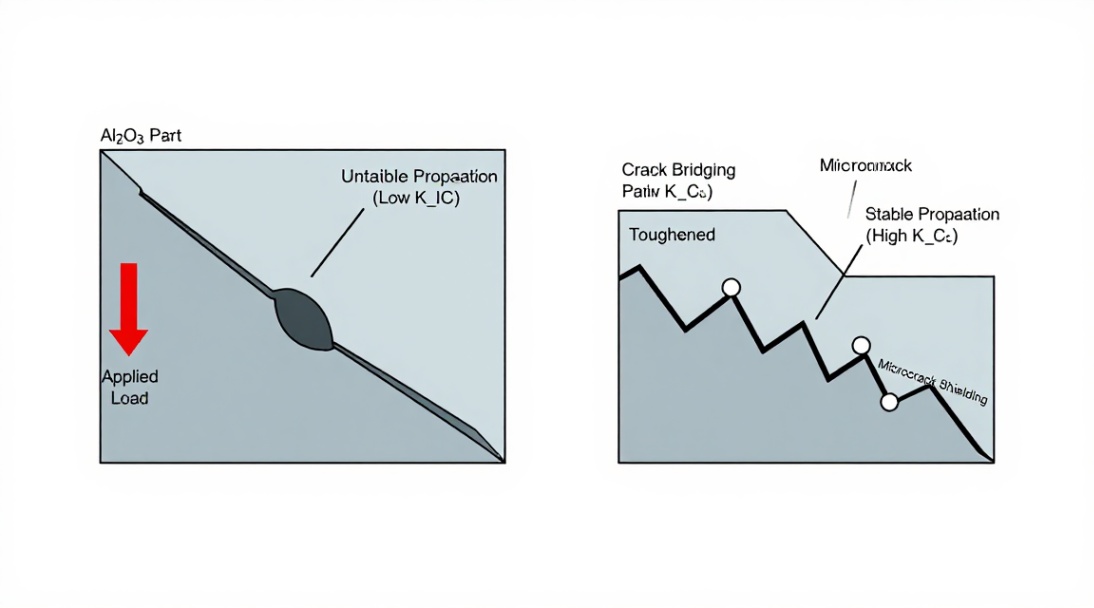
Aluminum oxide ceramic has high compressive strength, but low tensile strength. It behaves as a linear elastic material. When a crack initiates (from a surface scratch, micro-porosity, or impact), it propagates catastrophically. This is brittle failure.
Zirconia ceramic has higher fracture toughness due to transformation toughening. If your application involves thermal shock or impact, switch to zirconia or a composite. Aluminum nitride ceramic offers better thermal conductivity but is not tougher. Do not over-constrain your alumina part during assembly. Use compliant gaskets and controlled clamping forces.
One engineer I advised had a bearing component fail repeatedly. The problem was a sharp corner in the design. A stress concentration of just 0.5 mm radius was enough to initiate failure. He changed the fillet radius to 2 mm. Problem solved.
6. What Are The Key Applications Where Aluminum Oxide Ceramic Excels?
Aluminum oxide ceramic is the dominant technical ceramic by volume. It is a workhorse, not a wonder-worker. Use it where its specific strengths align with your requirements.
- Abrasives and cutting tools: Aluminum oxide grinding wheels and sandpaper. It sharpens to a hard, fine edge.
- Biomedical implants: High-purity alumina (99.5%+) is biocompatible, corrosion-free, and wear-resistant. Used in hip joint bearings and dental implants.
- Electronics substrates: Thin-film and thick-film circuits rely on alumina’s excellent electrical insulation and thermal conductivity (moderate). 96% alumina is the standard.
- Wear-resistant components: Mechanical seals, bearing balls, pump impellers, and nozzle liners. Alumina outperforms many metals in abrasive environments.
- Electrical insulation: Spark plugs, insulators for high-voltage equipment, and feedthroughs. Alumina remains stable under high voltages.
What are the limitations?
Honesty requires this list.
- Brittleness: Low fracture toughness. Not for impact loads.
- Difficult machining: Diamond grinding only after sintering. Expensive.
- Thermal shock sensitivity: Not as good as silicon carbide or aluminum nitride ceramics.
- Cost: More expensive than metals, less expensive than many other advanced ceramics like Boron carbide ceramic.
7. How Do Manufacturing Methods Affect My Final Part Quality?
Your choice of forming method directly controls the part’s consistency, cost, and properties.
Dry pressing: Fast, low cost for simple shapes. Limited geometry. Good for spark plugs and insulators.
Isostatic pressing: Uniform density throughout the part. Better for complex geometries like tubes and rods. More expensive.
Injection molding: Allows intricate, net-shape parts. High tooling cost. Excellent for high-volume production of small components.
Sintering: The critical step. Temperature, time, and atmosphere control final density and grain size. Under-sintered parts are porous and weak. Over-sintered parts can warp or contain large grains that reduce strength.
Do not buy sintered alumina parts from an uncertified supplier without requesting a grain size report. A 0.5 µm difference in average grain size can double the wear rate.
8. What Is The Trade-Off Between Aluminum Oxide And Other Technical Ceramics?
Let me be direct. For pure thermal conductivity, choose Aluminum nitride ceramic or Silicon carbide ceramic. For maximum toughness, choose Zirconia ceramic. For extreme hardness, choose Boron carbide ceramic. For high-temperature structural applications, choose Silicon nitride ceramic or Reaction-sintered silicon carbide ceramics.
Aluminum oxide ceramic wins on the combination of availability, cost, electrical insulation, wear resistance, and chemical inertness. It is the default choice. But do not default when your application demands a specialist material. I keep a decision matrix on my wall: list your top three requirements, then check the ceramic that satisfies all three.
Conclusion: One Simple Step To Avoid Failure
Here is your takeaway. Before you finalize your material selection, answer these three questions:
- What is the exact maximum service temperature and thermal cycling profile?
- What chemicals contact the part (concentration, temperature, pH)?
- What is the loading type: static, cyclic, impact, or wear?
If you answer these honestly, you will select the right aluminum oxide ceramic grade—or realize you need a different ceramic entirely.
My colleague from that failed insulator project? He now uses a standard checklist before every material selection. He has not had a field failure in eight years.
Do you need a reliable supply of high-purity aluminum oxide ceramic parts with verified properties? We can provide samples and full certification data. Contact our engineering team directly.
Suppiler
Synthetic-chemical focus on the research and development, production and sales of ceramic products, serving the electronics, ceramics, chemical and other industries. Since its establishment in 2015, the company has been committed to providing customers with the best products and services, and has become a leader in the industry through continuous technological innovation and strict quality management.
Our products includes but not limited to Aluminum Nitride, Aluminum Oxide, Boron Carbide, Boron Nitride, Ceramic Crucible, ect. If you are interested in any type of these, please feel free to contact us.