Next-Generation Ceramics: Unlocking Superior Properties for Industry

Your Material Is Burning Through Your Budget
Have you ever watched a high-performance component fail six months early? The seal leaks. The insulator cracks. The tool edge dulls. You recalculate, redesign, and hope next time will be different. That cycle is expensive. It eats time and money. The root cause is often simple: a material selection that traded long-term reliability for short-term savings. You need a ceramic that delivers consistent performance without the premium price tag. That ceramic is aluminum oxide ceramic.
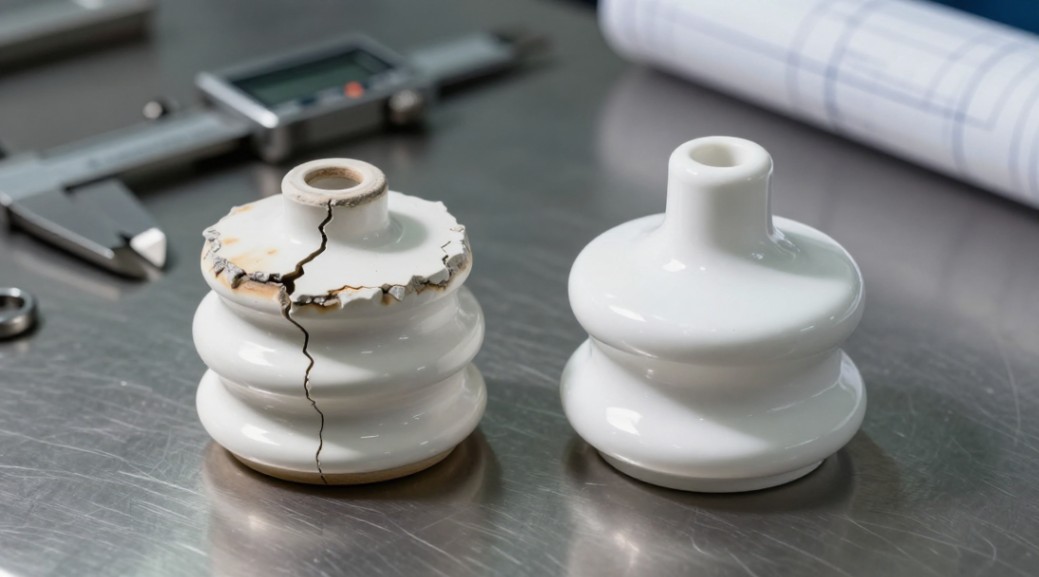
Don’t mistake this for a generic solution. Aluminum oxide—also known as alumina—is the workhorse of technical ceramics for a reason. Not because it’s the strongest, or the toughest, or the cheapest. Because it offers the best balance. It’s the material that engineers choose when they cannot afford a gamble. Let’s cut through the marketing fluff. Here is what matters.
The Hard Truth About Alumina Grades
Not all aluminum oxide is created equal. Ignore the label ‘ceramic‘ and focus on the number. The percentage of alumina content dictates almost everything: strength, wear resistance, thermal stability, and cost. Understanding this trade-off is the difference between a component that lasts and a warranty claim.
| Alumina Grade | Key Strengths | Critical Trade-offs | Typical Applications |
|---|---|---|---|
| 85% Alumina | Lower cost; good electrical insulation; easy to metalize | Lower strength; higher porosity; less corrosion resistant | Electrical insulators, resistor cores, low-cost wear parts |
| 96% Alumina | Excellent hardness; good mechanical strength; very cost-effective | Fracture toughness still moderate; not for extreme thermal shock | Mechanical seals, thick-film substrates, pump components |
| 99% Alumina | High density; superior wear resistance; better chemical inertness | Higher sintering cost; more difficult to machine | Cutting tools, high-wear nozzles, biomedical implants |
| 99.9% Alumina | Near-theoretical density; maximum strength and corrosion resistance | Highest cost; requires advanced processing (e.g., hot isostatic pressing) | Semiconductor components, high-temperature labware, critical aerospace parts |
Notice a pattern? Purity is not a gimmick. It is a direct lever on performance. Go from 85% to 99.9%, and you gain density, strength, and corrosion resistance. You also gain cost. The trick is to match the grade to the real operating conditions, not the wishful ones. A 96% grade will save you money in a low-wear electrical housing. Use it in a high-pressure slurry pump, and you are asking for failure.
Manufacturing: Where the Magic (and the Mistakes) Happen
Aluminum oxide ceramic does not leave the factory ready to use. It starts as a powder. How that powder is formed and fired determines the final part’s quality. There are three rules to remember. First, grain size controls wear. Smaller grains mean harder, smoother surfaces. Second, sintering density controls strength. A part with 95% density is not 5% weaker than a 99% dense part. It can be ten times weaker. Third, machining is expensive. The fired ceramic is harder than almost anything. You cannot drill it after sintering unless you use diamond tooling. Design your geometry for the green state.
The common methods are pressing, extrusion, and injection molding. Pressing is cheap for simple shapes. Extrusion works for tubes and rods. Injection molding gives you complex geometry but requires expensive tooling. For the highest performance parts, hot isostatic pressing (HIP) is used. HIP applies heat and pressure uniformly. It removes internal porosity. The result is a material that approaches theoretical maximum density. Use HIP for components that cannot fail. Skip it for parts where a 5% failure rate is acceptable.
Alumina vs. The Competition: Who Wins and Who Cracks
Alumina has a reputation problem. It is considered ‘basic.’ Advanced ceramics like zirconia, silicon carbide ceramic, and boron carbide ceramic get the headlines. They have higher strength or toughness. But they also have higher cost and more difficult processing. The real question is: does your application need the headline numbers, or does it need a workable solution?
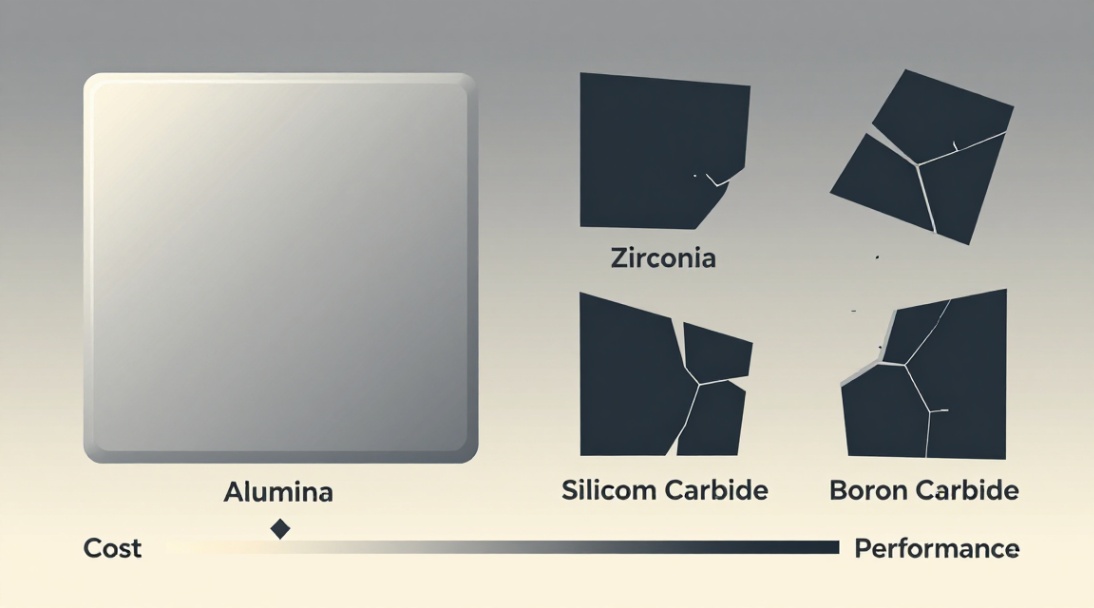
| Ceramic Type | Strength & Toughness | Wear Resistance | Thermal Conductivity | Cost (Relative to 96% Alumina) | Best Use Case |
|---|---|---|---|---|---|
| Alumina (96%) | Good; moderate toughness | Excellent | Moderate (20-30 W/mK) | 1x (Baseline) | General wear, electrical insulation, mechanical seals |
| Zirconia | Very high toughness (can be 2-3x alumina) | Good | Low (2-3 W/mK) | 3-5x | High-stress structural parts, blade guides |
| Silicon Carbide | Very high hardness; moderate toughness | Exceptional (2x alumina) | Very high (100-200 W/mK) | 2-4x | Mechanical seals in corrosive environments, heat exchangers |
| Boron Carbide | Extreme hardness (3rd hardest material) | Superior | Moderate (30-50 W/mK) | 5-10x | Armor, abrasive nozzles, lightweight ballistic protection |
Here is the counterintuitive part. If you only look at toughness numbers, zirconia wins. But zirconia suffers from low-temperature degradation. It can spontaneously weaken in humid environments over time. Alumina does not. If you only look at wear rate, silicon carbide ceramic wins. But silicon carbide is extremely brittle. A single thermal shock or impact can shatter it. Alumina handles impact better. The choice is not about picking the ‘best’ ceramic. It is about picking the ceramic that fails the slowest in your specific environment.
When Alumina Fails (And What to Use Instead)
Alumina has real limitations. Do not ignore them. It has lower fracture toughness than zirconia. It will not survive extreme thermal gradients without cracking. It is also difficult to machine after sintering. If you need a component that sees repeated thermal shock, consider a material like reaction-sintered silicon carbide ceramics or recrystallized silicon carbide ceramics. These materials handle rapid heating and cooling much better. If you need extreme wear in a chemically aggressive environment, silicon nitride ceramic or aluminum nitride ceramic may outperform alumina. Aluminum nitride has higher thermal conductivity and is better for electronics thermal management.
But here is the catch. Those advanced ceramics often require specialized processing. They have longer lead times. They are harder to bond or metalize. For 90% of industrial applications, alumina offers a better total cost of ownership. Do not be seduced by exotic materials for a standard problem.
Sustainability: The Unspoken Advantage of Alumina
Every engineering decision now has an environmental shadow. Aluminum oxide ceramic is not a perfect material, but it has a compelling story. Alumina is made from bauxite, one of the most abundant ores on earth. The production process is energy-intensive, but the resulting product is extremely durable. A component made from alumina can last decades in service. That longevity translates directly to fewer replacements, less waste, and lower lifecycle energy consumption. Compare that to a plastic that degrades in five years or a metal that corrodes. Alumina is effectively inert. It does not leach into the environment. It can be ground down and used as an abrasive or filler. The industry is also moving to ‘green’ sintering, using electric kilns powered by renewable energy. The message is simple: choose a material that lasts, and you are choosing a sustainable material.
Stop Overthinking. Start Testing.
You have read the numbers. You have seen the trade-offs. The data is clear. Aluminum oxide ceramic is the most reliable, cost-effective, and versatile ceramic for a broad range of engineering challenges. It is not the flashiest choice. But it is the smart one. Do not wait for another failure to prove the point. The best way to validate a material is to test it under your real operating conditions. Take a sample. Run it in your machine. Compare the wear rate. Compare the cost per hour. See for yourself.
We’ve been manufacturing engineered ceramic components for over two decades. We’ve seen every failure mode. We know which grade works for your application. Stop guessing. Contact us today for a free material consultation and a quote on your first test batch. We will help you select the right alumina grade, optimize the sintering process, and deliver parts that stay in service longer. Your equipment will thank you. Your budget will thank you. Make the call.
Suppiler
Synthetic-chemical focus on the research and development, production and sales of ceramic products, serving the electronics, ceramics, chemical and other industries. Since its establishment in 2015, the company has been committed to providing customers with the best products and services, and has become a leader in the industry through continuous technological innovation and strict quality management.
Our products includes but not limited to Aluminum Nitride, Aluminum Oxide, Boron Carbide, Boron Nitride, Ceramic Crucible, ect. If you are interested in any type of these, please feel free to contact us.