Next-Generation Ceramics: Unlocking Superior Properties for Industry

Introduction: The Broken Bushing That Changed My Mind
I watched a $50,000 production line go down because a aluminum oxide ceramic bushing shattered. The purchasing manager swore by Silicon carbide ceramic. The engineers blamed thermal shock. I walked over to the scrap bin, pulled out the fractured part, and ran my finger along the fracture surface. Gray discoloration. Porosity. The bushing was 88% alumina, not the 99.5% specified on the order sheet.
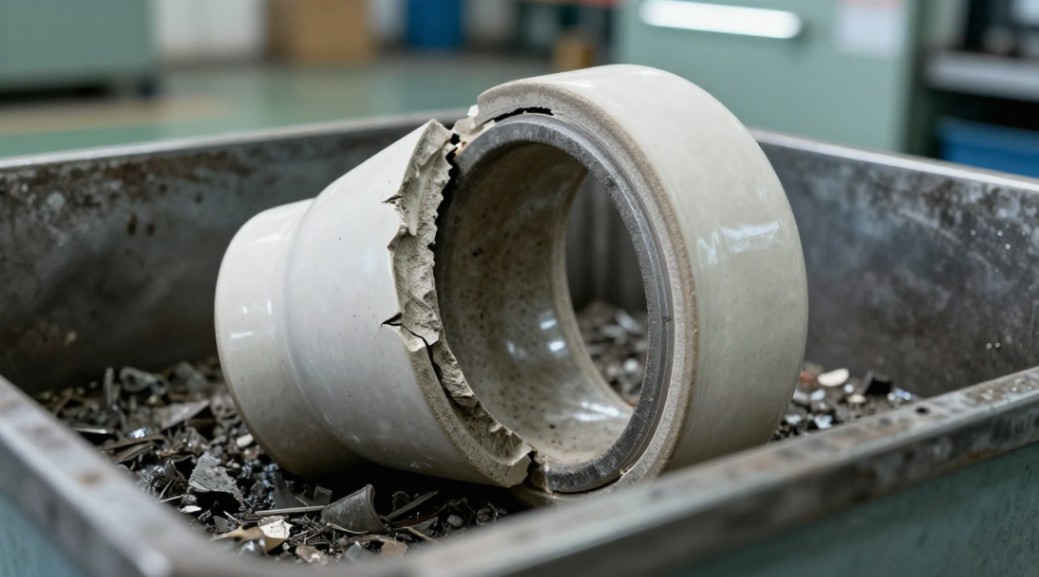
That day, I learned a hard truth: most failures blamed on Aluminum oxide ceramic are actually failures of specification, composition, or processing. Not the material itself.
Here are seven counterintuitive truths about Aluminum oxide ceramic that most engineers, purchasing agents, and even ceramic manufacturers get dangerously wrong. I’ll skip the textbook definitions. You can find those anywhere. I’ll show you why the conventional wisdom is costing you performance and money.
1. Hardness Is a Trap – The Real Enemy Is Fracture Toughness
Everyone brags about Aluminum oxide ceramic ranking near diamond on the Mohs scale. That’s a distraction.
Hardness resists wear. But wear resistance in a brittle ceramic means nothing if the part cracks on the first impact. In grinding media, Aluminum oxide ceramic balls wear at predictable rates. But drop one on a concrete floor, and you have shrapnel. Compare this to Silicon carbide ceramic, which is even harder but more brittle. Or Silicon nitride ceramic, which has higher fracture toughness but costs four times more.
- Aluminum oxide ceramic (96% purity): Excellent hardness, moderate toughness.
- Aluminum nitride ceramic: High thermal conductivity, lower hardness.
- Boron carbide ceramic: Extreme hardness, very low toughness (used in armor, but one-hit wonder).
- Silicon carbide ceramic: High hardness, poor thermal shock resistance in some variants.
The takeaway: For dynamic impact or cyclic loading, consider Silicon carbide-bonded silicon nitride ceramics or Reaction-sintered silicon carbide ceramics if you need toughness. But for steady-state wear applications, 99.5% Aluminum oxide ceramic remains the smart economic choice.
2. Thermal Conductivity Is a Double-Edged Sword
Textbooks say alumina is a thermal insulator. That’s only half true. Aluminum oxide ceramic has a thermal conductivity of 25-35 W/m·K (depending on purity and grain size). That’s significantly better than Quartz ceramic (1-2 W/m·K) or Mullite ceramic (3-5 W/m·K).
In high-power electronics, standard Aluminum oxide ceramic substrates provide acceptable heat dissipation alongside electrical insulation. But if your power density exceeds 100 W/cm², you need Aluminum nitride ceramic, which has conductivity up to 200 W/m·K. However, AlN costs more and is harder to metalize.
Let me reframe the problem: don’t ask ‘Is Aluminum oxide ceramic a good thermal conductor?’ Ask ‘Is it good enough for my heat flux, given my budget?’ For 90% of industrial applications, the answer is yes. For the other 10%, you need Boron nitride ceramic or AlN.
3. Chemical Inertness Is a Myth – Know Your Acids
I’ve seen Aluminum oxide ceramic pump seals dissolve in hydrofluoric acid. Yes, dissolve.
Aluminum oxide ceramic (Al₂O₃) is the passive oxide of aluminum. It resists most acids and alkalis. But concentrated hot alkalis (NaOH, KOH) and strong reducing acids (HF) will attack the grain boundaries. The result: catastrophic failure.
- Resists: H₂SO₄, HCl, HNO₃ (up to moderate temperatures).
- Fails: HF, hot concentrated NaOH, molten salts.
- Better alternatives for aggressive environments: Silicon carbide ceramic (HF resistant), Boron nitride ceramic (alkali resistant).
Don’t trust the generic ‘chemically inert’ label. Test your specific reagent at your process temperature.
4. Purity Percentages Are Not Linear in Performance
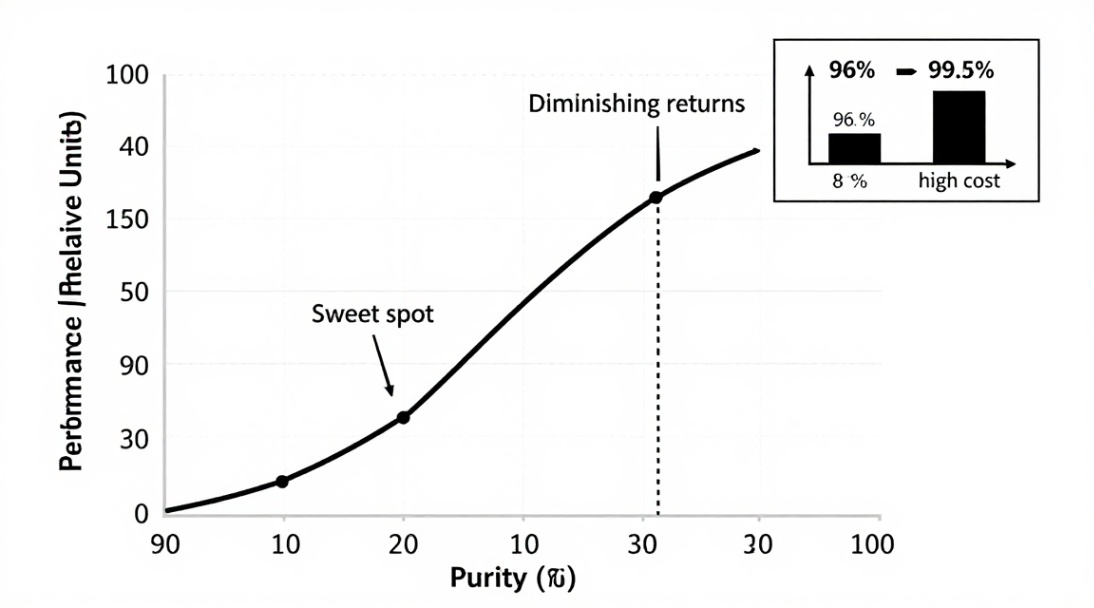
96% Aluminum oxide ceramic versus 99.5% versus 99.9%: the numbers suggest small differences. The performance is not small.
96% alumina contains silica and calcia sintering aids. These create a glassy grain boundary phase. That phase softens at 800°C, not 1700°C. 99.5% alumina uses magnesia doping, resulting in a finer, more uniform microstructure. 99.9% is translucent, used in sapphire watch crystals and high-end armor.
Here’s the rule:
- 96%: Cost-effective for low-temperature, low-wear applications (switchgear, low-grade insulators).
- 99.5%: The sweet spot for cutting tools, grinding media, and mechanical seals.
- 99.9%: For optical, electronic, and maximum corrosion resistance. Expensive.
Never specify 99.5% if 96% works. You waste money. Never specify 96% if you need 99.5%. You lose the line.
5. The Ballistic Armor Paradox: Hardness Absorbs Energy, But Toughness Stops the Bullet
Ceramic armor plates made from Aluminum oxide ceramic are standard for light vehicle and personal body armor. Boron carbide ceramic is lighter and harder. Silicon carbide ceramic offers a middle ground.
Here’s the counterintuitive part: a pure Aluminum oxide ceramic tile will stop a 7.62mm round. But after the first hit, the tile is fractured. It won’t stop a second round in the same spot. The design trade-off is not just material selection, but backing material (Kevlar, UHMWPE) and tiling strategy.
Don’t chase maximum hardness alone. The industry trend is moving toward Silicon carbide-bonded silicon nitride ceramics for multi-hit capability. But for single-hit, cost-effective protection, Aluminum oxide ceramic remains the benchmark.
6. Surface Finishing Is Where 80% of Sealing Failures Originate
Your Aluminum oxide ceramic mechanical seal is not failing because of bad material. It’s failing because of rough surface finish.
Standard as-sintered Aluminum oxide ceramic has a surface roughness of 0.8 to 1.6 microns Ra. For a high-performance seal, you need 0.05 microns Ra or better. That requires diamond grinding and lapping. Every 0.1 micron of roughness in a seal face reduces the hydrodynamic film stability and increases leakage.
Process rule of thumb:
- As-sintered Ra > 0.8 µm: Acceptable for static seals, low-pressure.
- Ground to 0.4 µm: Dynamic seals, moderate speed.
- Lapped to 0.05 µm or below: High-speed, high-pressure face seals.
You want to improve sealing performance? Don’t switch materials. Invest in surface finishing.
7. Manufacturing Method Dictates Part Geometry, Not Just Cost
Dry pressing Aluminum oxide ceramic is cheap. Isostatic pressing is more expensive but gives uniform density. Injection molding is for complex shapes but requires binder burnout, which introduces porosity risks.
I see engineers design parts for injection molding that could be dry pressed. They pay 3x more and get a weaker part because of residual binder. Conversely, I see simple block geometries specified for isostatic pressing that should be dry pressed.
Match the method to the shape:
- Simple discs, blocks: Dry press.
- Tubes, rods, complex solid shapes: Isostatic press.
- Threads, undercuts, complex internal cavities: Injection mold or CNC green machining.
Also, consider that Pressureless sintered silicon carbide ceramics and Recrystallized silicon carbide ceramics have different shrinkage behaviors. Don’t assume your alumina process experience transfers directly.
Conclusion: Stop Blaming the Material. Fix the Spec.
I’ve made my living for 25 years by asking one question: ‘What did the spec sheet actually say?’
Aluminum oxide ceramic is not a commodity. It is a family of materials differentiated by purity, grain size, processing, and finish. The failures I’ve seen were caused by treating it as a single, universal ‘ceramic’ option.
If you are specifying a ceramic component today, do not start with the material name. Start with the failure mode. Is it wear? Thermal stress? Chemical attack? Impact? Then work backward. You may find that Aluminum oxide ceramic (specifically 99.5% with a lapped finish) is the solution. Or you may need Boron carbide ceramic for weight savings, or Silicon nitride ceramic for toughness.
But if you need a ceramic that balances hardness, cost, chemical stability, and thermal performance for 90% of industrial applications, Aluminum oxide ceramic is your starting point. Now go check your spec sheet.
Suppiler
Synthetic-chemical focus on the research and development, production and sales of ceramic products, serving the electronics, ceramics, chemical and other industries. Since its establishment in 2015, the company has been committed to providing customers with the best products and services, and has become a leader in the industry through continuous technological innovation and strict quality management.
Our products includes but not limited to Aluminum Nitride, Aluminum Oxide, Boron Carbide, Boron Nitride, Ceramic Crucible, ect. If you are interested in any type of these, please feel free to contact us.