Next-Generation Ceramics: Unlocking Superior Properties for Industry

The Broken Spark Plug That Changed Everything
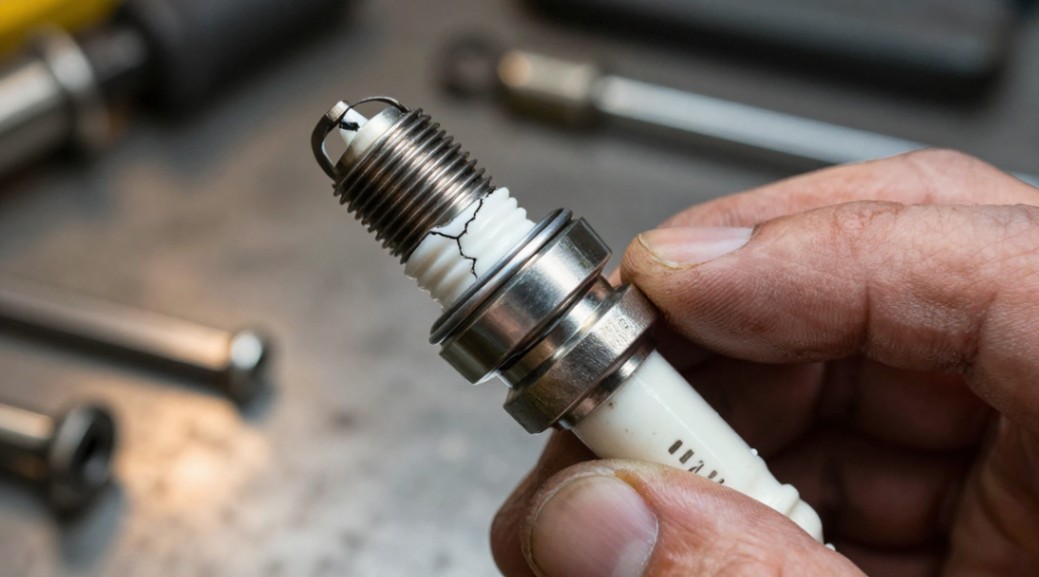
I still remember the first time I held a failed spark plug from a high-compression racing engine. The insulator — that white, hard piece — had cracked in service. My mentor handed it to me and said, “Look at this. This is aluminum oxide ceramic. It took 1600°C and 50,000 volts to break it. Do you know what else we can do with this stuff?” That moment sparked a 25-year career working with this remarkable material. Aluminum oxide ceramic is not exotic. It is not flashy. But it is the most reliable, cost-effective technical ceramic you will ever specify.
What Is Aluminum Oxide Ceramic?
Aluminum oxide ceramic — also called alumina — is a dense, polycrystalline ceramic based on the chemical compound Al2O3. When we talk about high-purity grades, the aluminum oxide content exceeds 99.5%. The material crystallizes in the alpha-phase corundum structure, the same crystal structure as ruby and sapphire. This structure is the key to its extreme hardness and chemical inertness.
Engineers choose aluminum oxide ceramic for one simple reason: it performs reliably in environments that destroy metals and polymers. It withstands temperatures above 2000°C. It resists abrasion better than hardened tool steel. It insulates electrically while conducting heat moderately well. And it costs a fraction of advanced ceramics like silicon carbide ceramic or silicon nitride ceramic.
Chemical Composition and Crystal Structure
Pure alumina starts as a fine white powder. Manufacturers press this powder into shape and then fire it at high temperature. During sintering, the particles bond and densify. The final product contains only Al2O3 — no binders, no glassy phases in high-purity grades. The alpha-phase crystal structure is hexagonal close-packed. Oxygen ions form the lattice. Aluminum ions fill two-thirds of the octahedral sites. This arrangement gives the ceramic its exceptional stiffness and hardness.
How Is Aluminum Oxide Ceramic Made?
You do not melt and cast alumina like metal. The melting point is simply too high. Instead, manufacturers use powder processing and sintering. Here are the common routes:
- Dry pressing: Powder is compressed in a die at high pressure. Good for simple shapes with tight tolerances.
- Isostatic pressing: Powder is sealed in a flexible mold and compressed from all sides. Produces uniform density for complex parts.
- Slip casting: A liquid suspension of powder is poured into a porous mold. The liquid is absorbed, leaving a solid layer. Ideal for thin-walled shapes like tubes or crucibles.
- Sintering: The shaped part is fired at 1500°C to 1700°C. The particles fuse into a dense, solid ceramic. Shrinkage is uniform and predictable.
After sintering, many parts require finishing. Surface finishing techniques like grinding, lapping, and polishing achieve the final dimensions and surface finish. A polished alumina surface can have a roughness below 0.05 microns. That smoothness is critical for mechanical seal faces and bearing surfaces.
What Are the Key Properties of Aluminum Oxide Ceramic?
Experienced engineers do not fall for marketing fluff. They look at data sheets. Here are the properties that matter:
- Hardness: 9 on the Mohs scale — just below diamond. This makes alumina the standard for abrasive applications and cutting tools.
- Wear resistance: Exceptional. Alumina outlasts steel by factors of 10 to 100 in erosive and sliding wear environments.
- High compressive strength: Typically above 2000 MPa. It handles crushing loads better than most metals.
- Moderate fracture toughness: Here is the trade-off. Alumina is brittle. Its fracture toughness is around 3 to 5 MPa·m1/2. That is lower than silicon carbide ceramic or silicon nitride ceramic. If your part will see impact loading, consider zirconia or silicon nitride instead.
- Electrical insulation: Excellent dielectric strength. Alumina is the standard substrate for thick-film and thin-film electronic circuits.
- Chemical inertness: Resists most acids, alkalis, and oxidizing agents. Only hydrofluoric acid and hot concentrated alkalis attack it.
- Thermal conductivity: Moderate — around 25 to 30 W/m·K. Compare that to aluminum nitride ceramic which offers 170 W/m·K or silicon carbide ceramic at 120 W/m·K. For high-power heat sinking, aluminum nitride is the better choice. But for general-purpose insulation with some heat dissipation, alumina works well.
Comparing Alumina to Other Technical Ceramics
You must understand the trade-offs. Zirconia ceramic is tougher than alumina. It can absorb mechanical shock. But it is softer and more expensive. Silicon carbide ceramic is harder than alumina and conducts heat better. But it costs more and is more difficult to machine. Boron carbide ceramic is even harder than silicon carbide — the third-hardest material known. But it is used almost exclusively for armor plating and nuclear shielding due to its cost. Boron nitride ceramic is soft and machinable, ideal for high-temperature electrical insulation but not for wear resistance. Mullite ceramic is less expensive than alumina but has lower strength and hardness. Quartz ceramic offers low thermal expansion and thermal shock resistance, but not the same wear resistance. For most industrial applications, alumina gives you the best balance of performance and cost. Period.
Where Is Aluminum Oxide Ceramic Used?
Let me walk through the applications that keep industry running:
- Spark plugs and ignition components: The classic application. Alumina insulates the high-voltage electrode and withstands combustion temperatures.
- Pump seals and valve components: Alumina seal faces resist corrosion and wear from slurries, chemicals, and high-pressure fluids.
- Cutting tools and abrasives: Alumina inserts and grinding media cut metals and ceramics efficiently.
- Electronic substrates: Thin alumina sheets carry thick-film resistors and conductor traces. They provide electrical insulation and thermal management.
- Armor plating: Alumina tiles absorb and deflect projectiles. Weight for weight, they outperform steel for ballistic protection.
- Laboratory ware: Crucibles, boats, and tubes made from high-purity alumina handle aggressive chemicals and high temperatures without contamination.
- Biomedical implants: Alumina is biocompatible. It is used in hip replacement ball heads and dental implants due to its wear resistance and inertness.
Frequently Asked Questions About Aluminum Oxide Ceramic
Is aluminum oxide ceramic the same as corundum?
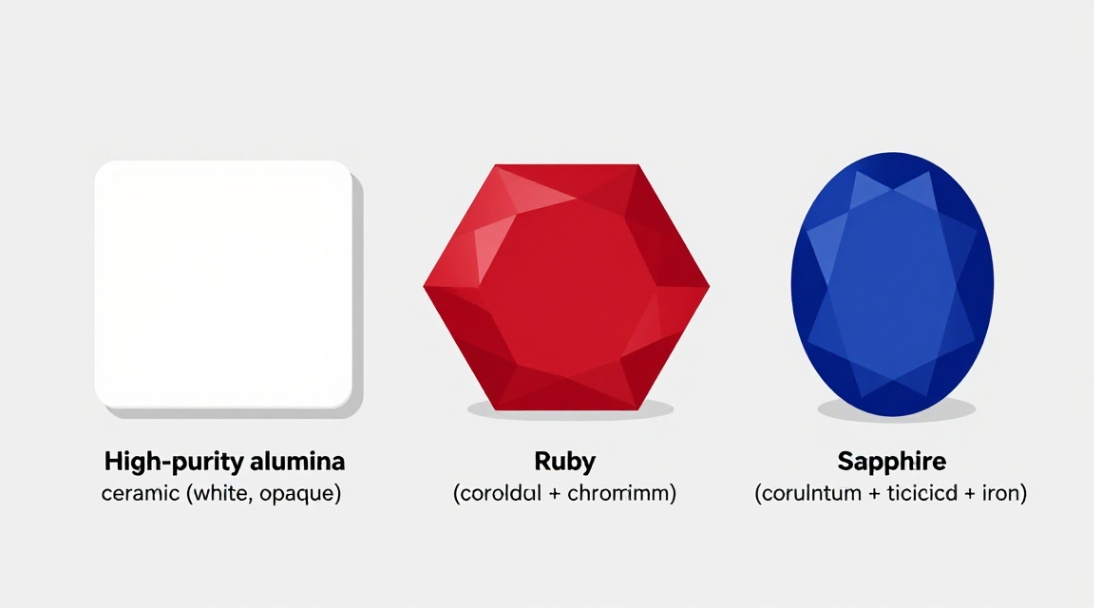
Yes, synthetic alumina ceramic has the same crystal structure as naturally occurring corundum mineral. The gemstone ruby is corundum with chromium impurities. Sapphire is corundum with titanium and iron impurities. High-purity alumina ceramic is white and opaque, not transparent like a gemstone.
Can aluminum oxide ceramic be machined after sintering?
Yes, but only with diamond tooling. Alumina is extremely hard. Standard carbide drills and mills will dull instantly. Manufacturers use diamond grinding wheels, diamond lapping compounds, and ultrasonic machining for precision holes and features. If you need complex shapes, it is cheaper to form the part near-net shape during pressing and then grind only critical surfaces.
How does aluminum oxide ceramic compare to aluminum nitride ceramic?
Aluminum nitride ceramic has five to six times higher thermal conductivity. It is the preferred material for high-power LED substrates and power electronics heat sinks. But aluminum nitride is more expensive and more difficult to process. For general insulation with moderate heat dissipation, alumina is the cost-effective choice. For thermal management under high heat flux, specify aluminum nitride.
What limits the use of aluminum oxide ceramic?
Its brittleness. If your application involves impact, thermal shock, or tensile bending loads, alumina may crack. In those cases, consider silicon nitride ceramic for toughness or reaction-sintered silicon carbide ceramics for thermal shock resistance. Also, alumina cannot be used in hydrofluoric acid environments. Finally, its moderate thermal conductivity limits its ability to spread heat in compact designs.
What finishing options are available for alumina components?
As-fired surfaces are typically matte and have a roughness around 1 to 3 microns. For seal faces and bearing surfaces, grinding, lapping, and polishing can produce mirror finishes. Polished alumina seal faces achieve the flatness needed to form a leak-tight interface in mechanical seals. Metallization is also possible — thin layers of molybdenum-manganese or titanium are fired onto the surface to allow brazing or soldering to metal parts.
Why Aluminum Oxide Ceramic Remains the Industry Standard
I have specified ceramics for military electronics, chemical pump seals, and high-temperature furnace components. Every time I consider a ceramic material, I ask three questions: Will it survive the environment? Can we produce it in volume at reasonable cost? Is the supply chain stable? Aluminum oxide ceramic answers yes to all three. It is the workhorse. It is not the perfect material for every job. Silicon carbide-bonded silicon nitride ceramics may offer better thermal shock resistance. Pressureless sintered silicon carbide ceramics may provide higher hardness. But for ninety percent of applications, alumina delivers the required performance with the lowest risk and cost.
Do not over-engineer your design. Start with alumina. If it fails, then move to a more exotic ceramic. That is the engineer’s way.
Your Next Step: Specify the Right Grade for Your Application
You now understand what aluminum oxide ceramic is, how it is made, and where it excels. Do not waste time searching for suppliers that promise miracle materials. Get a sample of high-purity alumina. Test it under your actual conditions. Measure the wear rate. Check the electrical insulation at your operating temperature. Confirm the chemical resistance in your process fluid.
I recommend starting with a 99.5% alumina grade from a manufacturer that specializes in technical ceramics. Request a quote for prototype parts. Compare the performance to your current metal or polymer components. The data will speak for itself. Contact our technical team today to discuss your requirements. We will send you a specification sheet and a sample within one week. Stop guessing. Start testing.
Suppiler
Synthetic-chemical focus on the research and development, production and sales of ceramic products, serving the electronics, ceramics, chemical and other industries. Since its establishment in 2015, the company has been committed to providing customers with the best products and services, and has become a leader in the industry through continuous technological innovation and strict quality management.
Our products includes but not limited to Aluminum Nitride, Aluminum Oxide, Boron Carbide, Boron Nitride, Ceramic Crucible, ect. If you are interested in any type of these, please feel free to contact us.