Next-Generation Ceramics: Unlocking Superior Properties for Industry

The Contradiction at the Core
Aluminum oxide ceramic is a paradox. It is one of the oldest and most widely used technical ceramics, yet it powers some of the most advanced applications in modern engineering. From the abrasive in sandpaper to the substrate enabling a 5G filter, its versatility is staggering. Its dominance isn’t about being the best at any one thing; it’s about offering the most reliable, cost-effective balance of properties across an unparalleled range of conditions. While newer materials like silicon nitride ceramic boast superior toughness or aluminium nitride ceramic offers higher thermal conductivity, aluminum oxide remains the workhorse. Its story is one of engineered compromise and relentless refinement.
Decoding the Material: Properties and Practicality
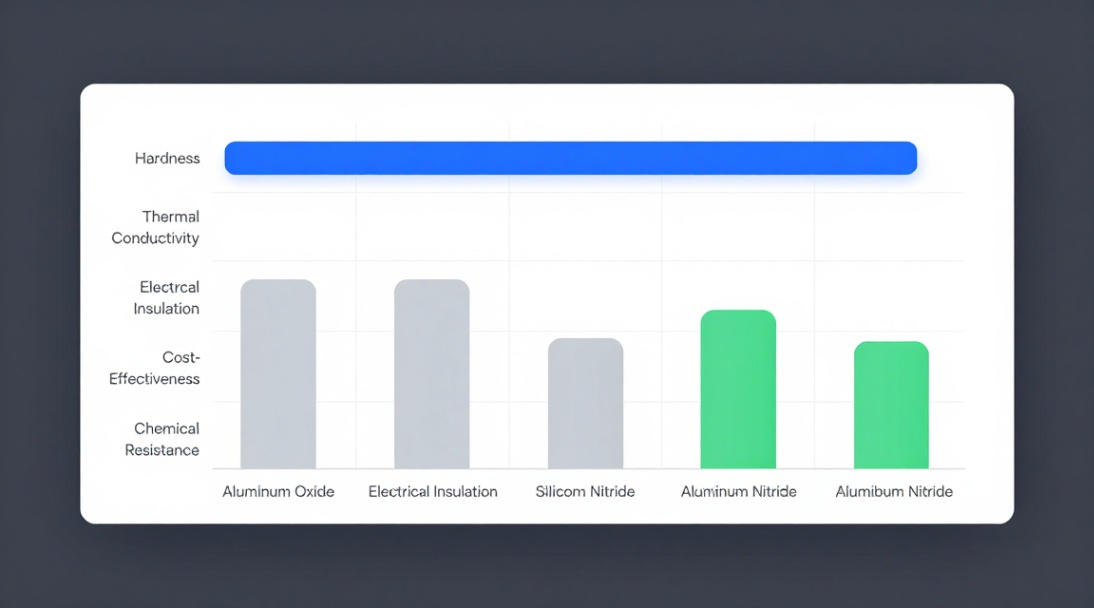
Fundamentally, aluminum oxide ceramic is a crystalline compound of aluminium and oxygen (Al2O3). Its performance is dictated by purity and microstructure. Purity grades range from 85% for economical wear tiles to 99.9%+ for transparent substrates and biomedical components. The higher the alumina content, the better the intrinsic properties: hardness approaches that of silicon carbide ceramic, electrical insulation increases, and chemical inertness becomes nearly absolute.
What defines its engineering value?
Its value proposition rests on three pillars. First, exceptional hardness (9 on the Mohs scale) and wear resistance make it superior to most metals in abrasive environments. Second, it maintains structural integrity at temperatures where metals soften, a key advantage over polymers. Third, its excellent dielectric strength and stability make it the default choice for insulating components and electronic substrates. Unlike zirconia, it does not undergo disruptive phase transformations. Unlike some silicon carbide-bonded silicon nitride ceramics, its manufacturing is highly standardized and scalable.
The Competitive Landscape: Alumina vs. The Field
Selection is a trade-off. Engineers don’t choose materials in a vacuum; they weigh options against specific failure modes.
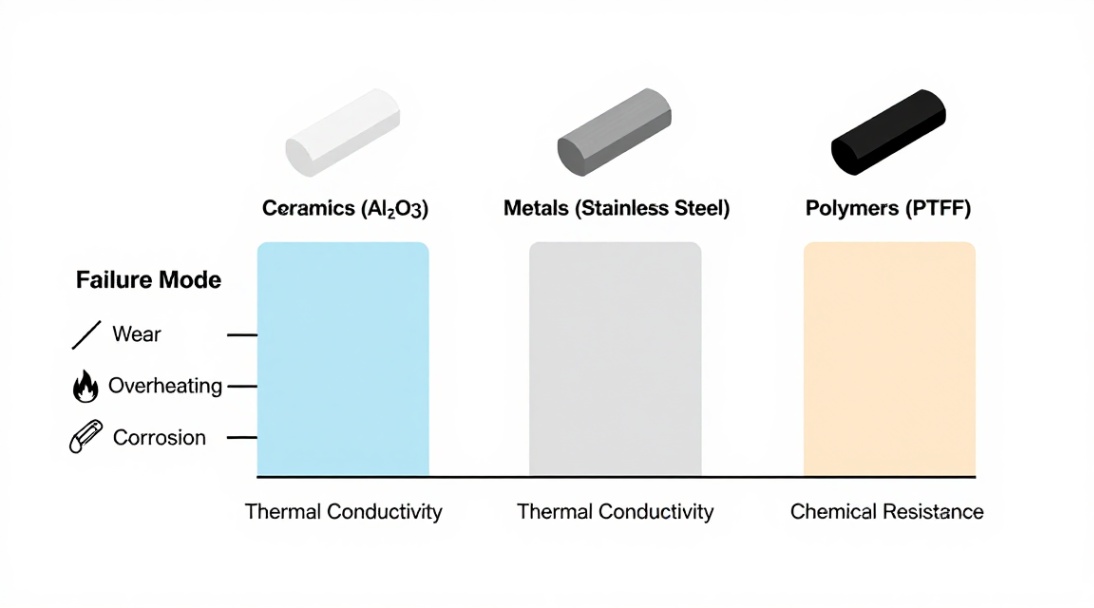
- Vs. Silicon Carbide Ceramic / Boron Carbide Ceramic: For pure wear and extreme hardness, SiC and B4C win. But alumina offers a much better balance with electrical insulation and lower cost. For a seal face that must also isolate electrically, alumina is the logical choice.
- Vs. Silicon Nitride Ceramic / Aluminum Nitride Ceramic: Si3N4 provides far greater fracture toughness and thermal shock resistance, ideal for bearings. AlN excels in thermal conductivity for heat sinks. Alumina sits between them, offering good (but not best-in-class) mechanical and thermal properties with superior dielectric performance and proven bio-inertness.
- Vs. Metals: Alumina outperforms tool steels in high-temperature wear and corrodes in nothing short of molten alkali or hydrofluoric acid. Its brittleness is the primary drawback, requiring careful design to avoid tensile stress concentrations.
Industry Applications: Where Theory Meets Reality
The applications are a direct reflection of its property profile. In industrial wear, it lines pumps, forms nozzle orifices, and protects critical surfaces in machinery. As a cutting tool material, it machines cast iron and superalloys at high speeds. In electronics, its role as a substrate for thick-film circuits and semiconductor packages is foundational. The biomedical field leverages its biocompatibility for dental implants, joint replacements, and surgical guides. High-purity grades are essential for the special coating for boron nitride ceramic crucibles used in high-purity metal processing.
The Future and the Inevitable Limitations
The evolution of aluminum oxide ceramic is not about replacement but enhancement. The future lies in composites and nanostructuring. Incorporating phases of zirconia or silicon carbide ceramic particles can dramatically improve toughness-transforming it from a brittle solid into a damage-tolerant material. The development of advanced, net-shape forming processes also addresses its primary machining difficulty. The goal is to push its performance envelope closer to that of more expensive ceramics while retaining its processing and cost advantages. For a project demanding a known quantity with a vast body of empirical data, specifying a well-characterized alumina often presents the lowest technical and procurement risk. Its continued dominance is a testament to the power of a balanced material solution.
Suppiler
Synthetic-chemical focus on the research and development, production and sales of ceramic products, serving the electronics, ceramics, chemical and other industries. Since its establishment in 2015, the company has been committed to providing customers with the best products and services, and has become a leader in the industry through continuous technological innovation and strict quality management.
Our products includes but not limited to Aluminum Nitride, Aluminum Oxide, Boron Carbide, Boron Nitride, Ceramic Crucible, ect. If you are interested in any type of these, please feel free to contact us.