Next-Generation Ceramics: Unlocking Superior Properties for Industry

When “Tough Enough” Just Isn’t Enough
Ever felt that familiar pang of frustration when a component fails prematurely? It starts as a slight wear, maybe a bit of chatter or a subtle loss of precision. Then, the downtime hits. Production slows. Costs climb. You’re stuck replacing parts made from materials that just can’t keep up with the relentless demands of friction, heat, or electrical stress. We’ve all been there, staring at a failed seal, a worn guide, or a compromised insulator, wondering if there’s a better way. The good news? There is. For over two decades, we’ve seen one material consistently rise to these challenges: aluminum oxide ceramic, or alumina. This isn’t about vague promises; it’s about a practical, proven solution. Let’s break down exactly how and where it works, so you can decide if it’s the right fit for your next project.
The Core of Alumina: What Makes It Special?
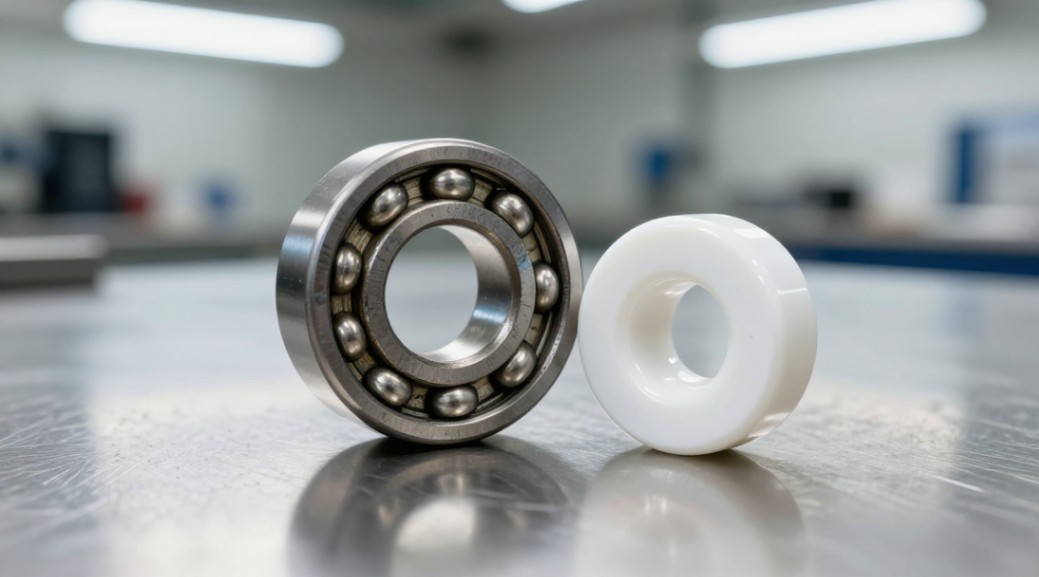
Aluminium oxide ceramic is not magic. Its power comes from a specific, engineered set of properties. At its heart, it’s a crystalline material made by sintering purified alumina powder at high temperatures. This process creates a structure with exceptional hardness-second only to diamond on some scales-and excellent electrical insulation. It resists wear not by being unbreakable, but by being significantly harder than the metals, plastics, and particulates that try to abrade it. It handles high temperatures because its chemical bonds remain stable well beyond the melting point of steel. Think of it less as a replacement for metal, and more as a specialized tool for the jobs where metal falls short.
Key Properties in Plain English
- Hardness & Wear Resistance: It outlasts tool steel in abrasive environments, making it ideal for liners, cutting tools, and guide rollers.
- Electrical Insulation: Even at high temperatures, it maintains high resistivity, which is critical for substrates and insulators in electronics.
- Chemical Inertness: It laughs off attacks from most acids, alkalis, and molten metals, perfect for labware and chemical processing parts.
- High-Temperature Stability: It retains its shape and strength up to 1700°C, enabling use in furnaces and thermal processing.
- Moderate Thermal Conductivity: Unlike some insulators, it still dissipates heat reasonably well, preventing hot spots.
Alumina in Action: Your Step-by-Step Selection Guide
Choosing the right ceramic isn’t guesswork. Follow this logic to match the material to your need. Many engineers on forums like Reddit and Practical Machinist share a common first step: identifying the primary failure mode of their current part.
Step 1: Diagnose the Primary Failure Mode
Is your part failing from abrasive wear? Corrosive chemical attack? Thermal shock? Electrical breakdown? Pinpointing this directs you to the most critical property. For pure abrasion, alumina’s hardness is your best friend. For severe thermal shock, you might later compare it to silicon nitride ceramic or silicon carbide ceramic.
Step 2: Select the Appropriate Alumina Grade
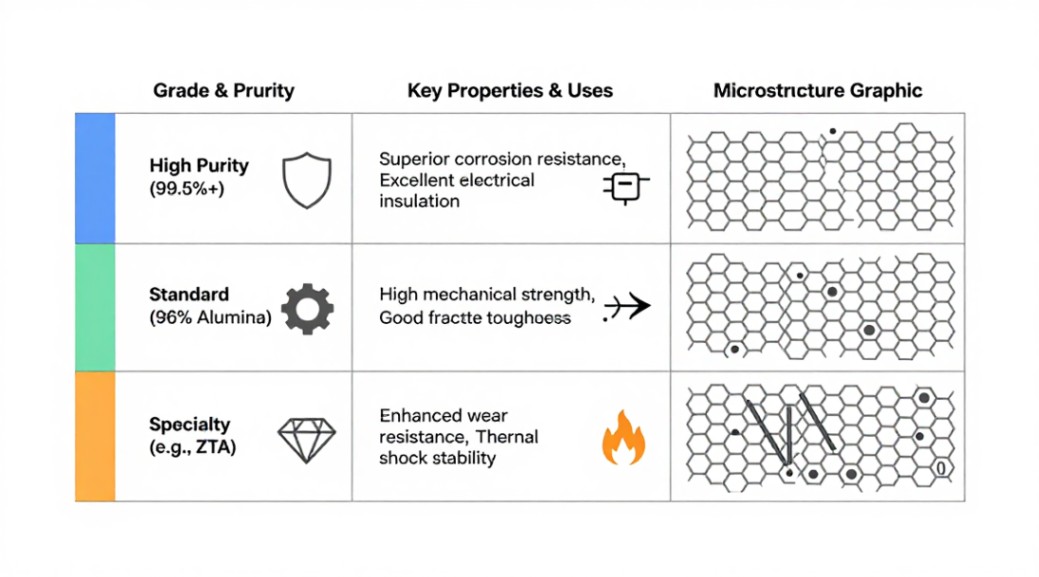
Not all alumina is the same. Purity and additives dictate performance. Higher purity (99.5%+) offers better corrosion resistance and electrical properties. Grades with small additions of other oxides (like 96% alumina) can improve mechanical strength and fracture toughness for structural parts. Here’s a quick comparison to clarify:
| Grade (Typical) | Key Characteristics | Best For |
|---|---|---|
| 99.5%+ Alumina | Superior corrosion resistance, highest electrical insulation, very high hardness. | Semiconductor components, advanced labware, high-purity lining. |
| 96% Alumina | Excellent mechanical strength, good wear resistance, cost-effective. | Wear plates, pump seals, thread guides, industrial insulators. |
| 85-90% Alumina | Good mechanical properties, lower cost, can be metalized for brazing. | Spark plug insulators, general wear parts, heater tubes. |
Step 3: Compare It to Other Material Options
Alumina isn’t always the answer. For extreme thermal conductivity, aluminum nitride ceramic is better. For the ultimate in hardness and wear, consider boron carbide ceramic. Use this table to weigh your priorities.
| Material | Top Advantage vs. Alumina | Trade-off to Consider |
|---|---|---|
| Aluminium Oxide (Alumina) | Best overall balance of hardness, wear, insulation, and cost. | Fracture toughness lower than metals; can be brittle under impact. |
| Zirconia (ZrO2) | Much higher fracture toughness (less brittle). | Lower hardness, more expensive, not as wear-resistant. |
| Silicon Carbide (SiC) | Superior thermal conductivity and thermal shock resistance. | More expensive, harder to machine to tight tolerances. |
| Aluminium Nitride (AlN) | Exceptional thermal conductivity for an insulator. | Significantly higher cost, more sensitive to moisture. |
Putting It All Together: Common Applications We See Every Day
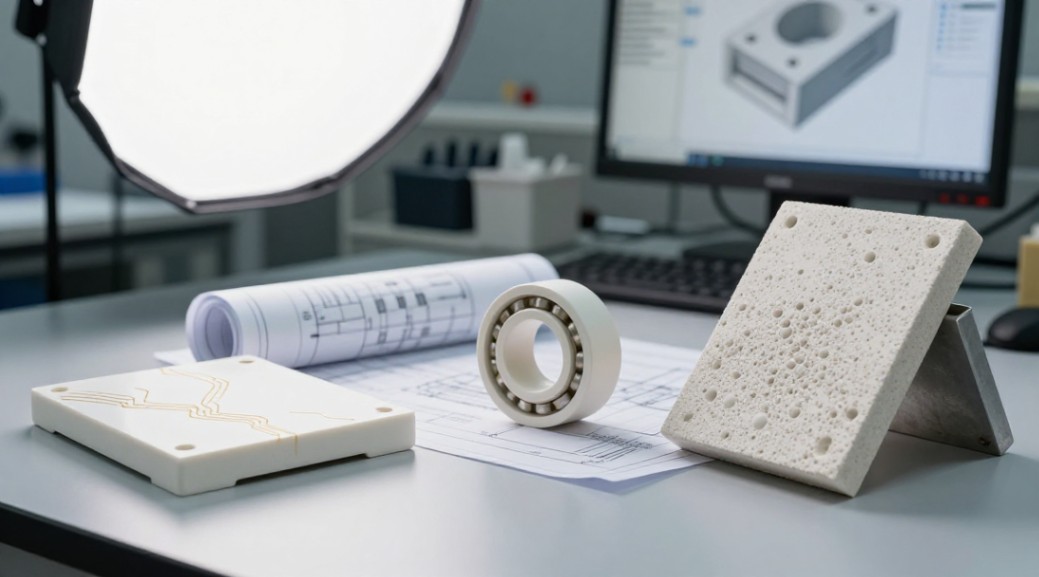
This theory translates directly to real-world parts. In electronics, high-purity alumina substrates carry circuits because they insulate perfectly and handle soldering heat. In pumps and valves, 96% alumina seals and bearings withstand abrasive slurries that destroy metals. In manufacturing, alumina tiles line chutes and hoppers, protecting steel from tons of abrasive ore. The key is matching the grade and form-be it a substrate, a tube, a complex-machined component, or a special coating for boron nitride ceramic crucibles-to the specific stress it will face.
The Future and Your Next Move
Material science keeps advancing. Researchers are pushing boundaries with new compositions, like high-entropy oxides, to achieve even higher temperature stability. For now, standard alumina remains a workhorse because it solves so many common industrial problems reliably. So, what’s your next step? Look at that failing part on your desk. Re-evaluate it against the failure modes and comparison tables we discussed. If wear, corrosion, or electrical isolation is the core issue, aluminium oxide ceramic likely offers a viable, long-term solution. The best way to know is to test it. Start with a critical wear component, specify a standard 96% alumina grade from a reputable supplier, and track its lifecycle cost. We think you’ll be pleasantly surprised by the results.
Suppiler
Synthetic-chemical focus on the research and development, production and sales of ceramic products, serving the electronics, ceramics, chemical and other industries. Since its establishment in 2015, the company has been committed to providing customers with the best products and services, and has become a leader in the industry through continuous technological innovation and strict quality management.
Our products includes but not limited to Aluminum Nitride, Aluminum Oxide, Boron Carbide, Boron Nitride, Ceramic Crucible, ect. If you are interested in any type of these, please feel free to contact us.